
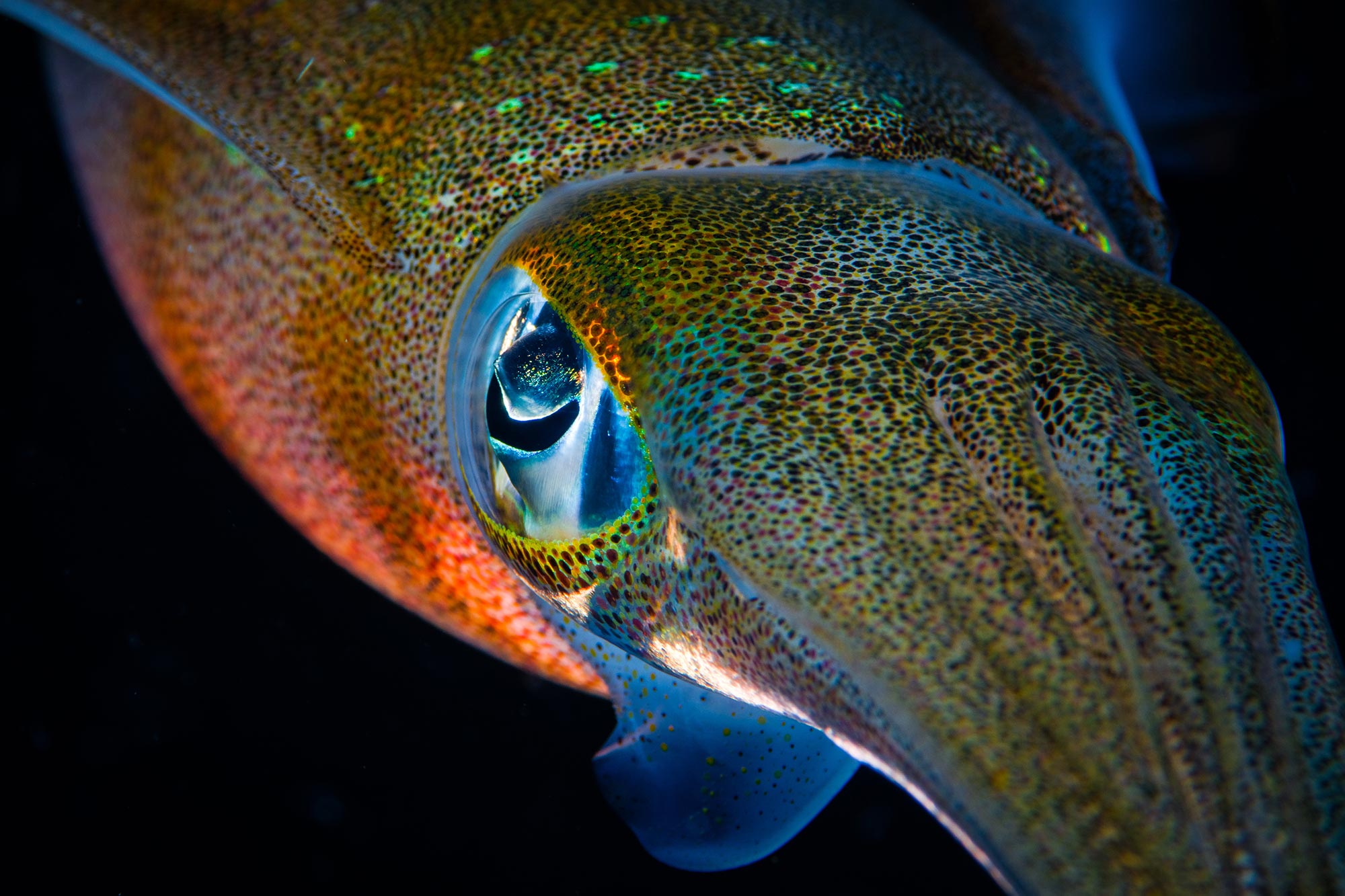
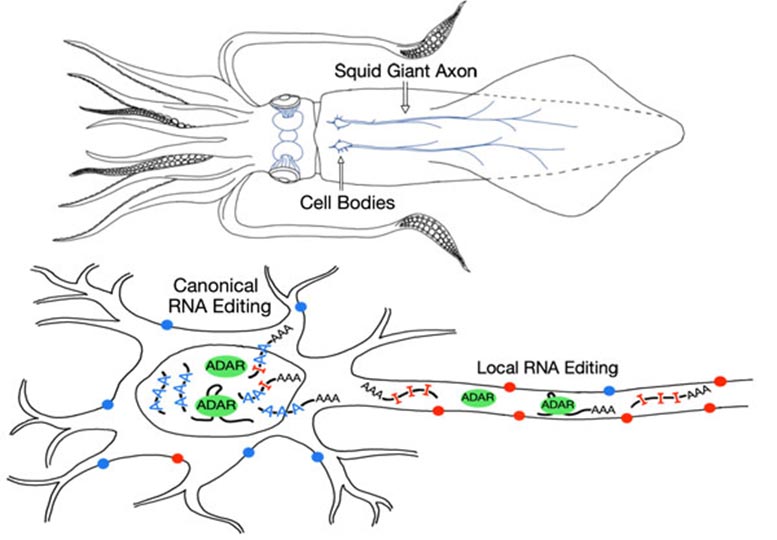
Revealing yet another super-power in the skillful squid, scientists have discovered that squid massively edits their own genetic instructions not only within the nucleus of their neurons, but also within the axon — the long, slender neural projections that transmit electrical impulses to other neurons. This is the first time that edits to genetic information have been observed outside of the nucleus of an animal cell.
The study, led by Isabel C. Vallecillo-Viejo and Joshua Rosenthal at the Marine Biological Laboratory (MBL), Woods Hole, is published this week in Nucleic Acids Research.
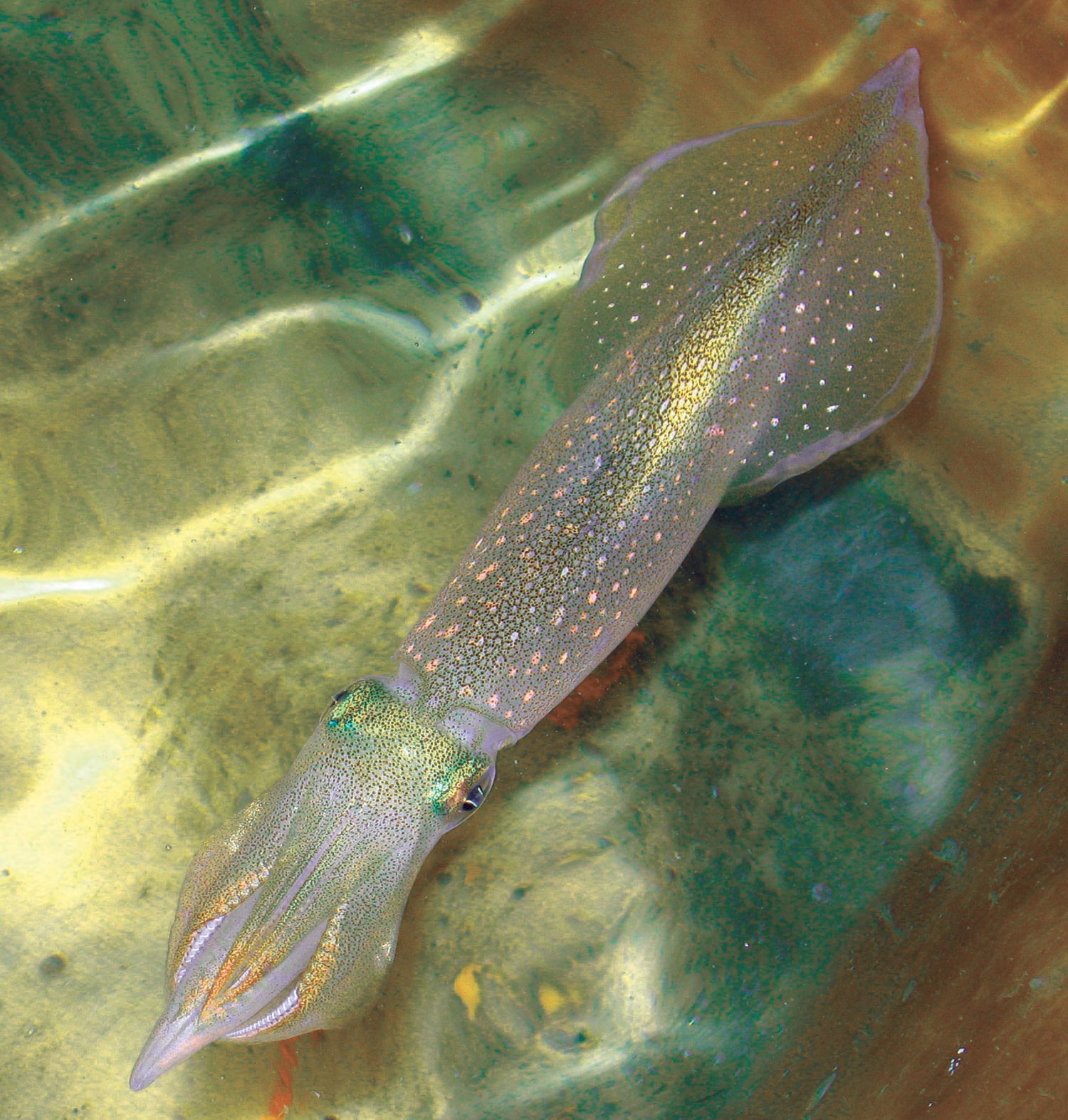
The discovery provides another jolt to the central dogma of molecular biology, which states that genetic information is passed faithfully from DNA to messenger RNA to the synthesis of proteins. In 2015, Rosenthal and colleagues discovered that squid “edit” their messenger RNA instructions to an extraordinary degree – orders of magnitude more than humans do — allowing them to fine-tune the type of proteins that will be produced in the nervous system.
“But we thought all the RNA editing happened in the nucleus, and then the modified messenger RNAs are exported out to the cell,” says Rosenthal, senior author on the present study. “Now we are showing that squid can modify the RNAs out in the periphery of the cell. That means, theoretically, they can modify protein function to meet the localized demands of the cell. That gives them a lot of latitude to tailor the genetic information, as needed.” The team also showed that messenger RNAs are edited in the nerve cell’s axon at much higher rates than in the nucleus.
In humans, axon dysfunction is associated with many neurological disorders. Insights from the present study could accelerate the efforts of biotech companies that seek to harness this natural RNA editing process in humans for therapeutic benefit.
Scientists from Tel Aviv University and The University of Colorado at Denver collaborated with MBL scientists on the study.
Previously, Rosenthal and colleagues showed that octopus and cuttlefish also rely heavily on mRNA editing to diversify the proteins they can produce in the nervous system. Together with squid, these animals are known for strikingly sophisticated behaviors, relative to other invertebrates.
Reference: “Spatially regulated editing of genetic information within a neuron” by Isabel C Vallecillo-Viejo, Noa Liscovitch-Brauer, Juan F Diaz Quiroz, Maria F Montiel-Gonzalez, Sonya E Nemes, Kavita J Rangan, Simon R Levinson, Eli Eisenberg and Joshua J C Rosenthal, 23 March 2020, Nucleic Acids Research.
DOI: 10.1093/nar/gkaa172
Never miss a breakthrough: Join the SciTechDaily newsletter.
Follow us on Google and Google News.
10 Comments
so can we use the squid gene and implant it in human beings so as to cope with tough situations
They are such cute little buggers…I have to wonder if they are thinking also !!!
The biological value of RNA editing has not been convincingly shown — knowing that it can occur in two places now (nucleus and axon) is not particularly compelling. Although RNA editing is billed as “fine-tuning”, it’s more like a “find-replace” that’s pre-set to find a specific sequence in mRNA and convert it to another— if you know anyone who has ever used that approach to “fine tune” a research paper, I’d like to know, bc it’s not clear how that process actually changes the expressed protein in ways that make it functionally better, though it is more variable than how it was encoded in DNA. Cool though that this story has made a big splash.
Do you consider alternative splicing of mRNA RNA editing? I would guess not, because you are most likely aware that splicing goes far beyond ‘find-and-replace’, with alternative mRNA secondary structures interacting with the cell enviro to produce alternative proteins.
Holy misleading article titles, Batman!
Color me confused. If gene editing is taking place, is it ‘conscious’ editing? Does the animal have some innate understanding of genetics and protein synthesis to design (by alteration) new proteins better suited to a particular task? If the mechanisms are real and random, one can attribute them to competition to produce more fit survivors; but if the changes are by design (by intention), it begs more questions than seems possible to answer.
I’m confused by your confusion. I didn’t see any suggestion of teleological design here (other than in the silly title). Evolution of course can operate by ‘real and random’ mechanisms, and no ‘conscious’ editing need be evoked for this to express intelligence — intelligence is ultimately a product of ‘real and random’ mechanisms, is it not? But yes I would agree that this blurb doesn’t do a great job in discussing the fitness benefits of localized mRNA editing. I am guessing that due to the extraordinary length of squid axons, that such editing allows a complex response to the protein and molecular enviro far from the nucleus. I think it is fair to call that a form of ‘intelligence’ without implying ‘consciousness.’
Human beings have extensive issues DNA, and being able to harness this super power could end diabetes, no more paraplegics, no skin diseases, assisting burn victims. The wonders could just be beginning.
Differences in RNA expresion and RNA splicing between different cell types is the norm in all metazoans (animals).If these charges were heritable, that would be a story!
Why cant these RNA’s be heritable ? Can CRISPR CAS cjange anything ?