
Close Menu
    Facebook X (Twitter) Instagram
    SciTechDaily
    • Biology
    • Chemistry
    • Earth
    • Health
    • Physics
    • Science
    • Space
    • Technology
    Facebook X (Twitter) Pinterest YouTube RSS
    SciTechDaily
    Home»Biology»The Secret to Grow More Arms – Eat More…if You’re a Sea Anemone
    Biology

    The Secret to Grow More Arms – Eat More…if You’re a Sea Anemone

    By European Molecular Biology LaboratorySeptember 2, 2020No Comments5 Mins Read
    Facebook Twitter Pinterest Telegram LinkedIn WhatsApp Email Reddit
    Share
    Facebook Twitter LinkedIn Pinterest Telegram Email Reddit
    Development of Sea Anemone Arm
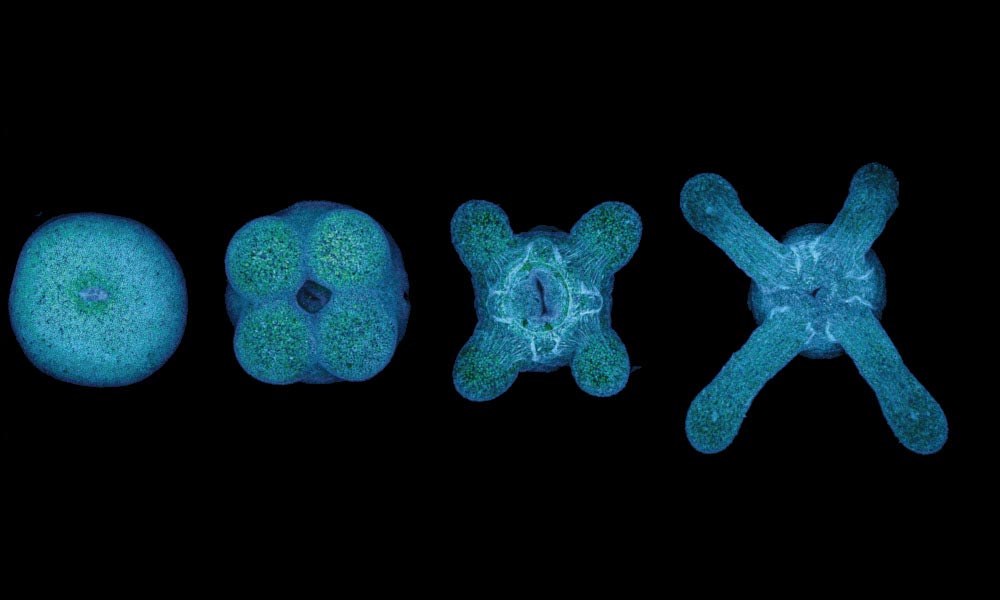
    These four images show the development process of the characteristic tentacle arms of a sea anemone. Credit: Anniek Stokkermans/EMBL

    Your genetic code determines that you will grow two arms and two legs. The same fate is true for all mammals. Similarly, the number of fins a fish has and the number of legs and wings an insect has are embedded in their genetic code. Sea anemones, however, defy this rule and have a variable number of tentacle arms.

    Until now it’s been unclear what regulates the number of tentacles a sea anemone can grow. Scientists from the Ikmi group at EMBL Heidelberg, in collaboration with researchers in the Gibson lab at the Stowers Institute for Medical Research in Kansas City, have shown that the number of tentacles is defined by the amount of food consumed. “Controlling the number of tentacle arms by food intake makes the sea anemone behave more like a plant developing new branches than an animal growing a new limb,” explains group leader Aissam Ikmi. Defining what environmental factors trigger morphological changes is a particularly important question given the longevity of sea anemones, with some species living for more than 65 years. “As predominantly sessile animals, sea anemones must have evolved strategies to deal with environmental changes to sustain such a long lifespan,” adds Ikmi.

    The scientists have shown that the growth of new tentacles happens not only when the sea anemone is a juvenile, but also throughout adulthood. “We can conclude that the number of tentacle arms must be determined by the interplay between genetic and environmental factors,” says Ikmi, who started this project when he was still a postdoc in the lab of Matt Gibson. While the sea anemone uses different strategies to build tentacles in the different stages of its life, the final arms are morphologically indistinguishable from each other. “If humans could do the same, it would mean that the more we ate, the more arms and legs we could grow,” says Ikmi. “Imagine how handy it would be if we could activate this when we needed to replace damaged limbs.”
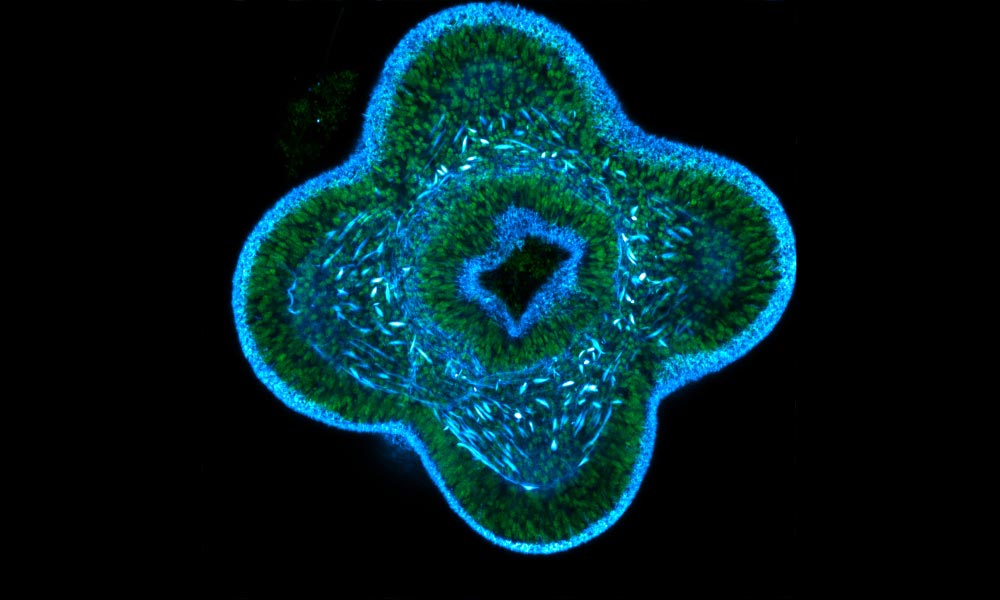
    Starlet Sea Anemone
    The starlet sea anemone (Nematostella vectensis) is native to the North American East coast. At EMBL Heidelberg it is used as a model organism. The anemone’s relatively simple body plan and transparent nature make it suitable for studies using fluorescence microscopy. Biologists use it to study evolution, genomics, reproductive biology, developmental biology and ecology. The image shown here, taken by Anniek Stokkermans from EMBL’s Ikmi Group, shows a larva of Nematostella vectensis. It is in the process of developing the buds that will give rise to its characteristic tentacles. These first four tentacles develop at defined positions when a larva becomes a primary polyp. When the primary polyp receives food, it can acquire additional tentacles, becoming first a juvenile and then an adult polyp. Adult polyps can have up to 16 tentacles. It can lose them in response to stress and regrow the tentacles after amputation. The blue colour in the image shows staining of a polymer microfilament (F-actin). This way the cytoskeleton and muscle fibers in the tentacle buds become visible. Green colours show the nuclei in the larval cells. Credit: Anniek Stokkermans/EMBL

    When Ikmi’s group studied the locations at which the new arms form, they found that muscle cells pre-mark the sites of new tentacles. These muscle cells change their gene expression signature in response to food. The same molecular signaling employed to build tentacles in sea anemones also exists in many other species — including humans. So far, however, its role has been studied mainly in embryonic development. “We propose a new biological context in which to understand how nutrient uptake impacts the function of this developmental signaling: a situation that is relevant for defining the role of metabolism in guiding the formation of organs during adulthood” explains Ikmi. “Sea anemones show us that it is possible that nutrients are not converted into excess fat storage — as it is the case in all mammals — but instead transformed into a new body structure.”

    While this finding is novel on its own, it also shows that sea anemones, which are traditionally used for evolutionary developmental studies, are well suited to study morphogenesis in the context of organism-environment interactions.

    To build the branching map of new tentacles, researchers analyzed more than 1000 sea anemones one by one. “Scoring such a massive number of tentacles is, in some ways, a story in itself,” says Mason McMullen, laughing. McMullen, a clinical pharmacist at the University of Kansas Health System, spent months imaging sea anemones’ heads to score their tentacle number and location.

    Knowing that the number of tentacles in sea anemones is determined by their food intake, the group plans to define the key nutrients critical to this process. Ikmi and his group also want to further investigate the unconventional role of muscles in defining the sites where new tentacles form. “We’re currently investigating this novel property of muscle cells and are eager to find out the mystery behind them,” he concludes.

    Reference: “Feeding-dependent tentacle development in the sea anemone Nematostella vectensis” by Aissam Ikmi, Petrus J. Steenbergen, Marie Anzo, Mason R. McMullen, Anniek Stokkermans, Lacey R. Ellington and Matthew C. Gibson, 2 September 2020, Nature Communications.
    DOI: 10.1038/s41467-020-18133-0

    Never miss a breakthrough: Join the SciTechDaily newsletter.
    Follow us on Google and Google News.

    Cell Biology Genetics Marine Biology Molecular Biology Popular
    Share. Facebook Twitter Pinterest LinkedIn Email Reddit

    Related Articles

    60-Year Scientific Mystery About DNA Replication Solved

    Need a New Tooth? Drug Discovered to Regenerate Lost Teeth

    Ferrets, Cats, Civets, and Dogs Most Susceptible to SARS-CoV-2 Coronavirus Infection After Humans

    Pituitary Puzzle Gets a New Piece: Insights Into Century-Old Controversy Revise Evolutionary History

    Discovery of Weird Microbes in the Deep Waters of the Black Sea Offers New Insights on Early Evolution of Life

    DNA May Not Be the Blueprint for Life – Just a Scrambled List of Ingredients

    “Superpower” Discovered in Squids: They Can Massively Edit Their Own Genetics

    Genetic Analysis Shows Life’s Earliest Evolution Was More Complicated Than Previously Suspected

    Scientists Discover a Gene for Brain Size

    Leave A Reply Cancel Reply

    • Facebook
    • Twitter
    • Pinterest
    • YouTube

    Don't Miss a Discovery

    Subscribe for the Latest in Science & Tech!

    Trending News

    Mezcal “Worm” in a Bottle Mystery: DNA Testing Reveals a Surprise

    New Research Reveals That Your Morning Coffee Activates an Ancient Longevity Switch

    This Is What Makes You Irresistible to Mosquitoes

    Shockingly Powerful Giant Octopuses Ruled the Seas 100 Million Years Ago

    Scientists Stunned by New Organic Molecules Found on Mars

    Rewriting Dinosaur Evolution: Scientists Unearth Remarkable 150-Million-Year-Old Stegosaur Skull

    Omega-3 Supplements Linked to Cognitive Decline in Surprising New Study

    First-of-Its-Kind Discovery: Homer’s Iliad Found Embedded in a 1,600-Year-Old Egyptian Mummy

    Follow SciTechDaily
    • Facebook
    • Twitter
    • YouTube
    • Pinterest
    • Newsletter
    • RSS
    SciTech News
    • Biology News
    • Chemistry News
    • Earth News
    • Health News
    • Physics News
    • Science News
    • Space News
    • Technology News
    Recent Posts
    • These Simple Daily Habits Can Quickly Improve Blood Pressure and Heart Risk Factors
    • A Common Nutrient May Play a Surprising Role in Anxiety
    • Doing This After 9 p.m. Could Double Your Risk of Gut Issues
    • New Research Challenges Long-Held Beliefs About How the Brain Makes Decisions
    • Breakthrough Technology Reveals New Treatment Targets for Cancer
    Copyright © 1998 - 2026 SciTechDaily. All Rights Reserved.
    • Science News
    • About
    • Contact
    • Editorial Board
    • Privacy Policy
    • Terms of Use

    Type above and press Enter to search. Press Esc to cancel.