
Close Menu
    Facebook X (Twitter) Instagram
    SciTechDaily
    • Biology
    • Chemistry
    • Earth
    • Health
    • Physics
    • Science
    • Space
    • Technology
    Facebook X (Twitter) Pinterest YouTube RSS
    SciTechDaily
    Home»Biology»Shedding New Light on the Evolutionary Origin of the Head
    Biology

    Shedding New Light on the Evolutionary Origin of the Head

    By Uni ResearchFebruary 21, 2013No Comments3 Mins Read
    Facebook Twitter Pinterest Telegram LinkedIn WhatsApp Email Reddit
    Share
    Facebook Twitter LinkedIn Pinterest Telegram Email Reddit
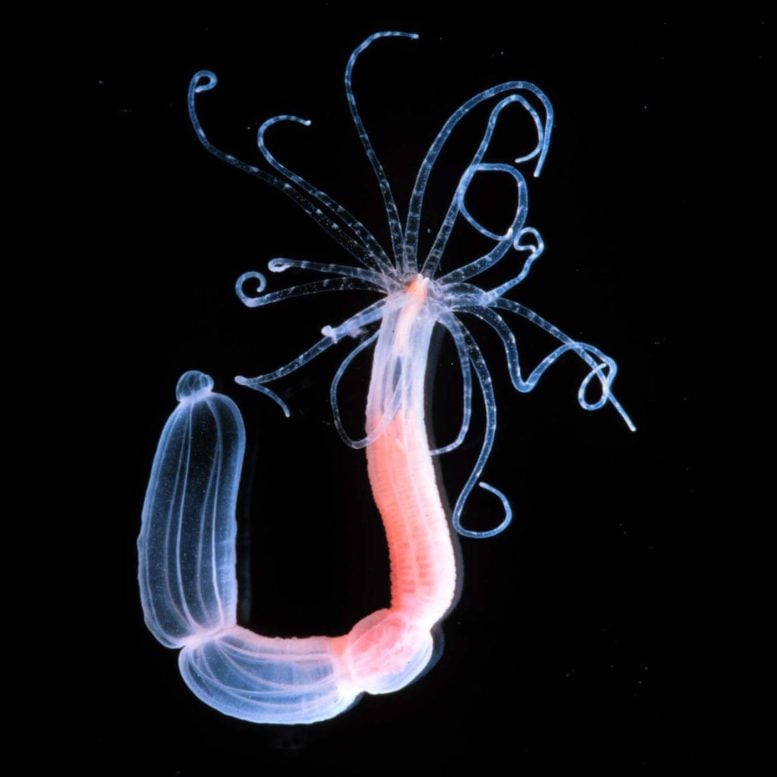
    Adult Nematostella
    Adult Nematostella. Credit: Timm Nuechter & Thomas Holstein

    In an effort to shed new light on the evolutionary origin of the head, a newly published study looks at the sea anemone Nematostella vectensis to find out if one of the ends of the sea anemone corresponds to the head of higher animals.

    A research group at the Sars Center in Bergen has shed new light on the evolutionary origin of the head. In a study published in the journal PLoS Biology they show that in a simple, brainless sea anemone, the same genes that control head development in higher animals regulate the development of the front end of the swimming larvae.

    In many animals, the brain is located in a specific structure, the head, together with sensory organs and often together with the mouth. However, there are even more distantly related animals, that have a nervous system, but no brain, like sea anemones and corals.

    In this study, a research group led by Fabian Rentzsch used the sea anemone Nematostella vectensis to find out if one of the ends of the sea anemone corresponds to the head of higher animals. To do this they studied the function of genes that control head development in higher animals during the embryonic development of the starlet sea anemone.

    “Despite looking completely different, it has become clear over the last decade, that all animals have a similar repertoire of genes, including those that are required to make the head of higher animals”, says first author and Ph.D. student Chiara Sinigaglia.

    Stands on its head

    When the sea anemone is in the larval stage it swims. As adults, the sea anemone stands with one end on the sea floor and uses long tentacles on its upper end to catch small animals which they stuff into the only body opening in the middle of the ring of tentacles.

    “Based on the appearance of the adult animals, the lower end of these animals has traditionally been called the foot and the upper end the head”, explains Rentzsch.

    What the research group found out was that in the sea anemone, the “head gene” function is located at the end that corresponds to the “foot” of the adult animals. The key was to study the larvae of the sea anemones when they still move around.

    “The larvae swims with the “foot” end forward and this end carries their main sense organ, so at this stage it looks more like this might be their head”, says Rentzsch. And indeed, the “head genes” function on this side of the animals.

    Sea anemones and all higher animals, including humans, share a common brainless ancestor which lived between 600 and 700 million years ago.

    “By revealing the function of “head genes” in Nematostella, we now understand better how and from where the head and brain of higher animals evolved”, Sinigaglia and Rentzsch explain.

    Reference: “The Bilaterian Head Patterning Gene six3/6 Controls Aboral Domain Development in a Cnidarian” by Chiara Sinigaglia, Henriette Busengdal, Lucas Leclère, Ulrich Technau and Fabian Rentzsch, 19 February 2013, PLoS Biology.
    DOI: 10.1371/journal.pbio.1001488

    Never miss a breakthrough: Join the SciTechDaily newsletter.
    Follow us on Google and Google News.

    Evolution Evolutionary Biology
    Share. Facebook Twitter Pinterest LinkedIn Email Reddit

    Related Articles

    Genome Study Links Paternal Age to Conditions Such As Autism

    Insects Help Scientists Understand the Predictability of Evolution

    Female Butterflies Prefer Flashier Mates

    Horizontal Gene Transfer Between Plants is More Widespread than Previously Thought

    Evolution Shapes Ecology of Dammed Connecticut Lakes

    Evolutionary Changes Surrounding the NOS1 Gene

    Human Evolution Still Tied to Darwinian Selection

    Human Y-Chromosome Has Enough Genes to Stay for Millions of Years

    Study Measures Mammalian Growth, Taking 24 Million Years to Go from Mouse to Elephant

    Leave A Reply Cancel Reply

    • Facebook
    • Twitter
    • Pinterest
    • YouTube

    Don't Miss a Discovery

    Subscribe for the Latest in Science & Tech!

    Trending News

    Scientists May Have Found the Key to Jupiter and Saturn’s Moon Mystery

    Scientists Uncover Brain Changes That Link Pain to Depression

    Saunas May Do More Than Raise Body Temperature – They Activate Your Immune System

    Exercise in a Pill? Metformin Shows Surprising Effects in Cancer Patients

    Hidden Oceans of Magma Could Be Protecting Alien Life

    New Study Challenges Alzheimer’s Theories: It’s Not Just About Plaques

    Artificial Sweeteners May Harm Future Generations, Study Suggests

    Splashdown! NASA Artemis II Returns From Record-Breaking Moon Mission

    Follow SciTechDaily
    • Facebook
    • Twitter
    • YouTube
    • Pinterest
    • Newsletter
    • RSS
    SciTech News
    • Biology News
    • Chemistry News
    • Earth News
    • Health News
    • Physics News
    • Science News
    • Space News
    • Technology News
    Recent Posts
    • Ancient DNA Reveals Irish Goats Have a 3,000-Year-Old Lineage Still Alive Today
    • Historians Reveal Secrets of the Strange Hat Wars That Shook Early Modern England
    • “A Plague Is Upon Us”: The Mass Death That Changed an Ancient City Forever
    • This Strange Material Can Turn Superconductivity on and off Like a Switch
    • Scientists Discover Game-Changing New Way To Treat High Cholesterol
    Copyright © 1998 - 2026 SciTechDaily. All Rights Reserved.
    • Science News
    • About
    • Contact
    • Editorial Board
    • Privacy Policy
    • Terms of Use

    Type above and press Enter to search. Press Esc to cancel.