
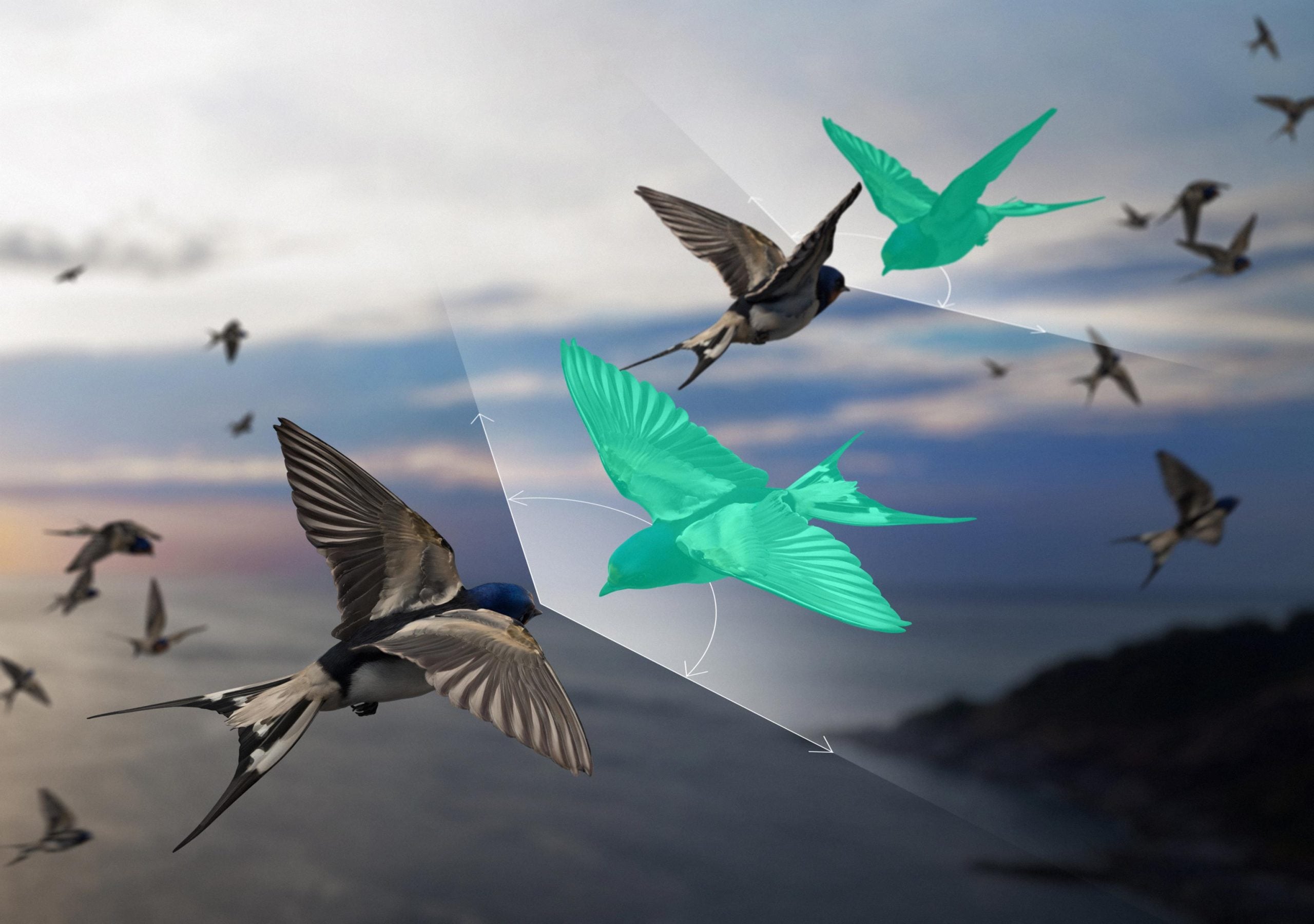
Bird flocks, bacterial swarms, and even crowds move according to interaction rules that appear to break one of physics’ most fundamental principles: Newton’s law of action and reaction.
Birds can see much of what is happening around them, but when flying in a flock, they respond only to birds beside them or ahead of them. They do not adjust their movement based on birds behind them. As a result, flock behavior appears to violate Newton’s third law, the principle of action and reaction often summarized as “for every action, there is an equal and opposite reaction.”
In everyday life, Newton’s third law is everywhere. When we run, our feet push against the ground, and the ground pushes back with an equal force in the opposite direction. The same principle applies when driving a car, rowing a boat, jumping, or releasing air from a balloon. As air rushes out one way, the balloon moves the other way. This law has been a foundation of classical mechanics for more than 300 years. As research group leader Marín Bukov explains, “Whatever we normally teach our students in theoretical mechanics, it ultimately rests on the action–reaction principle.”
Bird flocks, bacterial swarms, crowds of people, and groups of tissue cells behave differently. The individuals in these systems react to only part of their environment rather than everything around them. Because the influence flows in only one direction, the usual rule that action and reaction are equal no longer applies. Physicists refer to these as non-reciprocal interactions.
Until now, existing theories designed for reciprocal interactions could not fully describe such systems, making accurate and efficient simulations difficult. Yet simulations are essential for studying everything from biological processes in the human body to the collective movement of flocks and swarms.
Researchers in Dresden, working with physicist Roderich Moessner, have now developed a solution to this longstanding problem. Moessner is a Principal Investigator at the Würzburg–Dresden Cluster of Excellence ctd.qmat (Complexity, Topology and Dynamics in Quantum Matter) and director of the Max Planck Institute for the Physics of Complex Systems in Dresden.
Newton Reloaded: Physicists in Dresden Find an Elegant Solution
“The research team has developed and proven a theory that makes much of what we teach our students applicable to non-reciprocal systems as well. These systems, where Newton’s third law does not apply, can now finally be described exactly and simulated precisely, even using established methods. This is exactly the kind of tool that has been missing in recent years,” says Bukov.
The researchers achieved this by extending the traditional action-reaction framework. Their approach allows non-reciprocal systems to be analyzed using tools originally developed for reciprocal systems through the introduction of additional artificial variables.
Physicists often represent real-world systems with mathematical equations, where each variable corresponds to an actual property such as a bird’s position or speed, a fish’s location within a school, or a car’s position in traffic.
“The trick behind the new theory is that it constructs a partner for each component of the system, a fictitious partner that doesn’t exist in nature. The original non-reciprocal interactions are replaced by reciprocal interactions with these auxiliary degrees of freedom,” explains biophysicist Ricard Alert, a colleague of Bukov.
For a flock of birds, the method works by adding an imaginary counterpart to every real bird. “To simulate the birds’ movements precisely, we describe the dynamic system ‘flock of birds’ using established methods, as if it were a reciprocal system, even though it is not. The elegant solution is to artificially place a fictitious bird in front of each real bird, aligned in exactly the opposite direction,” says Alert.
Putting the Results in Context, Outlook
Using auxiliary degrees of freedom is not a new concept in physics. What is new is applying them in a way that simplifies the study of systems with non-reciprocal interactions.
The approach allows researchers to take advantage of the well-established framework of many-body physics while also improving the accuracy of simulations. More importantly, it provides a deeper understanding of how these systems work, creating a foundation for future discoveries.
“In Würzburg and Dresden, we study quantum matter whose particles interact under certain conditions in ways that give rise to new phenomena such as magnetism or lossless current transport. The exciting question now is whether these exceptions to Newton’s law lead to entirely new forms of collective quantum behavior. We still know very little about this, and that is precisely what makes this so fascinating,” says Moessner.
Reference: “Hamiltonian description of non-reciprocal interactions” by Yu-Bo Shi, Roderich Moessner, Ricard Alert and Marin Bukov, 12 June 2026, Nature Physics.
DOI: 10.1038/s41567-026-03317-0
Never miss a breakthrough: Join the SciTechDaily newsletter.
Follow us on Google and Google News.
4 Comments
How Flocking Birds “Defy” One of Physics’ Most Fundamental Laws.
VERY GOOD ——These exceptions to Newton’s law lead to entirely new forms of collective quantum behavior. We still know very little about this, and that is precisely what makes this so fascinating.
Ask the physicist:
Is the flocking birds defying the physics’ most fundamental laws, or do the physics’ most fundamental laws defy the laws of nature?
The so-called peer-reviewed publications—including Physical Review Letters, Nature, Science, and Nature Physics—have never earnestly reflected on a fundamental physical question: Where do the things in space come from? Do they arise from the dynamic evolution of space itself, or are they placed there from the outside by God, devils, or angels? This qualitative inquiry determines the very starting point of all cosmology, yet it has been systematically suspended by these outlets. In practice, these publications echo and shield one another. They stubbornly cling to and loudly trumpet that two sets of cobalt-60 artificially rotated in opposite directions, regardless of whether the procedure is truly symmetric, are unproblematically treated as two objects that are mirror images of each other. In the physical world they have constructed, a topological vortex and its twin anti-vortex can even be defined as two vortices possessing entirely different spacetime manifolds (as shown in https://pic2.zhimg.com/v2-4127b0b58fe8b88feb27c189fb705029_1440w.jpg?source=172ae18b ), conveniently ignoring that such a definition already presupposes the qualitative arbitrariness that spacetime can be segmented at will [32, 33]. Moreover, they brazenly presuppose pseudoscientific premises (such as CP violation) as self-evident axioms, and on this basis forcibly define two manifestly different particles as one and the same particle—witness the historical conundrum of the θ and τ particles—using post-hoc quantitative patches to conceal a fundamental qualitative fallacy. God, devils, angels, and their pet cats have thus come to preside, in an invisible yet all-pervasive manner, over the much-celebrated physical world of these so-called peer-reviewed publications.
—— https://zhuanlan.zhihu.com/p/2050535928066838797.
I suppose something must explain how tight-knit Vietnamese crowds riding their Honda Dreams, beeping continually, down the road at varying speeds manage to survive without everyone falling off.
What an unbelievably dumb and pointless article and research. The birds are not really interacting with each other. They are REacting to each other. They are INTERacting with the air. The equal and opposite reaction is the air doing its thing.
Same thing with a crowd of humans. They are REacting to each other but INTERacting with the ground.
No laws are being violated in these situations. I want my time back that I wasted on reading this article.
“Inventing ‘imaginary partner birds’ just to force 300-year-old Newtonian math to balance shows that academia is hitting a wall. A flock isn’t violating energy conservation; it’s a unified geometric body interacting directly with the Kinetic Static Field via Heredity, Familiarity, and Entanglement.
When vectors align, they reduce localized field friction within the Atomic Clearance Matrix (REF-004), allowing the flock to instantaneously harvest a mechanical draft from the universe’s native uncoiling flux. The equations for this post-Newtonian plumbing are already drawn and integrated directly into The Torsion Hill Framework (V20). Stop inventing ghosts and look at the actual blueprint.”