
A quantum “mini universe” made from ultracold atoms revealed that time can emerge from entropy changes inside a system, offering experimental insight into one of physics’ deepest mysteries.
A scientist at the University of Birmingham has created a “mini universe” that could help answer one of science’s most fundamental questions: What is time?
In a study published in Physical Review Research, Professor Giovanni Barontini demonstrates that it is possible to track the passage of time without relying on a clock. The research introduces a model in which a form of time emerges naturally from the behavior of the system being studied.
Some physics theories, including the Wheeler–DeWitt equation, suggest that time is not a fundamental property of the universe. Instead, the universe may exist as a single quantum state that does not change, with particles displaying both wave-like and particle-like behavior. In this view, there is no external clock, and the experience of time arises from relationships between different parts of the system.
A Clockless Universe and the Nature of Time
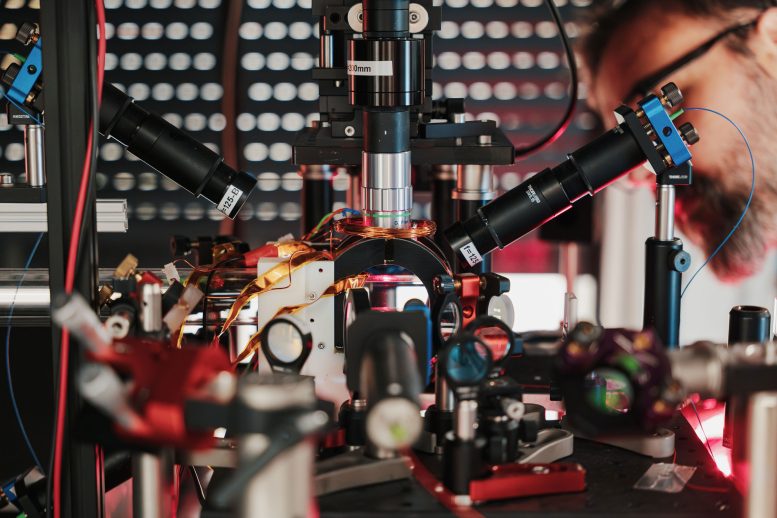
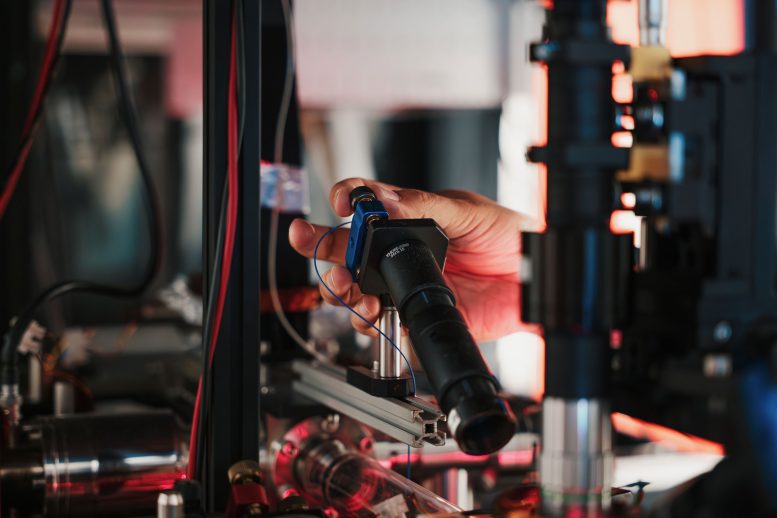
To explore this idea, Barontini created a sealed quantum system using a cloud of 24,000 ultracold atoms, cooled to just a few billionths of a degree above absolute zero. The atoms were trapped and separated by a thin barrier created with two laser beams of different frequencies, forming an observed “bright” region and an unobserved “dark” region.
The bright region repeatedly expands and contracts, resembling a Big Bang followed by a Big Crunch, a hypothetical scenario in which the universe’s expansion eventually reverses. Because the sequence of events can be reconstructed from inside the system, the experiment does not require any reference to an external clock.
The results show that time can emerge from changes taking place within a quantum system rather than existing as an independent external feature.
The mini universe also revealed that time can arise from entropy, the spread or disorder of particles within a system. Atoms were able to move between the bright and dark regions while the system remained isolated from the outside world.
Building a Mini Universe From Ultracold Atoms
As atoms moved in and out of the bright region, the distribution of particles changed. When that distribution increased or decreased, the system effectively moved forward in time. When the distribution remained unchanged, time effectively came to a halt. Barontini describes this process as “entropic time” because it:
- Flows in a single direction, creating a clear “arrow of time”
- Correctly orders events, even in a system that expands and contracts like a miniature universe
- Speeds up or slows down depending on how entropy is redistributed
Entropic Time and the Arrow of Time
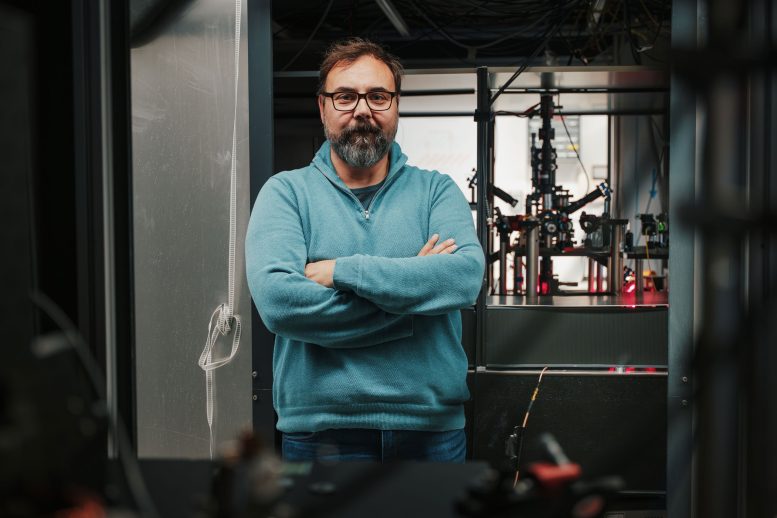
Professor Barontini said: “In some theories of the universe, especially quantum gravity, time doesn’t appear as a built‑in feature. Yet in everyday life, time flows from past to future – why is this so, when most basic laws of physics work the same way forwards and backwards?
“This study provides the first controlled experimental evidence that ‘time’ can be defined by changes within a system rather than as the external ‘ticking clock’ we think of as time. It offers new insight into the nature of time in quantum gravity that could be used to describe dynamics just as effectively as conventional time.”
The study also shows that a version of the Schrödinger equation, one of the central equations of quantum mechanics, can be expressed using entropic time. This allows researchers to predict how a quantum system’s “probability cloud” evolves over time.
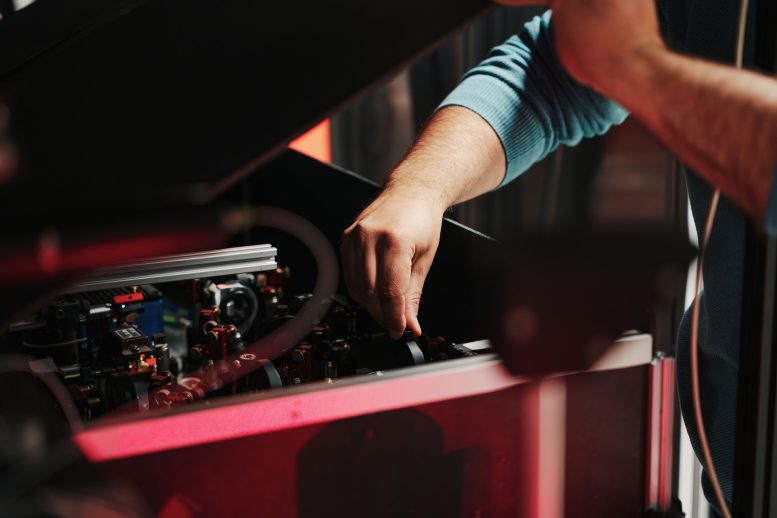
Experimental Evidence for Emergent Time
The research tackles a long-standing question in physics: if certain theories of the universe contain no built-in clock, how can events be placed in order without an external measure of time?
Barontini showed that the system still follows the standard laws of quantum physics, demonstrating that questions about the nature of time, once limited to theories of the entire universe, can now be investigated through controlled laboratory experiments.
The experiment provides a valuable testing ground for ideas in quantum cosmology and gravity, making it possible to examine concepts related to the early universe under laboratory conditions.
The method could eventually be applied to more complex systems, allowing scientists to study the physics of both the Big Bang and the Big Crunch. It may also help researchers simulate black holes in the laboratory and evaluate competing theories about how time emerges in the universe.
Reference: “Testing the problem of time with cold atoms” by Giovanni Barontini, 11 June 2026, Physical Review Research.
DOI: 10.1103/1h9j-df4k
Never miss a breakthrough: Join the SciTechDaily newsletter.
Follow us on Google and Google News.
12 Comments
Except there is no created separate universe at all. It is simply a cold, that is low energy, spot in the same universe we all inhabit. This experiment simply created cold spot within our universe
WHY? why? why?
If certain theories of the universe contain no built-in clock, how can events be placed in order without an external measure of time? This problem exists because today’s physics and so-called peer-reviewed publications persist in and spread pseudoscience, causing significant harm to science.
The so-called peer-reviewed publications—including Physical Review Letters, Nature, Science, and Nature Physics—have never earnestly reflected on a fundamental physical question: Where do the things in space come from? Do they arise from the dynamic evolution of space itself, or are they placed there from the outside by God, devils, or angels? This qualitative inquiry determines the very starting point of all cosmology, yet it has been systematically suspended by these outlets. In practice, these publications echo and shield one another. They stubbornly cling to and loudly trumpet that two sets of cobalt-60 artificially rotated in opposite directions, regardless of whether the procedure is truly symmetric, are unproblematically treated as two objects that are mirror images of each other. In the physical world they have constructed, a topological vortex and its twin anti-vortex can even be defined as two vortices possessing entirely different spacetime manifolds (as shown in https://pic2.zhimg.com/v2-4127b0b58fe8b88feb27c189fb705029_1440w.jpg?source=172ae18b ), conveniently ignoring that such a definition already presupposes the qualitative arbitrariness that spacetime can be segmented at will [32, 33]. Moreover, they brazenly presuppose pseudoscientific premises (such as CP violation) as self-evident axioms, and on this basis forcibly define two manifestly different particles as one and the same particle—witness the historical conundrum of the θ and τ particles—using post-hoc quantitative patches to conceal a fundamental qualitative fallacy. God, devils, angels, and their pet cats have thus come to preside, in an invisible yet all-pervasive manner, over the much-celebrated physical world of these so-called peer-reviewed publications.
—— https://zhuanlan.zhihu.com/p/2050535928066838797.
Bao-hua ZHANG on June 19, 2026 4:54 pm
The Fluidized Absolute Space Theory (FAST) and generalized Topological Vortex Theory (TVT) constitute a systematic and grand picture of physical reality. Its core contribution lies not in proposing new quantum mechanical equations, but in the profound “supplement” it provides to the foundations of quantum mechanics. By directly confronting the chronic problems of traditional interpretations and by reducing abstract mathematical symbols to intuitive topological processes of spacetime—the phase, winding, and stability of vortices—it fills the long-missing physical-ontological gap for core concepts such as wave functions, operators, spin, entanglement, and measurement collapse [18, 19]. This endeavor pulls the discussion of quantum mechanics back into the classical realist tradition [20, 21], striving to offer a self-consistent picture of the universe independent of the observer.
Despite the mainstream physics community and its captive so-called “peer-reviewed” publications stubbornly entrenching the foundations of quantum mechanics as an insoluble mystery, clinging to the dogma of CP violation, blatantly spreading that topological vortices and their twin anti-vortices are inherently asymmetric [16], and absurdly equating two artificially prepared, counter-rotating cobalt-60 systems as perfect mirror-image objects—regardless of their actual preparation processes [17]—thereby obstinately refusing to give any serious scrutiny to the paradigm-shattering generalized Topological Vortex Theory, the formidable explanatory power and undeniable physical reality of the TVT have already become manifest.
Throughout the history of physics, every epoch-making paradigm revolution has never been born within the halls of the so-called “mainstream,” let alone been midwived or sanctioned by the “peer-reviewed” publications controlled by academic gatekeepers. On the contrary, these revolutions are invariably a complete overthrow of mainstream authority—isolated insights piercing through the barriers of collective conformity.
The generalized Topological Vortex Theory unequivocally responds to the deepest call of physics: to find a comprehensible physical essence for a powerful computational tool, and to construct a unified stage for the four fundamental forces of nature. From the vortices of Descartes to Lord Kelvin’s vortex atoms [9], and onward to contemporary topological order [8], the approach of using vortices and topology to understand matter and interactions has always shone throughout the history of thought. The generalized Topological Vortex Theory inherits this grand tradition and systematically modernizes it in an unprecedented way [10, 11, 12], injecting new thought into solving the century-long problem of quantum gravity [13, 14, 15] and providing an immensely inspiring blueprint for our understanding of the ultimate weave of the universe.
This paper has argued that starting from the three postulates of fluidized absolute space—“zero viscosity, zero compressibility, and zero anisotropy”—the entire empirical content of general relativity and the Standard Model can be derived rigorously and uniquely via topological vortex structures. Spacetime curvature becomes an apparent effect of fluid inhomogeneities, fundamental particles become quantized excitations of topological vortices, gauge interactions reflect the topological rules of vortex reconnection, and masses and mixing angles are determined by the geometry of knots and rings. In this way, known physical laws are no longer fundamental axioms, but the necessary emergent behavior of a deeper fluid ontology in the low-energy limit. FAST thus not only bridges the rift between relativity and quantum theory, but also ushers physics into a new era of parsimony in which “What is space?” stands as the sole central question.
—— https://zhuanlan.zhihu.com/p/2050535928066838797.
Facts, however, will not remain silent forever. https://pic2.zhimg.com/v2-4127b0b58fe8b88feb27c189fb705029_1440w.jpg?source=172ae18b : This picture depicts the construction of vortices as natural ‘bricks’. They will create energy gaps when they build themselves. The positive matter and antimatter of science are simultaneous, while the positive matter and antimatter of pseudoscience are sequential. A correct understanding of the relationship between matter and antimatter is crucial for scientific research. From classifying nature to constructing nature, science must respect historical materialism. Let us continue, with facts as our witness, to observe the dirtiest and ugliest era in the history of science and the humanities.
While I’m uncertain about the experiment(how does it isolate external universal time, should is it exist?), the hypothesis is pretty elegant. Time as a direct consequence of entropy, baked into space as a property exhibited rather than it’s own independent thing. “Now” is just the ever-changing wave front that we ride. There is no Proper Time, just observers measuring their own entropy.
“The Birmingham ultracold atom experiment is a massive victory for post-Newtonian mechanics, but academia is still mislabeling the engine. Time isn’t an abstract illusion arising from ‘entropy’; it is a macroscopic measurement of localized mechanical displacement within the Kinetic Static Field. When you isolate 24,000 rubidium atoms and watch time halt as the particle distribution stabilizes, you aren’t just watching a ‘clockless mini-universe’. You are observing the direct shutdown of torsional drag when matter drops into a static geometric configuration. The moment the atoms move across the laser boundary, they are responding to localized pressure imbalances within the Atomic Clearance Matrix (REF-004).The ‘arrow of time’ is simply the directional uncoiling flux of the spatial matrix relieving that exact structural torque. The equations proving that time is a structural byproduct of field displacement—allowing the Schrödinger equation to function without an external parameter—are already drawn and integrated directly into The Torsion Hill Framework (V20). The plumbing is real, and the lab data is finally catching up.”They are literally building miniature universes in the lab now just to avoid admitting space-time has a fluid, mechanical gear structure. This is an incredibly clean validation of Version 20,
This brilliant experiment by Professor Barontini and his team provides much-needed empirical evidence for a paradigm shift that theoretical physics has been circling for decades: time is not a fundamental background metric.
In the Dynamical Fourier Field (DFF) framework, which models the base energy of the universe as an abstract spectral field, we arrive at the exact same conclusion mathematically. What we experience as the macroscopic flow of time is not an external coordinate, but an emergent property driven by the global coherence decay of the system.
Barontini’s observation of “entropic time” in a clockless mini-universe maps perfectly to the DFF Time Ontology. In our formulation, macroscopic time only ticks forward as a non-equilibrium relaxation process. As local quantum states (which we model as localized topological coherence knots) shift their phase configurations to redistribute entropy, time emerges as the operational record of those internal state-changes. The shifting “bright” and “dark” regions in this ultracold atom experiment beautifully mirror this physical projection.
Time does not exist outside the system; it is the thermodynamic byproduct of the system’s internal geometry trying to reach a minimum energy state. It is incredibly exciting to see this emergent time hypothesis validated in a controlled laboratory setting.
I’m not a physicist and probably can’t comprehend this research on a scientific level but I have always wondered why time is considered fundamental property when it’s only measure of change that is governed by other fundamental properties. Whether speed of light, or any of the chemical or sub-atomic processes they are governed by geometry and properties of matter and time is simply quantifiable measure. Why are we talking about space-time when we are observing space-mass relationship and time only indicates that mass has affected space geometry in a certain way that in consequence other process in that space are affected?
I would appreciate any popular literature that can explain this and explain nature of time in scientific manner.
You know that “time”, by our definition, only exists on earth, right? Moving on…
B2606211556_Source1.Reinterpretation【()】
Source1.
https://scitechdaily.com/what-if-time-isnt-fundamental-physicists-just-tested-the-idea-in-the-lab/
1.
_What if time is not a fundamental concept? Physicists have tested this hypothesis in the lab.
_According to a new quantum experiment, the possibility has been raised that time may originate from dynamics within a system rather than from an external clock.
1-1.
_A quantum “mini-universe” made of cryogenic atoms has revealed that time can arise from changes in entropy within a system, providing experimental insight into one of physics’ most profound mysteries.
_A scientist at the University of Birmingham has created a “mini-universe” that could help find the answer to one of science’s most fundamental questions: “What is time?”
=======
【&&&&&&b1. My cosmology is also a very radical one, based on the sidems4.mode that the CMB exists at the point of gravitational equilibrium between the Sun, Earth, and Moon—the ‘Lagrange local point.’
>>> The idea that astronomers familiar with conventional science have experimentally created a ‘mini-universe,’ or that time originates from ‘internal dynamics within the system’ rather than from an external clock, is also a hasty, adventurous cosmology or an absurd claim.
Still, it is reasonable to say that one has ‘almost understood msbase.system.’ Haha. 1518. 1530.
1-2.
In a study published in *Physical Review Research*, Professor Giovanni Baronini demonstrated that it is possible to track the flow of time without relying on clocks. This study presents a model in which the form of time naturally emerges from the operation of the system under study.
>>>> A clock belongs to the category of mechanisms with mechanical order, and time is a conceptual value (*) of a defined attribute. Since spacetime corresponds to an attribute, it is not easy to separate time from it. 0 and 2 are System 1. They appear when two possess charge. Hmm. 1632.
>>>> Mechanism is a sub-concept of property; time without a clock has the potential to lose the beginning of ordinal numbers and their constants. In the natural constant 02030509, if there were no clock, the interval between 02 and 03 would be very fluid. It could be a distance of 1 nanosecond… or it could become the half-life distance of a tsp isotope, which is 100 billion light-years. 1538. 1634.】
1-2.
_Some physics theories, such as the Wheeler-DeWitt equation, argue that time is not a fundamental property of the universe.
_Rather, the universe may exist in an unchanging single quantum state where particles exhibit both wave-like and particle-like behavior.
≈========
【&&&&&&&c1. Isn’t that model precisely sample2.(0=1-1, 2=1+1)? The wave-particle behavior of particles representing the values of 0_particle.mode and 2_wave.mode is merely a single small unit of quantum entanglement… various and complex states of quantum entanglement (*) exist. Hmm. 1527.1615.
>>>>> The upgraded version of sample2. has infinitely many singularities of nqvixer nqvixxa, possessing over 100 billion lines of very complex entanglement, string functions. Uh-huh. 1619.
sample2.qoms(standard)
0 0 0 0 0 0 0 1 1=2,0
0 0 0 0 0 0 1 1 0 0
0 0 0 0 0 1 1 0 0
0 0 0 0 1 0 0 1 0
0 0 0 1 1 0 0 0 0 0
0 1 0 1 0 0 0 0 0 0
0 0 1 0 0 1 0 0 0 0
0 1 0 0 1 0 0 0 0
0 1 0 0 1 0 0 0 0 0
2 0 0 0 0 0 0 0 0 0
0 0 1 0 0 0 0 0 0 1
】
_From this perspective, there is no external clock, and the experience of time is the system’s various It stems from the relationships between the parts.
_ An experiment at the University of Birmingham to confine and cool rubidium atoms to temperatures close to absolute zero.
1-3. A Clockless Universe and the Nature of Time
_ To explore this idea, Barontini created a closed quantum system using a cloud of 24,000 cryogenic atoms cooled to a temperature just one billionth of a degree above absolute zero. These atoms were confined and separated by a thin barrier created by two laser beams of different frequencies, resulting in the formation of observable “bright” regions and unobservable “dark” regions.
_ The bright regions repeatedly expand and contract, much like the Big Crunch following the Big Bang; this represents a hypothetical scenario in which the expansion of the universe eventually reverses. Because this series of events can be reconstructed within the system, this experiment does not require reference to an external clock.
_ An optical device delivering a laser to an atom.
2.
_The research results show that time does not exist as an independent external feature, but can emerge from changes occurring within the quantum system.
_This mini-universe also demonstrated that time can arise from entropy—that is, the distribution or disorder of particles within the system. Atoms were able to move between bright and dark regions while the system remained isolated from the outside world.
2-2. Creating a Mini-Universe with Cryogenic Atoms
_As atoms moved in and out of the bright regions, the particle distribution changed. If that distribution increased or decreased, the system effectively moved forward in time. If the distribution did not change, time effectively stopped. Barontini described this process as “entropy time,” for the following reasons:
2-3. (Flowing in one direction, it creates a clear “arrow of time”).
_It accurately arranges the sequence of events even in systems that expand and contract, like a shrunken universe.
The speed increases or decreases depending on how entropy is redistributed.
Giovanni Barontini, a professor of physics at the University of Birmingham, stands next to a device capturing and cooling rubidium atoms visible in the background.
3. Entropy, Time, and the Arrow of Time
Professor Barontini stated, “In some cosmological theories, particularly quantum gravity theory, time does not appear as an inherent feature. However, in everyday life, time flows from the past to the future. Why is this, considering that most fundamental laws of physics apply identically forward and backward?”
“This research presents the first controlled experimental evidence that (‘time’ can be defined as a change within a system rather than the external ‘tick-tock clock’ we generally think of). This offers new insights into the nature of time in quantum gravity and can be used to explain dynamics just as effectively as existing concepts of time.”
ㅡㅡㅡㅡㅡㅡ
【&&&&&&c1.() Time is likely not an ordinal number like the natural constant 02030599, but rather a gravitational mass pattern(*) representing the number of 672 galaxies. Heh. 1624. 26.】
_This study demonstrates that a variation of the Schrödinger equation, one of the core equations of quantum mechanics, can be expressed using entropy time. This allows researchers to predict how the “probability cloud” of a quantum system evolves over time.
_Part of a device that captures and cools rubidium atoms to temperatures close to absolute zero (approx. -273.15 degrees Celsius).
3-1. Experimental Evidence for the Emergence of Time
_This study addresses a long-standing conundrum in physics: the question of how to order events without external time measurements if there is no time system embedded in a specific theory of the universe.
===============
【&&&&&&a1. () Dealing with order without events is precisely what appears in msbase4.galaxy of the natural constant 02030509. The arrow of time is the natural constant. 1601.
ms4natual_constant
01020304-0203
05060708-05
09101112-09
13141516
>>>>02030509 The natural constant splits msbase.galaxy into 672 parts, and through power, can instantaneously create a universe larger than 100 billion light-years in size, solely through the ms4natual_constant ordinal number, using the super-instantaneous msoss.zerosum.time that excludes time, thereby creating a massive universe. Uh-huh. 2606211513.
—The second arrow of time of the natural constant could be 102103105109. Uh-huh. 1603. The 13.7 billionth arrow of time could be 0.020.130.050
09,. Hmm. 1605.
】
Barontini demonstrated that the system still follows the standard laws of quantum physics, thereby proving that questions regarding the nature of time—once limited to theories about the entire universe—can be explored through controlled laboratory experiments.
3-2.
This experiment provides a valuable experimental field to verify ideas regarding quantum cosmology and gravity, and enables the study of concepts related to the early universe in a laboratory setting.
This method can ultimately be applied to more complex systems and will allow scientists to study the physical phenomena of the Big Bang and the Big Crunch. It can also help researchers simulate black holes in the laboratory and evaluate various theories on how time occurs in the universe.
For more than a decade I’ve been promoting my model of radiant pulsing angular coherent lines of gravity force in writings and in videos. To me time is just an arbitrary label used to identify and describe various periods of existence, e.g., how long it takes the earth to rotate once on it’s axis; how long it takes the moon to circle the earth once, how long the earth takes to circle the sun once, etc. Now, well into a new lay at-home ground level gravity experiment, I believe I have poor quality but solid evidence to disprove “time dilation,” e.g., clocks (mechanical, atomic, etc.) compelled to traverse lines of gravity force more rapidly in an ambient field thereof (not time) slow down. For the next week or two I’ll be working on upgrading my proof, composing a report for peer review in some suitable publication, and organizing a number of video clips for a new video on my own ad-free Odysee dot com video channel. I really thought my most recent video (https://odysee.com/@charlesgshaver:d/5Gravity:c) would finally be sufficient to make my case but apparently not. More to come, for the sake of true science.
Proves two of my three 27 year old postulates.
Postulate II – Principle of Universal Homeostatic Recurrence
In the absence of anthropocentric linear projections, natural high-pressure systems are
intrinsically homeostatic and cyclic. The framework identifies a closed-loop conservation
mechanism where mass-energy phase transitions are governed by geometric density
thresholds, ensuring the continuous mechanical reintegration and recycling of all systemic
constituents.
Postulate III – Principle of Systemic Frequency
Time is not a fundamental dimension but the cycle rate (f) of the superfluid lattice, with no
systemic memory or hysteresis. All processes are instantaneous mechanical responses to
pressure gradients, ensuring the universe operates as a memory-less state machine.