
A newly discovered Ramesside tomb near Luxor is revealing details about ancient Egyptian burial practices while facing growing danger from flash flooding.
Standing at the entrance to a newly uncovered ancient tomb, there is no way to know what waits inside. I recently experienced that mixture of excitement and apprehension while directing an international research team working in the Theban necropolis, a UNESCO World Heritage site near the modern Egyptian city of Luxor.
Our work is primarily focused on establishing a conservation and risk management program for Lower Sheikh ʿAbd el-Qurna, a necropolis (burial ground) at the base of the Theban mountain. Its location leaves the monuments particularly exposed to flash flooding caused by intense rainfall.
To reduce that danger, we are clearing debris and excavating systematically so floodwater can be diverted away from the tombs while archaeological information is carefully preserved. During this work, we unexpectedly uncovered a previously unknown tomb dating back roughly 3,000 years.
Before entering, we could not tell whether its ceiling had fallen in, whether looters or other damage had destroyed the interior, or whether the tomb had survived largely intact.
Painted walls survived inside the tomb
Its layout is typical of Theban elite tombs dating to the New Kingdom period (ca. 1550-1069 BC). At this time, Thebes (now Luxor) was Egypt’s capital and main religious and political center.
The tomb features an outer courtyard, rock-cut chapel, and subterranean burial chambers. The well-preserved courtyard area includes a mudbrick platform with a niche for a stela (upright stone grave marker) and staircase with ramps on either side, giving access to the tomb.
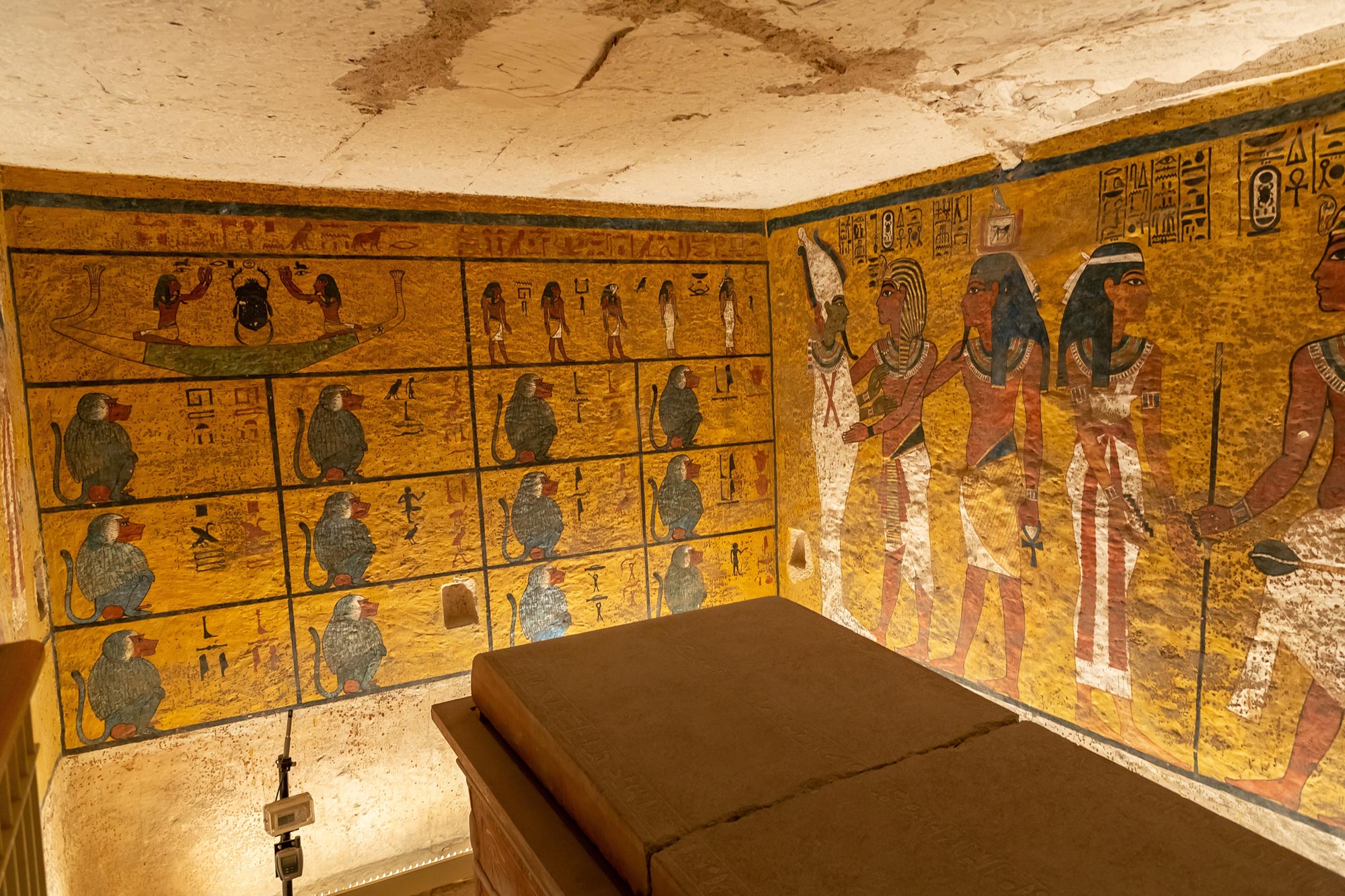
Once inside the rock-cut chapel, we noticed its walls are decorated with vivid paintings of the main tomb owner adoring various deities in shrines, and also sitting with his wife in front of an offering table laden with bread, beer, fruits, meat, and flowers. Based on the iconography and painting style, we determined that the tomb dates to the Ramesside period (ca. 1292-1069 BC), named after the many pharaohs called Ramesses in that era.
This was a particularly exciting moment. These wall paintings offer invaluable historical details about ancient Egyptian daily life and society. They also shed light on the tomb owner’s position in the Ramesside hierarchy, and on the other family members buried here – plus, potentially, later reusers of the tomb.
The vast Theban necropolis, comprising an area of around 10 km², was Egypt’s main royal and elite cemetery for half a millennium, from ca. 1550 BC onwards.
Situated opposite the city of Thebes on the west bank of the River Nile, it features many world-famous historical sites including the Valley of the Kings (a burial ground for pharaohs including Tutankhamun and Ramesses II) and Valley of the Queens, plus hundreds of private elite tombs, royal memorial temples and remains of royal palaces.
Our team has been carrying out fieldwork here since 2018, in close collaboration with the Egyptian Ministry of Tourism and Antiquities.
Paintings reveal the owner as Paser
Based on a first analysis of the painted decoration inside the tomb, we identified its main owner as a male official named Paser. However, the paintings are covered in a layer of dirt. Once they are cleaned by a conservation specialist, we expect to find out more about the identities and personal narratives of the people buried here.
One of the main research questions associated with our fieldwork focuses on the question of tomb placement and tomb reuse – for which the newly discovered tomb carries important scholarly significance. It will help us explain why in the Ramesside period, officials such as Paser chose to reuse, modify or build tombs adjacent to the monuments of the preceding 18th-dynasty elites.
Specific questions we will try to answer include: how did features of the ancient mortuary landscape (including proximity to processional routes, tombs of relatives, or monuments of special cultic importance) influence the placement of these tombs? And what influenced the decision to reuse them for burial, rather than building new ones?
Climate change threatens the tombs
Unfortunately, our work is something of a race against time. As a result of climate change, the frequency and intensity of flash flooding is expected to increase significantly in the coming years here.
This poses a major threat to the tombs in this area. Flooding can lead to immediate, extensive damage such as moisture-activated growth of salt crystals, loss of painted decoration, and, potentially, structural collapse. So, one of the most important aims of our project is to implement a preventive conservation and risk management program that safeguards these monuments for future generations.
Conservation is uncovering a neglected site
At the same time, these activities also allow us to explore this area archaeologically for the very first time, revealing the historical and cultural development of the Lower Sheikh ʿAbd el-Qurna necropolis. Up to now, this area has barely been studied in comparison with famous nearby sites such as the Valley of the Kings and the large temple complexes of Luxor and Karnak.
But our ongoing research shows that Lower Sheikh ʿAbd el-Qurna is rich in archaeological material. This includes exquisitely decorated tombs that offer a unique glimpse into the daily lives, funerary beliefs, artistry, and monuments of Egypt’s ordinary people and officials over many centuries.
Adapted from an article originally published in The Conversation.
Never miss a breakthrough: Join the SciTechDaily newsletter.
Follow us on Google and Google News.
4 Comments
Fascinating. Thank you for sharing.
For your information – ‘at this time’ the City was Waset – not Thebes – as Themes is a Greek name of a Greek town. This is like discussing an native American settlement of 650 BC as “New York”
There wasn’t even a ‘Thebes’ in the Greek world, nor a Greek world to have a Thebes – ‘at this time’
“As a result of climate change, the frequency and intensity of flash flooding is expected to increase significantly in the coming years here.”
An assertion without support. Even the most recent global temperature models tend to run warm, casting doubt on their reliability. However, even worse, the regional precipitation forecasts are often highly variable and even sometimes contradictory, raising the level of doubt about the potential risk of flooding. With unlimited money, the prudent thing to do would be to follow the risk mitigation path they have chosen. However, in the real world, there are always financial limits and hard decisions have to be made such as whether to spend what money there is to do fast research and learn as much as possible in a short amount of time, or spend some of the money to mitigate potential damage that may not happen, and thereby stretch out the time for research. Time WILL take its toll either way. But, the longer the risk exists, the greater the probability of a calamitous event. That argues for speedy research.
We are recovering from a major ice age, CO2 is at historic lows… The CC disciples do not want to know the truth.