

Researchers developed nanoparticles that could help block the addictive high produced by opioids.
A vaccine that stops an opioid from reaching the brain could one day blunt the high that helps drive repeated use. Virginia Tech researchers are developing that approach for drugs such as oxycodone and fentanyl, and new experiments in mice suggest they are making progress.
The team found that a new hybrid lipid-polymer nanoparticle vaccine produced a stronger immune response and improved protection against oxycodone in mice. Researchers also restored the effectiveness of a similar fentanyl-targeting vaccine by pairing it with an immune-boosting substance called an adjuvant.
The findings, published in the Journal of Controlled Release, could help guide the development of vaccines intended for people with opioid use disorder or those at high risk of exposure.
The immune system learns to target opioids
Unlike vaccines that prepare the immune system to recognize a virus or bacterium, these experimental vaccines are designed to make the body recognize a specific opioid as a threat.
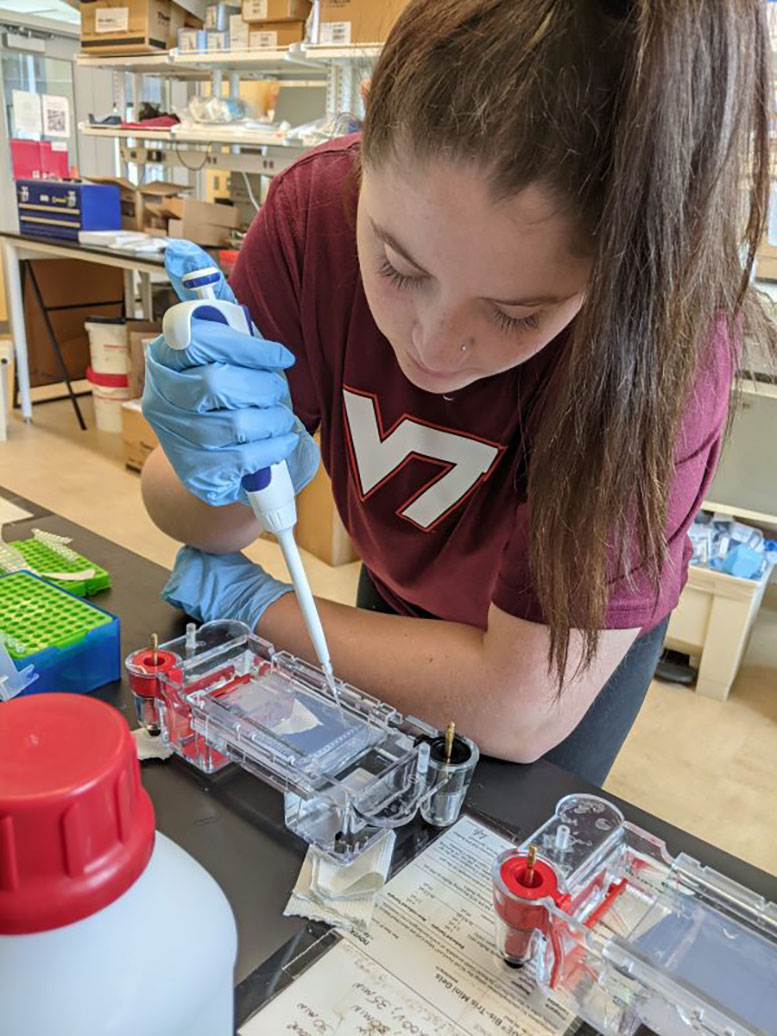
The team, led by Chenming “Mike” Zhang, professor and Turner Faculty Fellow in Virginia Tech’s Department of Biological Systems Engineering, developed a delivery system using biodegradable nanoparticles that resemble viruses in size and structure. College of Engineering undergraduate researcher Kari Cochran assisted with the work, which was supported by the National Institutes of Health.

The nanoparticles are coated with opioid molecules such as oxycodone or fentanyl. Their virus-like structure helps prompt the immune system to produce antibodies against the targeted drug.
“It’s similar to how we design vaccines for COVID-19 or influenza,” he said. “We want the body to recognize the drug as a threat and mount a defense.”
Antibodies are designed to block the high
Those antibodies are intended to prevent the targeted opioid from crossing the blood-brain barrier, limiting how much of the drug reaches the brain and blocking the euphoric effects associated with its use.
The vaccines are also designed to be highly specific. By targeting only the intended opioid molecule, the approach is meant to avoid interfering with other pain medications that a patient might need for medical treatment.
Early results suggest that antibody levels can remain effective for several months. Zhang hopes further optimization could eventually extend that protection to a full year.
The vaccine targets high-risk groups
The vaccines would not be intended for widespread use like a flu shot. Instead, researchers envision them for people with opioid use disorder or those at high risk of opioid exposure.
“Some of the oxycodone and fentanyl are so potent—you use it once or twice and you get hooked,” Zhang said. “If you can prevent people from getting hooked so quickly, that’s a big deal.”
Zhang also sees a potential role for vaccination among young people considered vulnerable to trying opioids.
“Some youth may be vulnerable to trying opioids,” Zhang said. “If they’re vaccinated, they won’t experience the high, which could deter future use.”

The vaccine would not stop drug use
The vaccine would not stop someone from taking an opioid. Instead, researchers hope that blocking the drug’s euphoric effects could reduce the desire for repeated use, lower the risk of accidental overdose, and help people with opioid use disorder become less reliant on the drugs.
It is not intended to be a standalone solution to the opioid crisis. Rather, the researchers see vaccination as another potential tool for addressing a public health problem in which overdose deaths in the United States exceed 100,000 each year.
Zhang argues that reducing those deaths could have benefits that extend beyond individual patients.
“Reducing overdose deaths would alleviate emotional trauma, lower medical costs, and improve workforce productivity,” said Zhang.
Reference: “Innate immune mechanisms underlying the efficacy of a next-generation nanoparticle-based vaccine against opioid use disorders” by Fatima A. Hamid, Kobra Rostamizadeh, Nicholas Skiados, Nguyet-Minh Nguyen Le, Debra L. Walter, Bryan Hannon, Courtney Marecki, Yuanzhi Bian, Diego Luengas, Chenming Zhang and Marco Pravetoni, 6 October 2025, Journal of Controlled Release.
DOI: 10.1016/j.jconrel.2025.114294
Never miss a breakthrough: Join the SciTechDaily newsletter.
Follow us on Google and Google News.