
A newly published study presents the most convincing evidence so far that abrupt climate change was instrumental in the development human evolution.
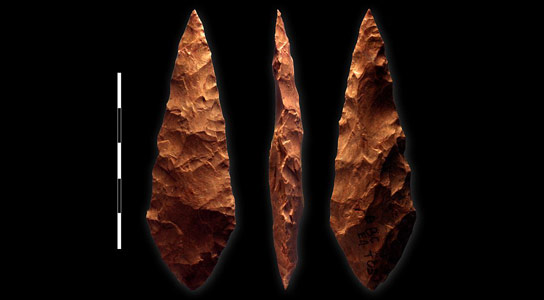
Rapid climate change during the Middle Stone Age, between 80,000 and 40,000 years ago, during the Middle Stone Age, sparked surges in cultural innovation in early modern human populations, according to new research.
The research, published in the journal Nature Communications, was conducted by a team of scientists from Cardiff University’s School of Earth and Ocean Sciences, the Natural History Museum in London, and the University of Barcelona.
The scientists studied a marine sediment core off the coast of South Africa and reconstructed terrestrial climate variability over the last 100,000 years.
Dr. Martin Ziegler, Cardiff University School of Earth and Ocean Sciences, said: “We found that South Africa experienced rapid climate transitions toward wetter conditions at times when the Northern Hemisphere experienced extremely cold conditions.”
These large Northern Hemisphere cooling events have previously been linked to a change in the Atlantic Ocean circulation that led to a reduced transport of warm water to the high latitudes in the North. In response to this Northern Hemisphere cooling, large parts of the sub-Saharan Africa experienced very dry conditions.
“Our new data, however, contrasts with sub-Saharan Africa and demonstrates that the South African climate responded in the opposite direction, with increasing rainfall, that can be associated with a globally occurring southward shift of the tropical monsoon belt.”
Linking climate change with human evolution
Professor Ian Hall, Cardiff University School of Earth and Ocean Sciences, said: “When the timing of these rapidly occurring wet pulses was compared with the archaeological datasets, we found remarkable coincidences.
“The occurrence of several major Middle Stone Age industries fell tightly together with the onset of periods with increased rainfall”
“Similarly, the disappearance of the industries appears to coincide with the transition to drier climatic conditions.”
Professor Chris Stringer of London’s Natural History Museum commented “The correspondence between climatic ameliorations and cultural innovations supports the view that population growth fueled cultural changes, through increased human interactions”.
The South African archaeological record is so important because it shows some of the oldest evidence for modern behavior in early humans. This includes the use of symbols, which has been linked to the development of complex language, and personal adornments made of seashells.
“The quality of the southern African data allowed us to make these correlations between climate and behavioral change, but it will require comparable data from other areas before we can say whether this region was uniquely important in the development of modern human culture” added Professor Stringer.
The new study presents the most convincing evidence so far that abrupt climate change was instrumental in this development.
Reference: “Development of Middle Stone Age innovation linked to rapid climate change” by Martin Ziegler, Margit H. Simon, Ian R. Hall, Stephen Barker, Chris Stringer and Rainer Zahn, 21 May 2013, Nature Communications.
DOI: 10.1038/ncomms2897
The research was supported by the UK Natural Environment Research Council and is part of the international Gateways training network, funded by the 7th Framework Program of the European Union.
Never miss a breakthrough: Join the SciTechDaily newsletter.
Follow us on Google and Google News.
2 Comments
I always wondered what caused climate change before humans, as if it never happened before we walked the earth.
Thanks for sharing this. I was also thinking the same thing with you Chris. I wonder when there was a change in our climate and when did this start?