
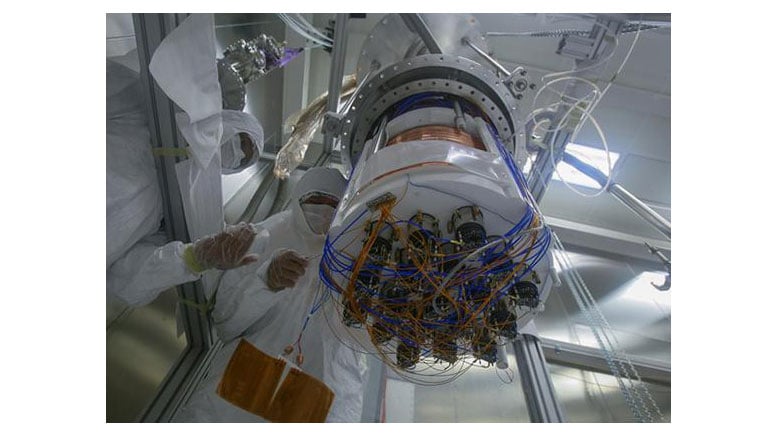
University of Houston scientists are helping to develop a technology that could hold the key to unraveling one of the great mysteries of science: what constitutes dark matter? Scientists believe dark matter makes up 85 percent of the matter in the universe, but nobody actually knows what dark matter is.
“If we are the experiment that finds dark matter, we can change the fundamental understanding of the universe as we know it,” said UH assistant professor Andrew Renshaw. “We can really start to understand the fundamental properties of the universe – how we got from the big bang to where we are, and what the future holds.”
Renshaw and professor Ed Hungerford are leading a team of physicists from the College of Natural Sciences and Mathematics in the DarkSide program, an international research collaboration seeking to detect dark matter in the form of weakly interacting massive particles (WIMPs). In principle, when WIMP particles collide with ordinary nuclei, extremely small, low-energy nuclear recoil would result. In very simple terms, the scientists are trying to build technology that can detect WIMPS by detecting this very tiny, but observable recoil.
The UH team is using the DarkSide program’s first physics detector, DarkSide-50 (DS-50), located underground at the Gran Sasso National Laboratory in Central Italy. The team and their collaborators have improved the sensitivity of the DS-50 detector in recent years by switching from atmospheric argon to low-radioactivity liquid argon, which was extracted from underground gas wells in Colorado. But a next-generation detector in development will take it even further.
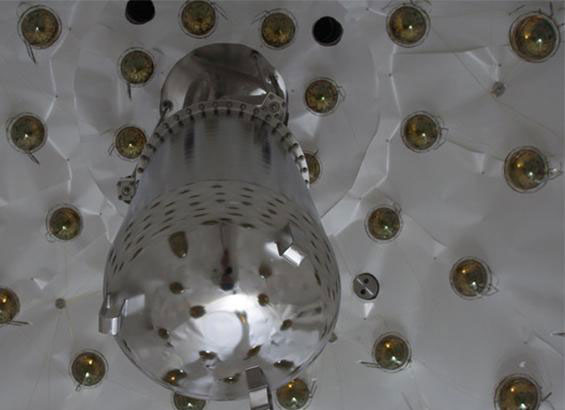
DarkSide-20k (DS-20k) is currently being constructed using similar components from the present DarkSide experiment. Whereas DS-50 holds about 9.5 gallons (50 kilograms) of low-radioactivity liquid argon, this new detector, DS-20k, will employ new readout technology and will be some 400 times larger, holding 3,800 gallons (20,000 kilograms) of liquid argon. The new experiment is expected to start acquiring data at the Gran Sasso National Laboratory in 2021.
This detector, said Hungerford, will push the search for WIMP dark matter to new levels of sensitivity, hopefully finding the elusive WIMP. Or, he said, it could demonstrate that dark matter is not a particle, since this technology has now proven capable of searching for types of dark matter other than WIMPs.
“Previously, if you wanted to look for a specific kind of dark matter, you really had to look for a specific kind of detector. Now with this liquid argon technology, it’s really opening the door to using a single technology to search for a handful of different kinds of dark matter,” added Renshaw, who recently presented DarkSide findings at the UCLA Dark Matter Conference.
While Hungerford and Renshaw continue their research in Houston, three other members of the UH team are manning the day-to-day operations in Italy. Research associate Nicola Canci manages the DS-50 detector and monitors its performance.
“The cryogenic system keeping the argon in liquid phase needs to be monitored, and some operations are needed to allow for the good performances of the detector. Electronics are monitored. Signals coming from the detector are improved, if needed, and the quality of data is routinely checked,” Canci said.
UH’s participation in the DarkSide collaboration is funded by an annual $200,000 grant from the National Science Foundation.
Never miss a breakthrough: Join the SciTechDaily newsletter.
Follow us on Google and Google News.
2 Comments
RUNII: No SUSY, No WIMP, No HIGGS, No HEW PHYSICS?
“Whether politicians and taxpayers will be up for this remains to be seen. That fundamental physics has got as far as it has is, essentially, a legacy of its delivery to political leaders of the mid-20th century of the atom and hydrogen bombs. The consequence of this was that physicists were able to ask for expensive toys—for who knew what else they might come up with. That legacy has now been spent, though, and any privilege physics once had has evaporated. This risks leaving in permanent limbo not only the GUTs and their brethren, but also the sceptical idea of Dr Hossenfelder that the Standard Model really is all there is. And that would surely be the most depressing result of all.”?
wat cha gunna duu wensya’s find out entire worlds and massive civilizations exist and sum may not bee peaceful