
Engineers have created innovative materials that pull drinking water from the air, including a water-harvesting jacket and a record-setting collection system.
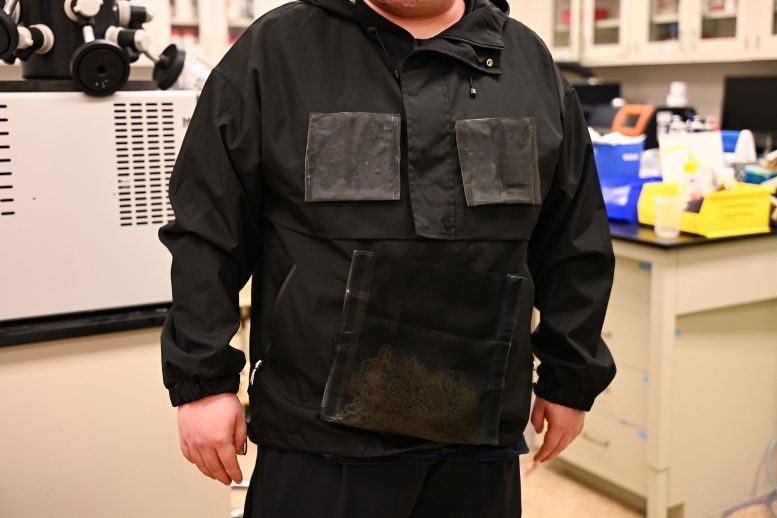
Engineers at the University of Texas at Austin have created a jacket that can generate drinking water from moisture in the air. The innovation could help people who spend long periods in places where clean water is difficult to access, including hikers, campers, runners, farm workers, emergency responders, and military personnel.
“Water harvesting from air is usually imagined as a stationary device such as a box, a panel, or a large sorbent bed,” said Guihua Yu, chair professor of the Cockrell School of Engineering’s Walker Department of Mechanical Engineering and Texas Materials Institute and one of the leaders of the new research in Science Advances. “Here, we wanted to rethink the form of the technology. If the fabric itself can collect water from air, it opens a new direction for personal and portable water access.”
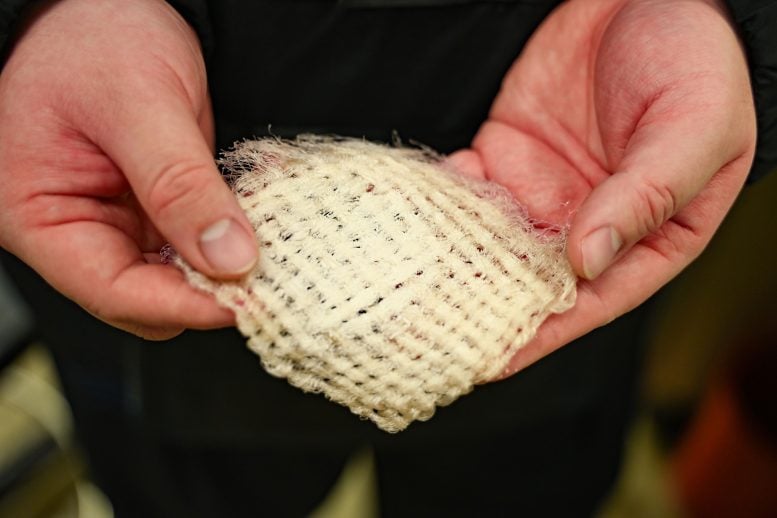
The jacket contains a specialized textile that captures moisture from the atmosphere and directs it into detachable collection units. These units are then placed inside a foldable collector and heated to release the water.
Depending on humidity conditions, the jacket produced between 400 and 900 milliliters (14 to 30 fluid ounces) of drinkable water per day.
High-Performance Moisture Collection Fabric
Compared with existing water harvesting materials, the textile delivered a threefold to tenfold improvement in large-scale performance. Instead of creating another bulky water collection device, the team focused on improving how water moves through the fibers, addressing a longstanding challenge in the field.
“The important advance here is that the team did not simply make another material that absorbs water,” said Keith Johnston, co-author and chair professor of the Cockrell School of Engineering’s McKetta Department of Chemical Engineering. “They designed a pathway for water to move quickly, from vapor in the air, to liquid on the fiber surface, and then into the textile. That transport design is what allows the material to work not just in a small lab test, but in a wearable system.”
The researchers believe the technology could be used in products beyond clothing, including backpacks, tents, emergency shelters, and other outdoor equipment. Future work will focus on applications for recreation, remote field operations, disaster response, and improving water access in dry or infrastructure-limited regions.
Record-Breaking Water Extraction Device
The wearable textile was developed alongside a separate system from the same research team that achieved record levels of atmospheric water collection in both the hot, dry conditions of New Mexico’s Chihuahuan Desert and the more humid climate of Austin. The results highlight the practical potential of using moisture from the air to help address drinking water shortages.
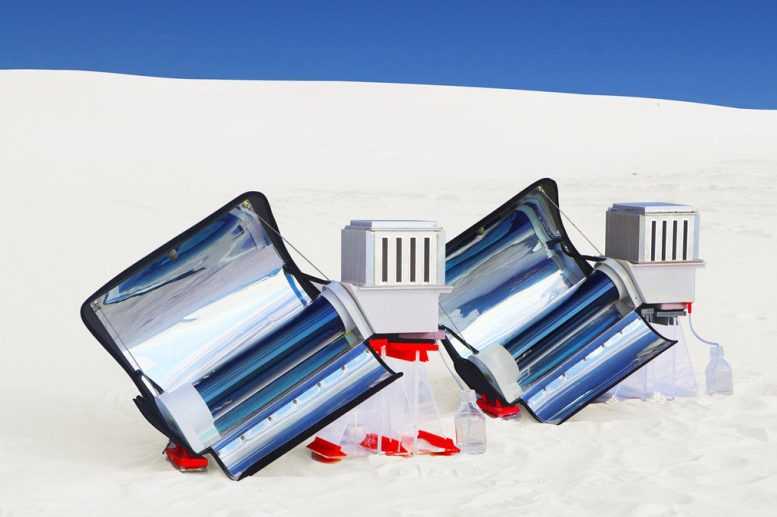
During testing, the device collected 1.3 liters (44 fluid ounces) of clean water per day in both arid and semi-humid environments. That performance equals 4.3 liters (1.1 gallons) of water per kilogram (2.2 pounds) of moisture-capturing material each day, surpassing previous results reported by other research groups.
“This is a big stride toward practical atmospheric water harvesting,” said Weixin Guan, one of the lead authors of a new paper published in Nature Water. “This goal has been incubated over years of work, from molecular design to real-world operation, and it is especially meaningful to see those pieces finally come together in a field-ready system.”
Hydrogel Technology for Water-Stressed Regions
At the heart of the device is a specially engineered hydrogel fabric made from biomass-derived materials. The material absorbs water vapor from the air and releases it when warmed by sunlight, allowing the moisture to be condensed and collected as liquid water.
Many of the areas where the technology is expected to perform best are also among the world’s most water-stressed regions, including parts of North Africa, the Middle East, South Asia, and sub-Saharan Africa. As a result, the system could provide a decentralized source of drinking water for remote communities, disaster response efforts, and other locations where traditional water infrastructure is difficult to build or maintain.
References:
“Scalable hierarchical textile fibers toward personalized wearable atmospheric water harvesting” by Chuxin Lei, Yongzheng Zhang, Lu He, Yuyang Wang, Juan Wu, Weixin Guan, Yaxuan Zhao, Qiang Fu, Keith P. Johnston, Kai Wu and Guihua Yu, 10 June 2026, Science Advances.
DOI: 10.1126/sciadv.aed9949
“Field‑portable, solar‑powered, litre-scale atmospheric water harvesting across climates with gel fabric architecture” by Weixin Guan, Yaxuan Zhao, He Shan, Yan Zhe Wong, Chuxin Lei, Debapriyo Roy, Yuyang Wang, Xiaomeng Liu, Ghim Wei Ho, Keith P. Johnston and Guihua Yu, 9 June 2026, Nature Water.
DOI: 10.1038/s44221-026-00645-6
Never miss a breakthrough: Join the SciTechDaily newsletter.
Follow us on Google and Google News.
6 Comments
Who’s gonna wear a black jacket in Chihuahua? Maybe it’s duskwear, but still.
“You’ve worn a stillsuit before,” the Fremen ecologist Kynes says.“Your desert boots are fitted slip-fashion at the ankles. Who taught you how to do that?” Paul casually replies, “It seemed the right way.”
THANK YOU!!! Was hoping to see SOMEONE… ANYONE reference Dune.
What is an ounce?
A unit of measurement in the imperial system.
How does it pull water from the air and not off of your body?
How do you know your not drinking
your own sweat ?