
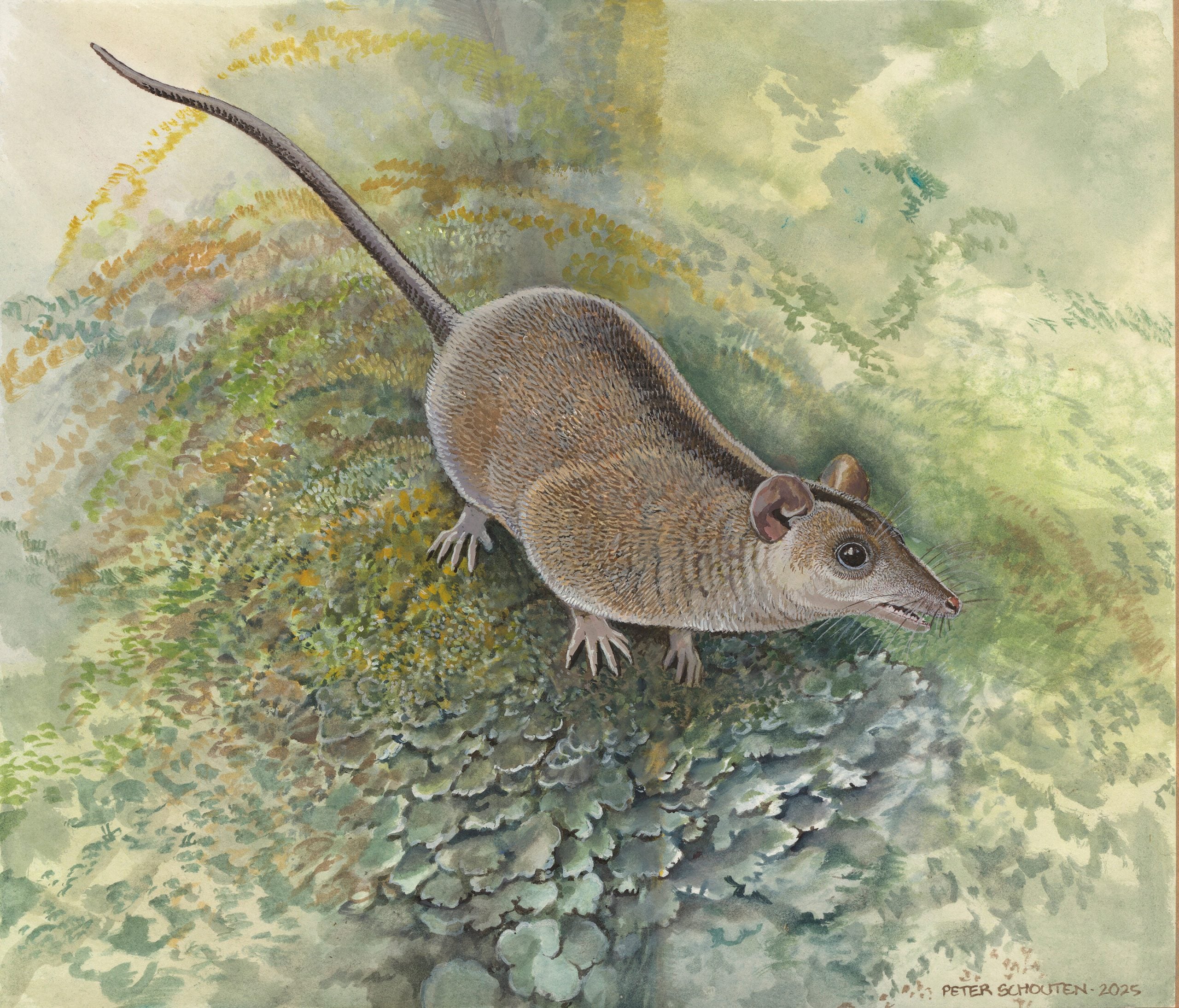
The discovery of a new branch on the marsupial family tree suggests that the history of Australia’s unique mammals is more complex and less understood than previously thought.
Since marsupials reached Australia more than 55 million years ago, they have diversified into almost every kind of habitat and ecological role imaginable.
Today, they range from the High Country, home to (thumb-sized possums that sleep through the winter), to the Red Center, where (little moles with pink hair and no eyes that live underground) live below the surface. In all, Australia has about 160 marsupial species, each shaped by the demands of its environment.
Yet their early history remains difficult to trace. Major gaps in the fossil record have hidden tens of millions of years of marsupial evolution, leaving scientists unsure exactly how these animals spread and diversified across the continent.
Fossils reveal a missing branch
A new paper published in the Journal of Paleontology now offers a rare look into that missing history. UNSW scientists have described three new species that may point to an ancient and previously unknown order of marsupials, giving researchers fresh evidence from the early stages of marsupial evolution in Australia.
“Not only is it a new order, it could also be the most ancient lineage of all Australian marsupials,” says UNSW paleontologist Dr Tim Churchill.
“It may be the early ancestor of all our marsupial carnivores.”
Ancient Australia was changing
The standard explanation is that marsupials reached Australia from South America by crossing Antarctica before the breakup of Gondwana.
The details are still uncertain. Fossils dating to about 55 million years ago suggest that Australian marsupials may have come from a single lineage that later branched into the marsupial orders alive today.
Those orders are grouped within the superorder Australidelphia, which includes all living and extinct Australian marsupials, along with (and one South American).
Dr. Churchill is now proposing a sixth order, Keeunamorphia, which he says survived for about 35 million years.
These animals were probably small insect eaters weighing about (25-200 grams). They lived in the forests of what is now north Queensland before disappearing around 15 million years ago.
That part of Queensland is now open, dry country with rough grass and scattered trees. At the time, however, it was a wet rainforest filled with the ancestors of many species still living today.
“Around 14 million years ago is when the region starts to cool again,” Dr. Churchill says.
“The dense forest disappears and becomes more open woodland, with more lakes and more grasslands.”
Teeth redraw the family tree
The three Keeunamorphia species described by Dr. Churchill died about 18 million years ago. Their remains were washed into shallow cave pools and partly preserved at Riversleigh World Heritage Area, now regarded as one of the world’s richest fossil sites.
Complete skeletons are uncommon, so Dr. Churchill and his colleagues relied on teeth and pieces of jaw. From those small fragments, they worked to understand where the animals fit in the marsupial family tree.
The group combined fossil evidence with genetic data from living species to create a phylogenetic tree. This type of model shows how species are related and estimates when different lineages split from one another.
“We’re essentially trying to create a tree that shows both the relationships of all the different species in the tree, while also calculating when those branches probably diverged,” Dr. Churchill says.
The analysis showed that these three species lived alongside several previously known marsupials, but their teeth stood apart. They did not seem closely related to the other animals known from the same period.
Their teeth closely resembled those of Djarthia murgonensis, an extinct marsupial that lived 35 million years earlier and is often treated as a prototype for Australian marsupials.
Dr. Churchill says the evidence points to a separate marsupial lineage that science had not recognized before, one that branched off early and persisted for millions of years.
“Whatever these things were, they seemed to be primitive compared to other marsupials at the time, and they seem to have been doing their own thing and surviving well enough alongside them,” says Dr. Churchill.
Phylogenetic trees often support the idea of one early group giving rise to the marsupials seen today, but the fossil record tells a less straightforward story.
Evolution looks less tidy
Dr. Churchill says the earliest members of Keeunamorphia lived soon after marsupials first arrived from Antarctica about 55 million years ago.
The UNSW group thinks Keeunamorphia may have been among the first marsupial orders to split from the main evolutionary trunk. If so, it complicates the simple version of how Australian marsupials evolved.
A major question remains: if this primitive, ancestral marsupial separated so early, how did it remain relatively unchanged for so long?
“Evolutionary history is a lot more complex than just one group leading to all of Australia’s marsupials after being left behind when the continent broke off from Antarctica,” says Dr. Churchill.
“It’s more likely that when Australia was part of Gondwana it was swarming with all sorts of bizarre, primitive marsupial-like things, and that several of them survived and led to our modern lineages”
Much of that ancient diversity may still be invisible, hidden within a nearly 20-million-year gap in the fossil record.
The species may have shared one common ancestor, but they could also descend from several different lineages that became isolated in Australia as the continents separated.
Scientists may never be able to reconstruct every route taken by Australia’s early marsupials. But each tooth recovered from ancient deposits adds another detail to a story that is becoming more complex, and more revealing.
Reference: “A new metatherian order from Australia (Keeunamorphia, Metatheria), and new Early Miocene species from the Riversleigh World Heritage Area, northwestern Queensland” by Timothy James Churchill, Michael Archer, Suzanne J. Hand and Robin M. D. Beck, 14 June 2026, Journal of Paleontology.
DOI: 10.1017/jpa.2026.10238
Never miss a breakthrough: Join the SciTechDaily newsletter.
Follow us on Google and Google News.