
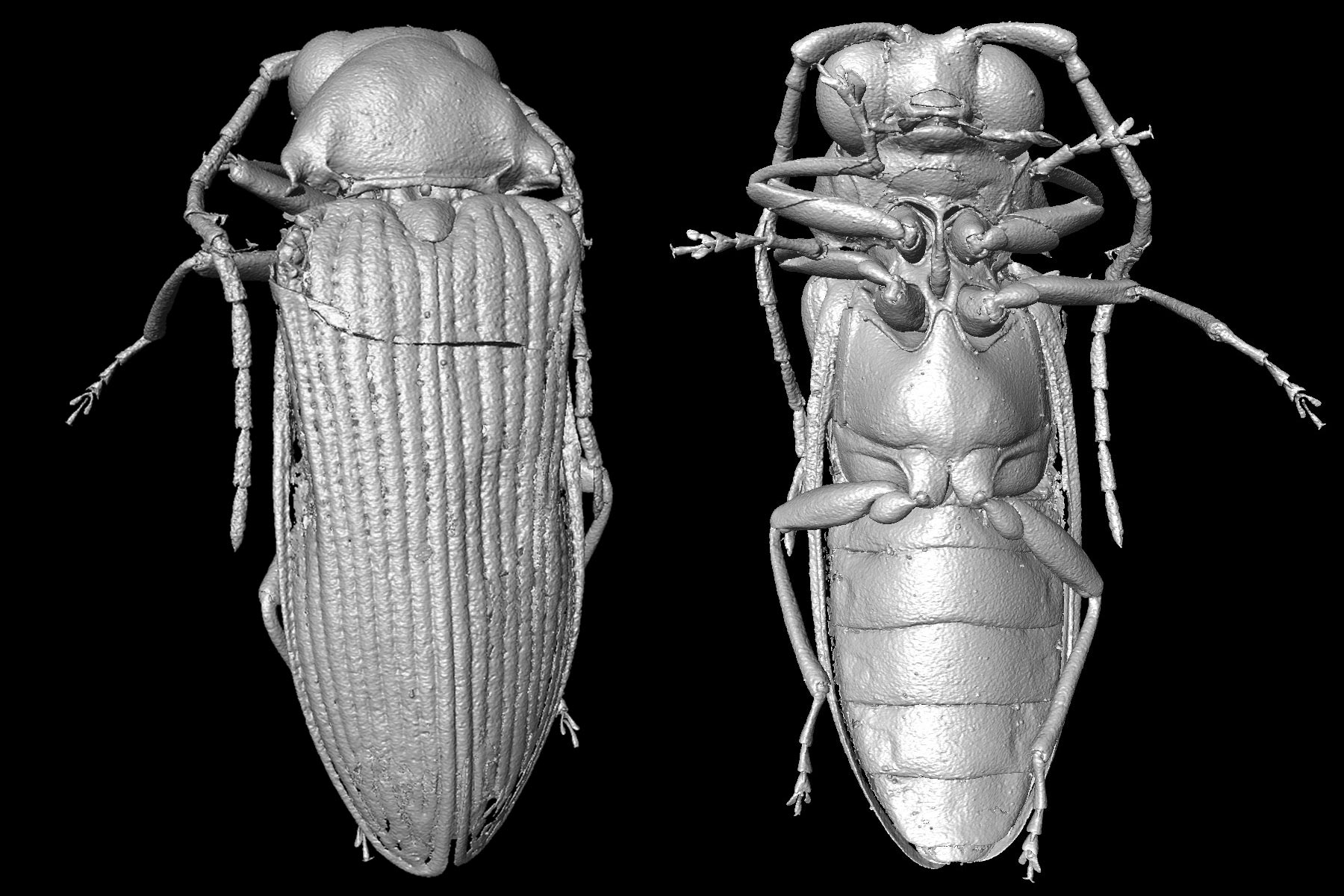
International research team gains new insights into the evolution of fossil beetles.
About a year ago, researchers found fossil specimens of beetles in an amber deposit in Myanmar, thereby describing a new beetle family that lived about 99 million years ago. However, the scientists had not been able to fully describe the morphology of the insects in the amber sample, which is why the beetles were subsequently given the mysterious name Mysteriomorphidae. An international research team led by the University of Bonn and Palacky University (Czech Republic) has now examined four newly found specimens of the Mysteriomorphidae using computer tomography and has been able to reconstruct them. The results allow to draw conclusions about the evolution of the species during the Cretaceous period. The study has been published in the journal Scientific Reports.
Small creatures enclosed in amber can provide scientists with important information about past times, some of which date back many millions of years. In January 2019, the Spanish paleontologist Dr. David Peris, one of the two main authors of the study, collected several amber samples from the northern state of Kachin in Myanmar during a scientific trip to China and found beetle specimens from the same group as the Mysteriomorphidae.
Some of the newly found specimens showed a very good state of preservation – a good prerequisite for David Peris and his colleagues to carry out a virtual reconstruction of one of the beetles using computer tomography (CT scan). The technique used in paleontology allows researchers to study many small features of the fossils – even internal structures such as genitalia, if preserved.
While David Peris and his colleagues started to study and describe the morphology, i.e. the outer shape of the beetles, another research group also described the new family of Mysteriomorphidae by means of further specimens, that also came from the amber deposit in Myanmar. “However, the first study left some open questions about the classification of these fossils which had to be answered. We used the opportunity to pursue these questions with new technologies,” explains David Peris, researcher now at the Institute for Geosciences and Meteorology at the University of Bonn.
“We used the morphology to better define the placement of the beetles and discovered that they were very closely related to Elateridae, a current family,” explains Dr. Robin Kundrata from Palacky University, the second main author of the study and also an expert on this group of beetles. The scientists discovered important diagnostic characteristics that these beetle lineages share on mouthparts, thorax and abdomen.
Analysis of the evolution of beetles
Apart from the morphology, the researchers also analyzed the evolutionary history of the beetles. Earlier models had suggested that the beetles had a low extinction rate throughout their long evolutionary history, even during the Cretaceous period. However, the researchers provided a list of fossil groups of beetles described from the Cretaceous amber findings that, as Mysteriomorphidae, are only known as fossils from that time and had not survived the end of the Cretaceous period.
Background: During the Cretaceous period, flowering plants spread all over the world, replacing the old plants in the changing environment. This distribution of plants was connected with new possibilities for many associated animals and also with the development of new living beings, for example pollinators of flowers. However, most previous theories had not described that the animal species that were previously well adapted to the old plants were under pressure to adapt to the new resources and possibly became extinct. “Our results support the hypothesis that beetles, but perhaps some other groups of insects, suffered a decrease in their diversity during the time of plant revolution,” states David Peris.
Reference:
“Unlocking the mystery of the mid-Cretaceous Mysteriomorphidae (Coleoptera: Elateroidea) and modalities in transiting from gymnosperms to angiosperms” by David Peris, Robin Kundrata, Xavier Delclòs, Bastian Mähler, Michael A. Ivie, Jes Rust and Conrad C. Labandeira, 8 October 2020, Scientific Reports.
DOI: 10.1038/s41598-020-73724-7
Institutions involved and funding:
In addition to the University of Bonn (Germany) and Palacky University (Czech Republic), the study involved the University of Barcelona (Spain), the Montana State University, and the Smithsonian Institution (USA).
The study received financial support from the Alexander von Humboldt Foundation, the Spanish Ministry of Science, Innovation and Universities, and the “Strategic Priority Research Program” of the Chinese Academy of Sciences.
Never miss a breakthrough: Join the SciTechDaily newsletter.
Follow us on Google and Google News.
1 Comment
Very Interesting.
Hope Scientists can trace the Geenology of modern day beetles as well as other insects and creatures which keep us healthy by pollination, and performing many tasks , without which we would be dead in a few months. There are such creatures, which also cause the spread of dreaded known and unknown Diseaes, gobble up our food sources (Vegetarian Plant Based) and cause health problems and keep our medical professionals and medical persons busy.
In the case of the pandemic (seems to be repeated every 100 years) we turn the Medical Professionals into Heroes and sacrifice them to Protect our lives and continue to conume harmful foods. These insects, can be monitored much more closely and their abilities and capabilities should not be underestimated asbwel as their evolution from ancient times.
We need to respect the sanctity of all the creations of Nature and not treat them as future sources of Protiens and Food for Humans. Saw a article from some German authors some time back, suggesting this could be a food source and a possible solution for a population of ten billion humans on earth.
Saw another video which showed locals in a unnamed SouthEast Asian, showing the capture of Locusts and sale of dead Locusts in local markets to create a meal out of them. There is no need for such food chains today or for the future, if we can ensure that we keep the planet healthy for all of Mother Natures Creations rather than think it is our birthright to consume all these creatures. Technology can be a game changer.
On a lightr note, a dear friend of mine (Non-Vegetarian) used to tell me at weddings where we met, ” I only eat food which is alive and moves around. I smack it, cook it and add salt and masala and eat it”.
Wonder , if these are heathy habits, given that we are completely unaware of the Viruses , bacteria and pathogens , whch may be an integral part of their ecosystems and may survive the cooking! Doctors of the World , time to wake up and guide humanity towards healthy eating habits and ensure survival of the Human race. These are not radical views or any attempt to change the food habits of people across the Globe. It s just a common sense approach and suggestion that prevention is better than cure.