
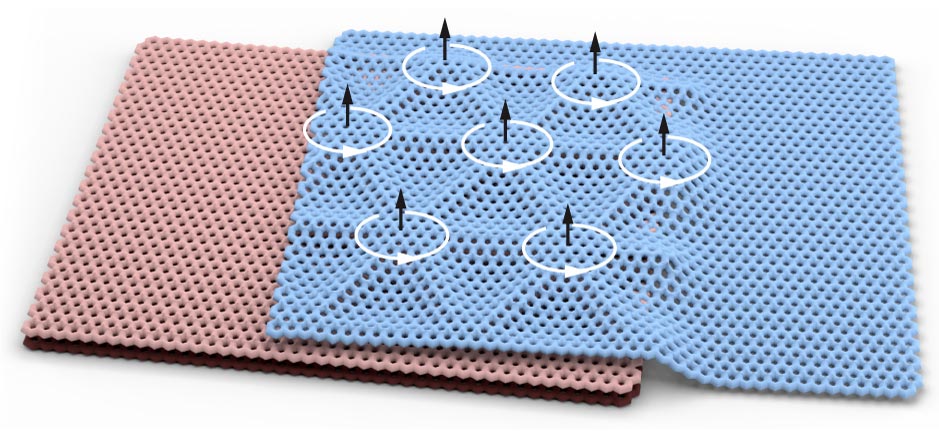
Twisting a monolayer and a bilayer sheet of graphene into a three-layer structure leads to new quantum mechanical states.
Since the discovery of graphene more than 15 years ago, researchers have been in a global race to unlock its unique properties. Not only is graphene—a one-atom-thick sheet of carbon arranged in a hexagonal lattice—the strongest, thinnest material known to man, it is also an excellent conductor of heat and electricity.
Now, a team of researchers at Columbia University and the University of Washington has discovered that a variety of exotic electronic states, including a rare form of magnetism, can arise in a three-layer graphene structure.
The findings appear in an article published on October 12, 2020, in Nature Physics.
The work was inspired by recent studies of twisted monolayers or twisted bilayers of graphene, comprising either two or four total sheets. These materials were found to host an array of unusual electronic states driven by strong interactions between electrons.
“We wondered what would happen if we combined graphene monolayers and bilayers into a twisted three-layer system,” said Cory Dean, a professor of physics at Columbia University and one of the paper’s senior authors. “We found that varying the number of graphene layers endows these composite materials with some exciting new properties that had not been seen before.”
In addition to Dean, Assistant Professor Matthew Yankowitz and Professor Xiaodong Xu, both in the departments of physics and materials science and engineering at University of Washington, are senior authors on the work. Columbia graduate student Shaowen Chen, and University of Washington graduate student Minhao He are the paper’s co-lead authors.
To conduct their experiment, the researchers stacked a monolayer sheet of graphene onto a bilayer sheet and twisted them by about 1 degree. At temperatures a few degrees over absolute zero, the team observed an array of insulating states—which do not conduct electricity—driven by strong interactions between electrons. They also found that these states could be controlled by applying an electric field across the graphene sheets.
“We learned that the direction of an applied electric field matters a lot,” said Yankowitz, who is also a former postdoctoral researcher in Dean’s group.
When the researchers pointed the electric field toward the monolayer graphene sheet, the system resembled twisted bilayer graphene. But when they flipped the direction of the electric field and pointed it toward the bilayer graphene sheet, it mimicked twisted double bilayer graphene—the four-layer structure.
The team also discovered new magnetic states in the system. Unlike conventional magnets, which are driven by a quantum mechanical property of electrons called “spin,” a collective swirling motion of the electrons in the team’s three-layer structure underlies the magnetism, they observed.
This form of magnetism was discovered recently by other researchers in various structures of graphene resting on crystals of boron nitride. The team has now demonstrated that it can also be observed in a simpler system constructed entirely with graphene.
“Pure carbon is not magnetic,” said Yankowitz. “Remarkably, we can engineer this property by arranging our three graphene sheets at just the right twist angles.”
In addition to the magnetism, the study uncovered signs of topology in the structure. Akin to tying different types of knots in a rope, the topological properties of the material may lead to new forms of information storage, which “may be a platform for quantum computation or new types of energy-efficient data storage applications,” Xu said.
For now, they are working on experiments to further understand the fundamental properties of the new states they discovered in this platform. “This is really just the beginning,” said Yankowitz.
Reference: “Electrically tunable correlated and topological states in twisted monolayer–bilayer graphene” by Shaowen Chen, Minhao He, Ya-Hui Zhang, Valerie Hsieh, Zaiyao Fei, K. Watanabe, T. Taniguchi, David H. Cobden, Xiaodong Xu, Cory R. Dean and Matthew Yankowitz, 12 October 2020, Nature Physics.
DOI: 10.1038/s41567-020-01062-6
The study, “Electrically tunable correlated and topological states in twisted monolayer-bilayer graphene,” was developed with support from Programmable Quantum Materials, an Energy Frontier Research Center funded by the United States Department of Energy (DOE), Office of Science and Basic Energy Sciences.
Never miss a breakthrough: Join the SciTechDaily newsletter.
Follow us on Google and Google News.
1 Comment
Could an application of this nature be used to assist in increasing the decay process of radioactive material? And also be an application to harness the energy of said?