
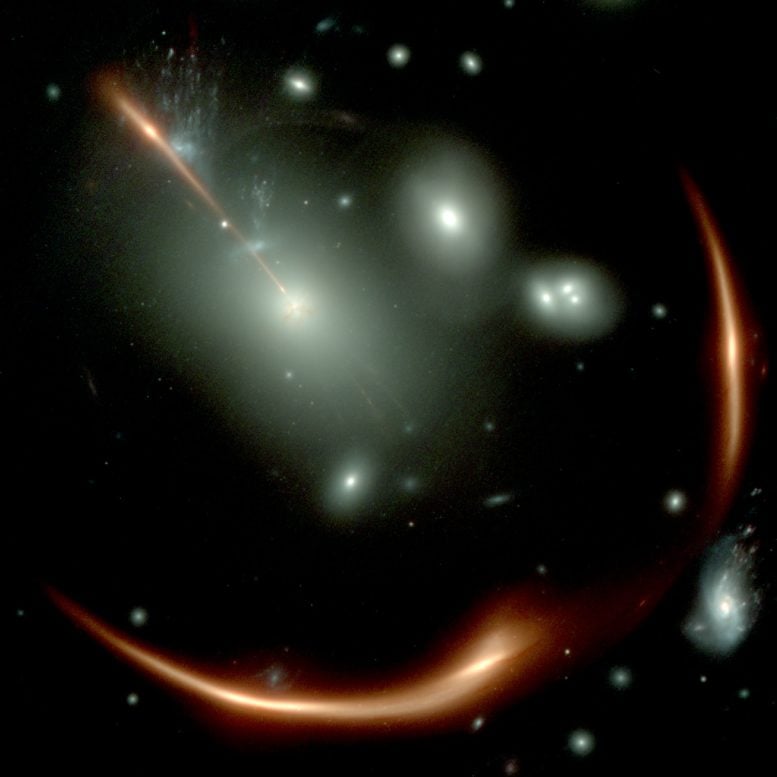
Researchers have identified the most distant dormant black hole known, dating back to the universe’s early history.
Astronomers have long relied on brilliant quasars, supermassive black holes actively feeding on surrounding matter, to study the early universe. Yet these luminous objects reveal only part of the story. Now, researchers have detected the most distant dormant black hole ever found, offering a rare look at a giant cosmic object that has gone quiet.
The international team, including scientists from UCL, identified the black hole in the galaxy MRG-M0138, located more than 10 billion light-years from Earth. The discovery, published in Science, shatters the previous distance record for a dormant black hole by a factor of 15.
With a mass roughly 6 billion times that of the Sun, the black hole is being observed at a time when the universe was just 3 billion years old. Its existence provides an unprecedented opportunity to investigate how massive black holes and their host galaxies evolved during the universe’s formative years.
To determine its mass, researchers used observations from NASA’s James Webb Space Telescope (JWST) to track the movements of stars orbiting the otherwise invisible object. Although this method, known as stellar dynamics, has been used to measure dormant black holes in much closer galaxies, this is the first time it has been successfully applied at such a vast (cosmological) distance.
Senior Author, Professor Richard Ellis (UCL Physics & Astronomy) said: “Determining how stars collectively move within the core of this distant galaxy has allowed us to measure the mass of its otherwise undetectable supermassive black hole. By demonstrating the feasibility of such a technique for galaxies in the early universe, we can now undertake a more complete census of how black holes develop over time and infer their role in shaping galaxy evolution.”
How Astronomers Weighed an Invisible Black Hole
Black holes do not emit light themselves, but gas falling into them can release enormous amounts of radiation. These bright objects, known as active galactic nuclei or quasars, are among the most luminous phenomena in the universe and are relatively easy to spot.
The supermassive black hole in MRG-M0138, however, is inactive. Because no gas is currently falling into it, astronomers could detect it only through its gravitational influence on nearby stars.
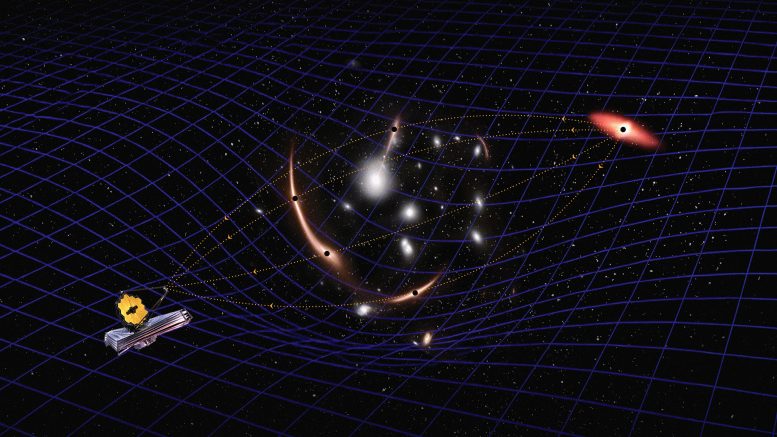
By measuring the combined motions of stars orbiting the galaxy’s center, the team was able to confirm the black hole’s presence and calculate its mass. Differences in the speeds of stars near the black hole compared with those farther away provided the data needed for the measurement.
This approach is similar to methods used to determine the mass of the black hole at the center of our own galaxy, the Milky Way, as well as those in several nearby galaxies. However, this is the first time it has been applied to an object at such an extreme distance. Previously, the farthest galaxy studied using this technique was about 700 million light-years away.
Gravitational Lensing Enables Historic Measurement
Normally, observing stellar motions in a galaxy this distant would be impossible. The researchers overcame this challenge by taking advantage of gravitational lensing, a natural cosmic magnification effect.
A second galaxy positioned between Earth and MRG-M0138 bends and refocuses the distant galaxy’s light, enlarging its image by a factor of 30. This magnification allowed the team to reconstruct the galaxy’s internal structure at a level of detail that would otherwise be unreachable.
Lead author Dr. Andrew Newman of the Carnegie Science in Pasadena, California, said: “By combining JWST data with gravitational lensing, we could peer inside the black hole’s sphere of influence, where its gravity boosts the speeds of stars. This is one of the best techniques we have to weigh a black hole, so we were excited to extend it to a much earlier period in cosmic history.”
Only a handful of dormant black holes of this size have been identified before, and all were much closer to Earth.
What the Discovery Reveals About Galaxy Evolution
The finding provides important clues about how galaxies and their central black holes evolved together in the early universe. Observations of nearby galaxies have revealed a strong link between galaxy mass and black hole mass, but researchers need more data from earlier periods of cosmic history to understand how that relationship developed.
The team found that both the black hole and its host galaxy are dormant. The galaxy is no longer producing new stars, suggesting that MRG-M0138 may once have contained a bright quasar. Researchers believe that as the black hole rapidly grew, the energy it released either heated or expelled the gas needed to form new stars, effectively shutting down star formation.
Scientists expect future observations with JWST and other space telescopes to uncover many more dormant black holes from the early universe. These discoveries could reveal more about how black holes suppress star formation and how dormant black holes can become active again when fresh material begins flowing into them.
Reference: “A stellar dynamical mass measurement of an inactive black hole at redshift 2” by Andrew B. Newman, Meng Gu, Sirio Belli, Richard S. Ellis, Sai Gangula, Jenny E. Greene, Jonelle L. Walsh, Sherry H. Suyu, Sebastian Ertl, Gabriel Caminha, Giovanni Granata, Claudio Grillo, Stefan Schuldt, Tania M. Barone, Simeon Bird, Karl Glazebrook, Marziye Jafariyazani, Mariska Kriek, Allison Matthews, Takahiro Morishita, Themiya Nanayakkara, Justin D. R. Pierel, Ana Acebrón, Pietro Bergamini, Sangjun Cha, Jose M. Diego, Nicholas Foo, Brenda Frye, Yoshinobu Fudamoto, M. James Jee, Patrick S. Kamieneski, Anton M. Koekemoer, Asish K. Meena, Shun Nishida, Masamune Oguri, Piero Rosati and Adi Zitrin, 4 June 2026, Science.
DOI: 10.1126/science.adx5816
Never miss a breakthrough: Join the SciTechDaily newsletter.
Follow us on Google and Google News.
1 Comment
B Memo 2606231300_Source1.Reinterpretation【()】
Source1.
https://scitechdaily.com/astronomers-discover-a-sleeping-giant-ancient-black-hole-6-billion-times-the-suns-mass/
1.
_Astronomers have discovered a sleeping giant: an ancient black hole reaching 6 billion times the mass of the Sun.
_This is an image of the severely distorted red galaxy MRG-M0138 seen through the galaxy cluster in the foreground (white area), taken by the James Webb Space Telescope (JWST). Due to gravitational lensing, the same background galaxy appears four times in multiple images.
=========
【&&&&&c1.() There are countless giant msbase.galaxys in the universe. Within these massive galaxies and galaxy clusters, there are many black hole vixers, but there are also some equivalent to trillions of solar masses. This means that the universe is one where ordinary matter elements exist infinitely.
>>>>However, going further, the dark galaxies in the dark matter system that absorbed msbase (sample4.msoss) are infinitely heavy. In such a universe, a 6 billion solar mass is nothing more than a piece of chewing gum. Hehe. This is fun!! 1310.14.
sample4.msoss(standard)
zxdxybzyz
zxdzxezxz
xxbyyxzz
zybzzfxzy
cadccbcdc
cdbdcbdbb
xzezxdyyx
zxezybzyy
bddbcbdca
】
_The research team has discovered the most distant dormant black hole known to date, dating back to the early universe.
Astronomers have long studied the early universe using bright quasars, which are supermassive black holes that actively absorb surrounding matter. However, these bright objects reveal only a part of the universe. Recently, a research team discovered the most distant dormant black hole found to date, providing a rare opportunity to observe a massive cosmic object that has ceased activity in detail.
1-1.
An international research team, including scientists from UCL, discovered a black hole in the galaxy MRG-M0138, located more than 10 billion light-years from Earth. This discovery, published in the scientific journal Science, broke the previous record for the distance to a dormant black hole by 15 times.
This black hole, with a mass approximately 6 billion times that of the Sun, was observed when the universe was only 3 billion years old. The existence of this black hole offers an unprecedented opportunity to study how massive black holes and their surrounding galaxies evolved during the early stages of the universe’s formation.
1-2. To measure the mass of the black hole, the research team utilized observational data from NASA’s James Webb Space Telescope (JWST) to track the movement of stars orbiting the black hole. This method, known as stellar dynamics, has been used to measure the mass of dormant black holes in much closer galaxies, but this marks the first time it has been successfully applied to a black hole at such a vast (cosmological) distance.
“By collectively understanding how stars move at the center of this distant galaxy, we were able to measure the mass of a supermassive black hole that was previously unobservable,” said lead author Professor Richard Ellis (UCL Physics and Astronomy).
“By demonstrating that this technique can be applied to galaxies in the early universe, we can now conduct a more complete investigation into how black holes develop over time and infer the role they play in galactic evolution,” he added.
How did astronomers measure the weight of an invisible black hole?
Although black holes themselves do not emit light, the gas being sucked into them can emit a tremendous amount of radiative energy. These bright objects, called active galactic nuclei or quasars, are one of the brightest phenomena in the universe and can be observed relatively easily.
=========
【&&&&&&b2.() The centers of galaxies are like the diagonal zone of msbase, and it is estimated that two types of black holes exist within them, satisfying the zz’ condition pms.state(*). Hmm. 1253.
They are ordinary matter vix_msbase.elctectromagnetic_power and dark matter msoss.vixer_qpeoms.gravity_power.
^^^^ Of course, all of these substances originated from the dark energy eqpms.nqvixer.qqcell singularity. Hmm. 1257.
】
1-3.
However, (the supermassive black hole in MRG-M0138 is currently inactive. Since gas is not falling into the black hole, astronomers can detect the black hole only through the gravitational influence it exerts on surrounding stars.)
=========
【&&&&&&b1.() If it is a black hole nk2, the size of the galaxy can be estimated by its size.
If it is just an nk (neutrostars.k2) of normal mass, it is speculated that the galaxy is larger1. Hmm. 1217.
>>>>> If a vix.blackhole with a solar mass of 6 billion like MRG-M0138 is large enough to be observed even with the James Webb,
^^^^^^ msbase.galaxy(MRG-M0138) was easily captured by quantum mechanical estimation data in the CMB within the sidems4.mcell.L2 size region. Heh. 2606231221.
】
_An international team of astronomers led by Andrew Newman of the Carnegie Institution for Science has measured the mass of a dormant black hole that existed in the early universe for the first time using the JWST and gravitational lensing.
2.
_The research team was able to confirm the existence of the black hole and calculate its mass by comprehensively measuring the motion of stars orbiting the galactic center. They measured the mass by utilizing the difference in velocities between stars near the black hole and stars far away.
_This method is similar to the one used to measure the mass of the black hole at the center of our galaxy, the Milky Way, and has also been used to measure the masses of nearby galaxies. However, this is the first time this method has been applied to a celestial body at such an extremely distant distance. Previously, the farthest galaxy studied using this technique was about 700 million light-years away.
_Historical measurements have become possible through gravitational lensing.
2-1.
_Generally, it is impossible to observe the movement of stars in galaxies this far away. The research team overcame this challenge by utilizing gravitational lensing, a natural cosmic magnification effect.
Another galaxy located between Earth and MRG-M0138 bent and refocused the light from the distant galaxy, magnifying the image 30 times. Thanks to this magnification, the research team was able to reconstruct the galaxy’s internal structure to a level of detail that would have been unreachable by other methods.
2-2.
Dr. Andrew Newman, lead author at the Carnegie Institution for Science in Pasadena, California, said, “By combining JWST data with gravitational lensing, we were able to look inside the black hole’s sphere of influence—the region where the black hole’s gravity accelerates the stars.
This is one of the most effective techniques available for measuring the mass of a black hole, and I am very pleased that this study has allowed us to extend our research to much earlier times in cosmic history.”
Only a tiny fraction of dormant black holes of this size have been discovered so far, and all of them were much closer to Earth.
2-3.
What does this discovery reveal about galaxy evolution?
.
_This discovery provides important clues about how galaxies and their central black holes evolved together in the early universe. Observations of nearby galaxies have revealed a strong correlation between galaxy mass and black hole mass, but researchers need more data from the early period of cosmic history to understand how this relationship was formed.
3.
_The research team discovered that both the black hole and its host galaxy are in a dormant state. The fact that new stars are no longer being formed in the galaxy suggests the possibility that a bright quasar once existed in MRG-M0138. The researchers speculate that the energy released as the black hole grew rapidly heated or released the gas necessary for new star formation, effectively halting star-forming activity.
3-1.
_Scientists expect to discover more dormant black holes that existed in the early universe through future observations using the JWST and other space telescopes.
These findings could provide more information on how black holes suppress star formation, and how dormant black holes become reactivated once new material begins to flow in.
—————————————————————-
【&&&&&a1.() Dormant black holes (rivery.vix=qvixxa,qvixer) are already in a state where neutron stars vixxa are deployed, like sample1.oms.vix.ain. Hmm. 0919. 1234.
^^^^ Neutron stars vixxa without black hole vix do not exist in the universe according to the gravitational magicsum principle. They are just like a house without an owner. Such a structure without a system does not exist in the cosmic ecosystem. Hmm. 1232. 1236.
>>>>> The active black hole msbase.active_nqvixer(*) in our universe, an elemental-based ordinary matter system, corresponds to a state of attempting to arrange new neutron stars. 2606230917. Hmm.
sample1.
msbase12.qpeoms.2square.vector
oms.vix.a’6,vixx.a(b1,g3,k3,o5,n6)
b0acfd|0000e0
000ac0|f00bde
0c0fab|000e0d
e00d0c|0b0fa0
f000e0|b0dac0
d0f000|cae0b0
0b000f|0ead0c
0deb00|ac000f
ced0ba|00f000
a0b00e|0dc0f0
0ace00|df000b
0f00d0|e0bc0a
】