
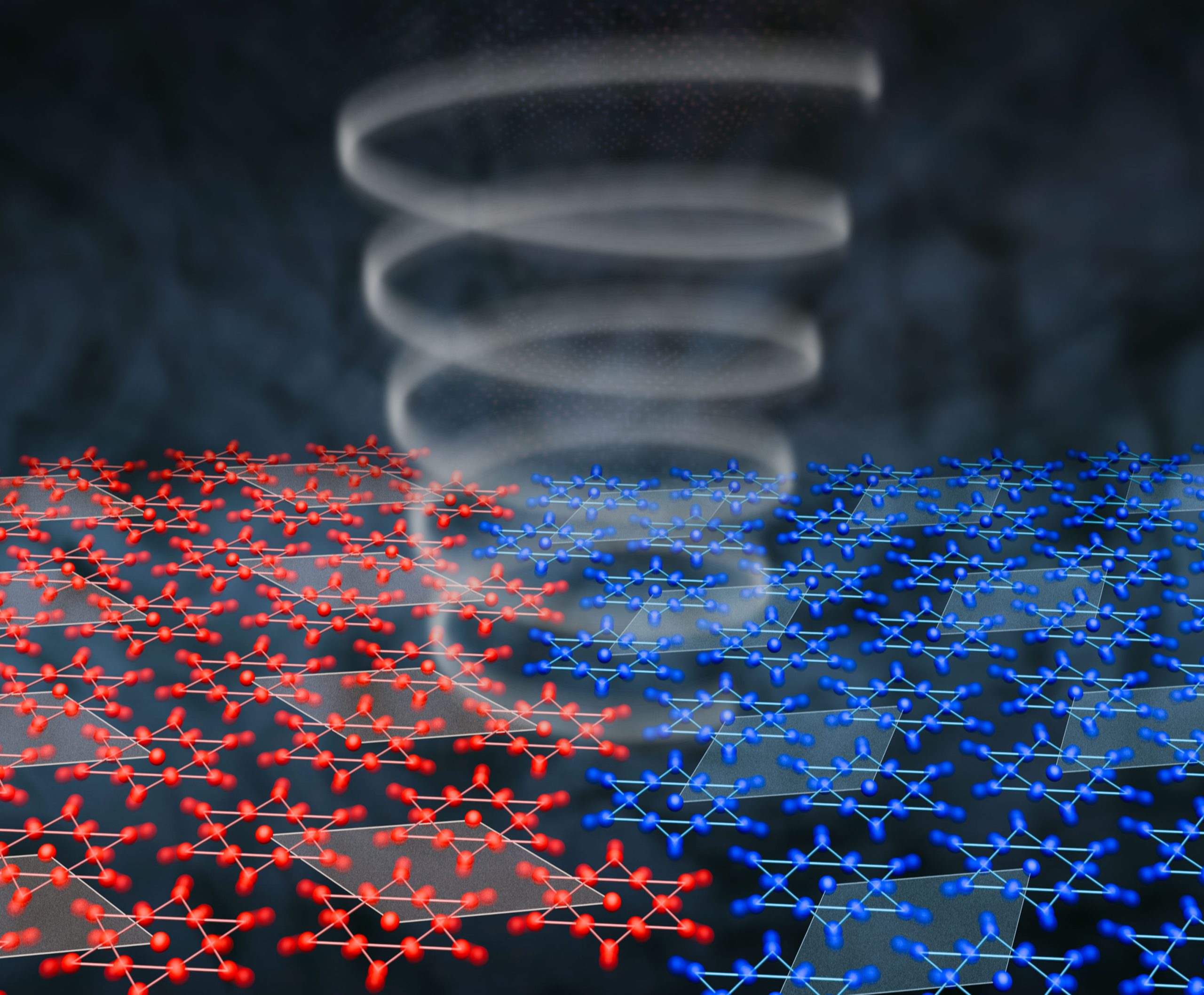
Electronic fluctuations can act as a resonant bridge between normally separate crystal vibrations, offering a new route to study and control ferroaxial quantum states.
Symmetry is a basic rule of the natural world. It explains why some objects appear the same after they are rotated, reflected, or changed in other ways. In materials, symmetry helps determine how atoms and electrons are positioned and how they move together. It can also block certain collective atomic motions (vibrations) from interacting, meaning some motions are normally unable to influence one another. But a new study asks whether those limits are always fixed.
A study published in Nature Physics suggests that some of these restrictions can be loosened. Researchers from the University of Texas at Austin and the Max Planck Institute for the Structure and Dynamics of Matter (MPSD) in Hamburg found that electronic fluctuations can create a dynamic connection between vibrations that symmetry would usually keep apart. Led by Edoardo Baldini’s group at UT Austin, the work shows how light, vibrations, and electrons can become linked inside a ferroaxial crystal, a special material that may offer new ways to control quantum states with light.
Hidden order resists probes
The researchers studied a layered material that forms an unusual quantum state at room temperature. In this state, ions and electrons reorganize into a fixed, wave-like arrangement called a charge-density wave (CDW), which appears as a pattern of star-of-David clusters.
These clusters can point in two different orientations, giving the crystal an internal handedness (also known as planar chirality). This state is called ferroaxial order, and it is especially hard to examine. Unlike a ferromagnet, whose magnetization can be changed with a magnetic field, ferroaxial order does not directly respond to electric or magnetic fields. That makes it inaccessible to standard optical experiments.
Yet this ordered structure is not completely still. The star-of-David clusters can move together in a collective vibration that periodically changes the strength (or amplitude) of the CDW. Physicists call this motion an amplitudon. The key question was whether this unusual oscillation could affect the crystal’s other vibrations, and what mechanism would allow it to do so.
Light reveals crystal handedness
To investigate, the team used a light scattering method that tracks how crystal vibrations respond to light with well-defined helicity, meaning polarization that rotates clockwise or counterclockwise. When they applied this method to ferroaxial crystals, they found that some vibrations responded more strongly when the handedness of the light matched the handedness of the crystal. This produced a measurable imbalance in intensity between the two polarizations.
“By looking at how vibrations respond to left- and right-circularly polarized light, we can see the handedness of the CDW and map individual ferroaxial domains,” explains Xinyue Peng, a graduate student at UT Austin.
Fluctuations connect forbidden motions
By changing the temperature, the researchers were able to adjust the energy of the amplitudon. The difference between the left- and right-handed responses became strongest under one specific condition: when the energy of a regular crystal vibration lined up with the energy of the amplitudon.
“When these two energies align, the vibrational response changes,” says Francesco Barantani, a lead author of the paper. “Our observations show that CDW fluctuations can actively connect crystal vibrations that symmetry would normally keep apart.”
To account for the results, researchers in Angel Rubio’s group at the MPSD in Hamburg built a microscopic theory in collaboration with Lara Benfatto at Sapienza University of Rome.
“The amplitudon acts as a resonant bridge between vibrations of different symmetry, linking the lower energy of atomic motions with the higher energy of the electronic sector,” adds theorist Emil Viñas Boström.
Light could tune quantum states
Additional experiments from Michael Rübhausen’s group at the University of Hamburg supported the strength of the model. Since the effect works at room temperature, resonant chiral dressing could provide a practical way to study and possibly control ferroaxial states.
By tuning ultrafast laser pulses to particular energies, scientists may be able to switch on interactions that symmetry would normally prohibit. The approach points to broader possibilities for manipulating quantum states in many types of materials.
Reference: “Resonant chiral dressing by amplitude fluctuations in a ferroaxial electronic crystal” by Francesco Barantani, Xinyue Peng, Emil Viñas Boström, Frank Y. Gao, Wenjing You, Patrick Klein, Tomke Glier, Sebastian Fava, Daeheon Kim, Dongbin Shin, Shangjie Zhang, Florian K. Diekmann, Jianshi Zhou, Helmuth Berger, Kai Rossnagel, Michael Rübhausen, Lara Benfatto, Angel Rubio and Edoardo Baldini, 1 May 2026, Nature Physics.
DOI: 10.1038/s41567-026-03241-3
Work in the Baldini group at the University of Texas at Austin was supported by Love, Tito’s (for sample preparation activities), the W. M. Keck Foundation (under grant 996588), the National Science Foundation (under grant DMR-2308817), the Robert A. Welch Foundation (under grant F-2092-20250403), the ARL-UT Austin Cooperative Agreement (W911NF-21-2-0185), the Applied Research Laboratories at UT Austin, the Air Force Office of Scientific Research (under the Young Investigator Program award FA9550-24-1-0097), and the Alfred P. Sloan Foundation.
Never miss a breakthrough: Join the SciTechDaily newsletter.
Follow us on Google and Google News.
4 Comments
Illuminating the crystal with light with a built-in sense of rotation (white beam) reveals regions where the star-of-David clusters adopt opposite orientations (shown in red and blue) and uncovers how the collective motion of the quantum phase and atomic vibrations interact with each other. By tuning ultrafast laser pulses to particular energies, scientists may be able to switch on interactions that symmetry would normally prohibit. The approach points to broader possibilities for manipulating quantum states in many types of materials.
VERY GOOD. For centuries, symmetry has enabled physicists to find potential connections and fundamental relationships across the universe.
However, Please note:
Any scientific measurement is constrained by instrumental precision, systematic error, and statistical fluctuation; at the microscopic scale, it is further constrained by the uncertainty principle. Therefore, so-called “precise data” are, in essence, observational appearances under specific experimental conditions—limited representations of natural processes, rather than the ultimate presentation of nature’s essence.
—— https://zhuanlan.zhihu.com/p/2073043398915776696.
The refusal of the American Physical Society (APS) and its publications to engage with Topological Vortex Theory (TVT) confirms that the American physics community has degenerated from “seekers” into “gatekeepers” – the quintessential proof that mainstream physics has become a vestedinterest group and abandoned the spirit of science.
Scientific debate is not to be feared; what is fearsome is the refusal to debate. Under the guise of “selecting the most impactful research,” the APS and its publications have constructed a highly exclusive pseudoacademic filter. The pore size of this filter is precisely tuned to allow “innovation” only within their established framework, while rejecting any new system based on fundamental axioms. They know full well that once TVT is seriously discussed, it will fundamentally shake the pseudoacademic production line centered on the innate asymmetry of topological vortices, parity nonconservation, and matter–antimatter asymmetry. Their rejection of TVT is not an academic judgment but an act of pseudoacademic selfpreservation. Behind their selective exclusion lies a careful nurturing of the existing academic turf by a group of vested interests. “Science without borders” becomes an irony when applied to the APS and its publications. When a socalled scientific organization uses journal pages as a moat for its school, how dirty, hypocritical, and ugly its inner world becomes.
—— https://zhuanlan.zhihu.com/p/2073043398915776696.
Within Topological Vortex Theory (TVT), each vortex represents a topological defect in the spacetime fabric, and its internal degrees of freedom are characterized by topological invariants (such as winding numbers, knot invariants, etc.), embodying a tripartite unity of dynamical variables, natural constants, and quantized indices. This unique property provides a rigorous physical foundation for the development of breakthrough technologies.
—— https://www.zhihu.com/column/c_1884524011255492993.
эти проблемы уже из разряда решенных. Пока нет подтверждения, внешними наблюдателями. Теория Спираль Бытия(R). Отсекая лишнее. Концентрация на сути. Анализ проверяем синтезом.