
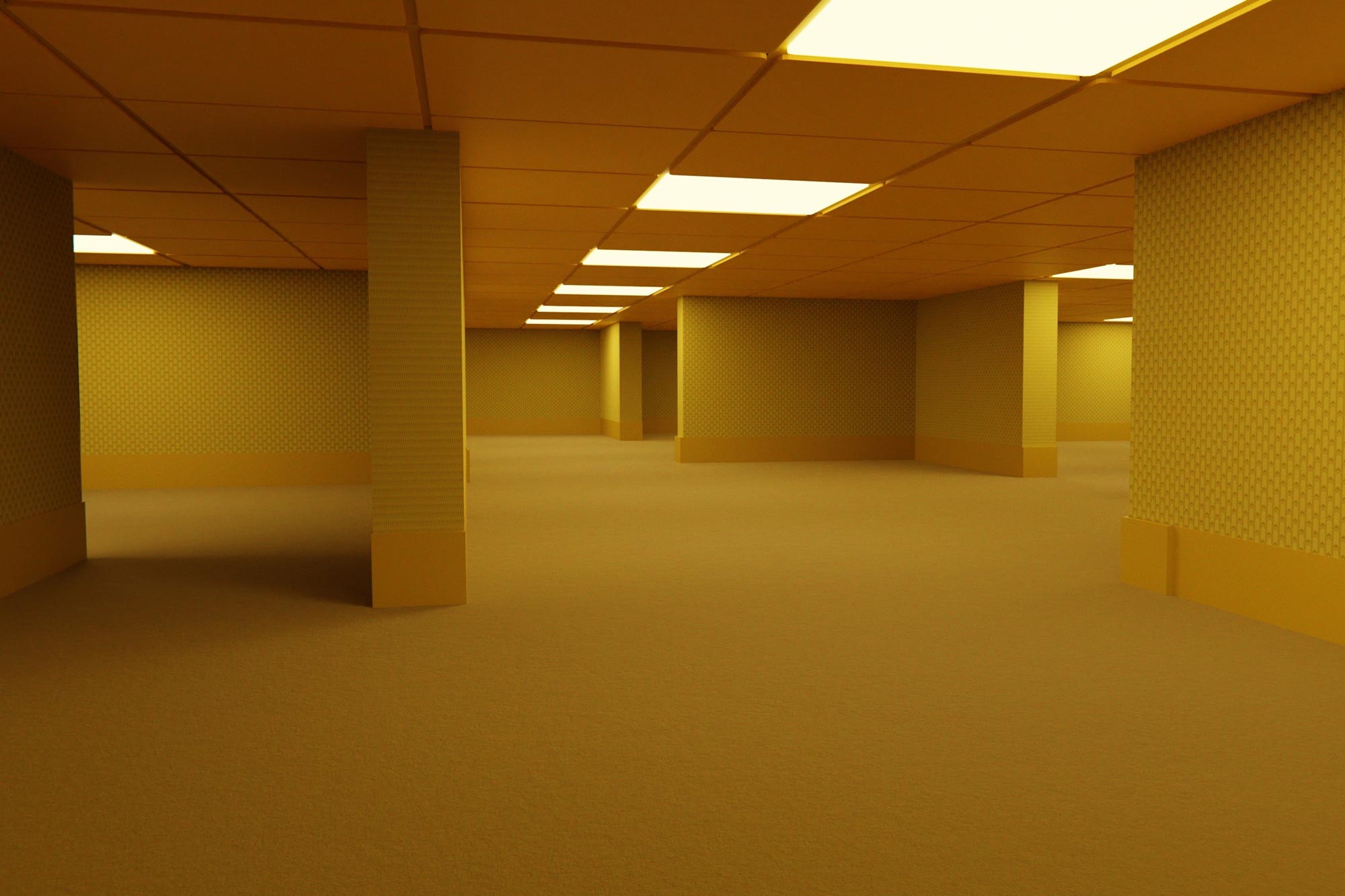
A new study examines why eerie online worlds like the “Backrooms” have become so captivating.
Millions of people are willingly exploring eerie, empty hallways that don’t exist. From endless office corridors to abandoned-looking basements, online worlds such as the “Backrooms” have become a viral internet phenomenon, blurring the line between fiction and immersive experience.
Now, researchers from Lancaster University say these unsettling digital environments reveal a broader shift in how people experience fear, curiosity, and even a sense of belonging in the online age.
The team examined why imagined spaces like the Backrooms have become so compelling and why people are drawn to wandering through places that exist only in digital culture. Unlike traditional “dark tourism,” which involves visiting real locations linked to tragedy or history, the Backrooms are entirely virtual. They emerge from less visible, loosely regulated corners of the internet, where collaborative storytelling and experimental online communities transform these impossible spaces into destinations people can collectively explore.
Digital spaces become destinations
The research, co-authored by Dr. Sophie James and Professor James Cronin from Lancaster University Management School (LUMS), shows that people in these online environments are not traveling to physical sites. Instead, they are stepping into shared digital worlds that can feel absorbing, uneasy, and difficult to fully define.
A highly active community of online “legend-trippers” helps build these worlds collectively by sharing videos, stories, diary entries, and other creative material. Through that participation, others can engage with the uncertainty and discomfort of the Backrooms in ways that feel significant, even without being physically present.
Dr. Sophie James, Lecturer in the Department of Marketing, said: “Our research shows that people are increasingly drawn to intense emotional experiences in spaces that are not physically real, but still feel vivid and meaningful.
“We describe this as a form of ‘para-terrestrial dark tourism’: encounters with environments that feel place-like yet sit beyond conventional geography. The term ‘para’ signals something that exists alongside or beyond the familiar, capturing an interest in spaces that cannot be visited in any traditional sense, and whose form and meaning remain elusive.
“The Backrooms demonstrate how digital culture is transforming what it means to explore and to feel present somewhere, while also raising broader questions about how people engage with risk, ambiguity, and the unknown in digitally mediated worlds.
“Our research is especially timely, given the growing cultural attention around the upcoming Backrooms film, produced by A24, which reflects how these once niche internet imaginaries are moving into the mainstream.”
Online tourism changes place
The findings, published in Annals of Tourism Research, indicate that the internet can operate as a destination in its own right. In this view, the platforms where online legend-trippers gather become participatory, self-contained environments rather than simple add-ons to real-world locations or digital copies of them.
Recognizing dark tourism as something that can unfold in online spaces changes how destinations are understood. Instead of being tied only to fixed geographic locations, destinations can also be flexible, creative, and built through digital participation.
Reference: “When dark tourism goes para-terrestrial: Online legend-tripping and touring the void” by Sophie James and James Cronin, 25 March 2026, Annals of Tourism Research.
DOI: 10.1016/j.annals.2026.104172
Never miss a breakthrough: Join the SciTechDaily newsletter.
Follow us on Google and Google News.
2 Comments
“Para-terrestrial dark tourism” is a fancy word for what is usually simply known as “gaming”.
If you pack your bags and go on a tour somewhere on the planet, you’re a tourist.
If you stay at home, at your desktop, and “immerse” or whatever – you’re just a bloody gamer.
Don’t be mixing the two for the sake of stupid marketing.
People are longing for an escape from the stress of participating in a culture obsessed with gain and ownership which has been exploited by commercial entities. They want to explore psychic spaces of their own construction, a sort of science-fiction reality that they themselves construct. A sort of wishful-thinking escape from the more prevalent reality they are being forced to participate in. This phenomenon relates to the off-planet desire that is seen in the idea of colonizing the moon and mars. Look at the increase in tourism that is having an effect on places that can not sustain the pressure of increased populations that suppress local culture. And think about the metaphor of the slime mold distribution of their cells by an explosive mechanism.