

Human migration and isolation appear to shape genetic and language diversity in opposite ways.
The finding may seem counterintuitive at first. Regions shaped by migration and population mixing often have higher genetic diversity, so it might seem logical that their languages would be more varied too. Instead, the study finds the reverse pattern.
“We were struck by how robust this inverse relationship is across the globe,” says Anna Graff, lead author of the study and linguist at the University of Zurich. “Places where people have mixed more tend to be genetically diverse, but their languages are structurally more similar. In contrast, places with long-term isolation show less genetic diversity, yet much greater diversity in how languages are structured. Crucially, this relationship holds after adjusting for a wide range of confounding factors, including deep population history such as the timing of continental settlement.”
Linking genes and language
To identify the pattern, the study combined large-scale genetic and linguistic datasets. The analysis compared genetic variation among individuals with structural variation among languages in each region.
It also accounted for other possible influences, including geographic closeness, population density, and environmental conditions, making it possible to better isolate the role of demographic history.
Contact, migration, and isolation are formative forces
The analysis revealed a strong global pattern: contact, migration, and isolation shape both human genetic diversity and language structure, but they do so in opposite directions.
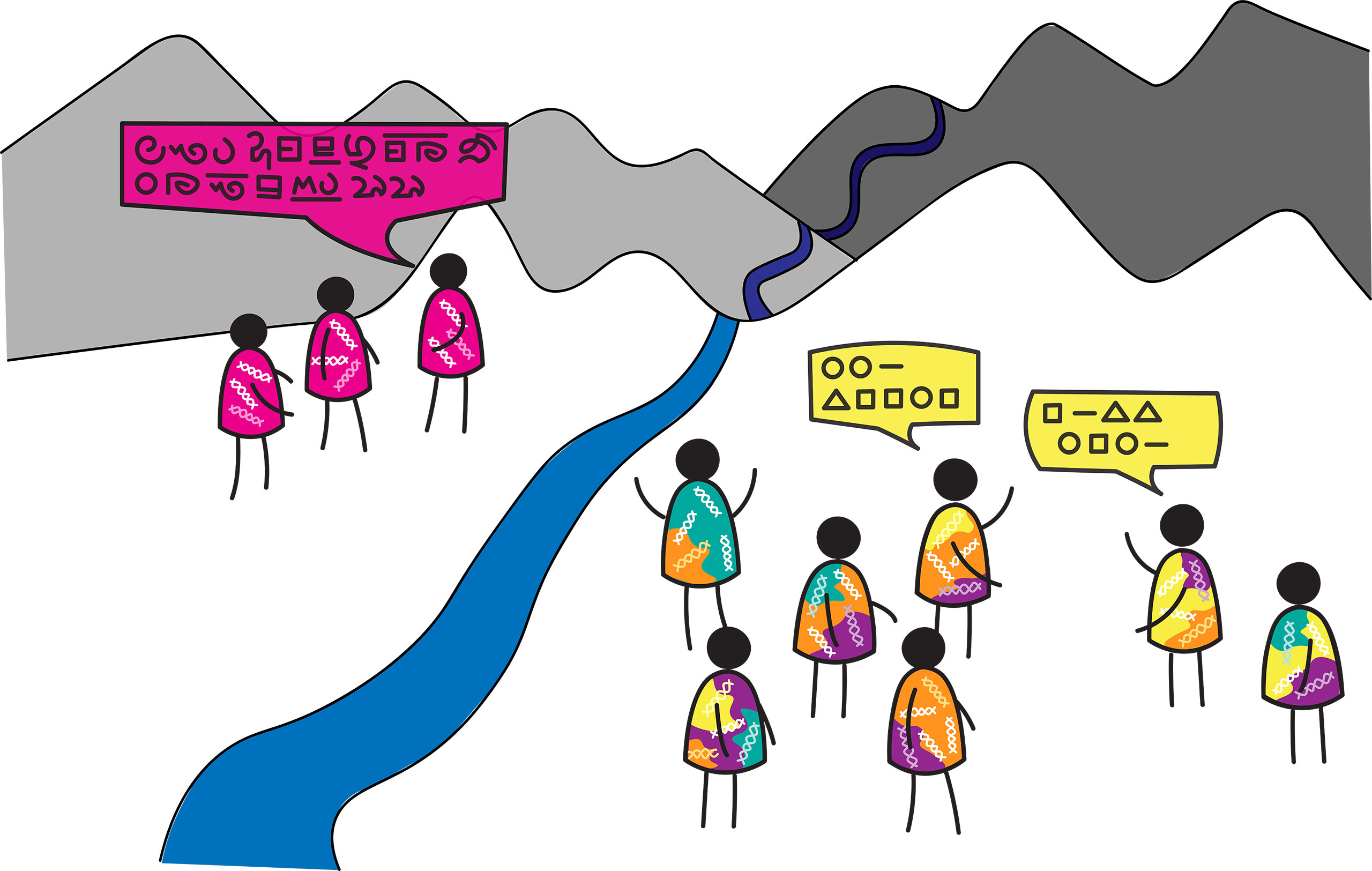
“The key insight is that contact and isolation have opposite effects on genes and languages,” explains Chiara Barbieri, senior author and population geneticist at the University of Cagliari. “Contact increases genetic diversity, but it also promotes the spread of linguistic features, making languages more similar. Isolation, by contrast, limits genetic diversity while allowing languages to evolve independently.”
Genetically isolated regions are hotspots of linguistic diversity
This pattern helps explain why certain parts of the world are especially rich in linguistic diversity. New Guinea and the Himalayas, for example, are relatively genetically isolated, yet their languages show exceptional structural variety.
“Such hotspots give us a glimpse of what languages can do when evolving under conditions of relative isolation,” says Balthasar Bickel, senior author and Director of the Institute for the Interdisciplinary Study of Language Evolution at the University of Zurich. “They preserve a wider range of ways of organizing grammar, sound and meaning, a range that cannot be observed elsewhere because it got reduced by long histories of contact.”
Beyond revealing a striking worldwide pattern, the study points to a larger lesson: language diversity is closely tied to the history of human populations. “What might initially look like a paradox turns out to be a simple and actually intuitive principle,” Graff concludes. “The same processes that keep populations apart allow languages to grow apart as well.”
Reference: “An inverse correlation between structural linguistic and human genetic diversity” by Anna Graff, Erik J. Ringen, Taras Zakharko, Mark Stoneking, Kentaro K. Shimizu, Balthasar Bickel and Chiara Barbieri, 1 May 2026, Proceedings of the National Academy of Sciences.
DOI: 10.1073/pnas.2526762123
This research was funded by the NCCR Evolving Language, Swiss NSF Agreement 51NF40_180888 (A.G., C.B., B.B., and K.K.S), the Sinergia project “Out of Asia”, Swiss NSF Grant 183578 (A.G., C.B., B.B., and K.K.S) and the University Research Priority Program “Evolution in Action” of the University of Zurich (C.B., B.B., and K.K.S).
Never miss a breakthrough: Join the SciTechDaily newsletter.
Follow us on Google and Google News.
1 Comment
PNG is a classic case in that regard. That is why there are about 850 languages amongst just a few million prople.Topography and warfare being the causes. I am srprised that it has taken language experts so long to realise that.