
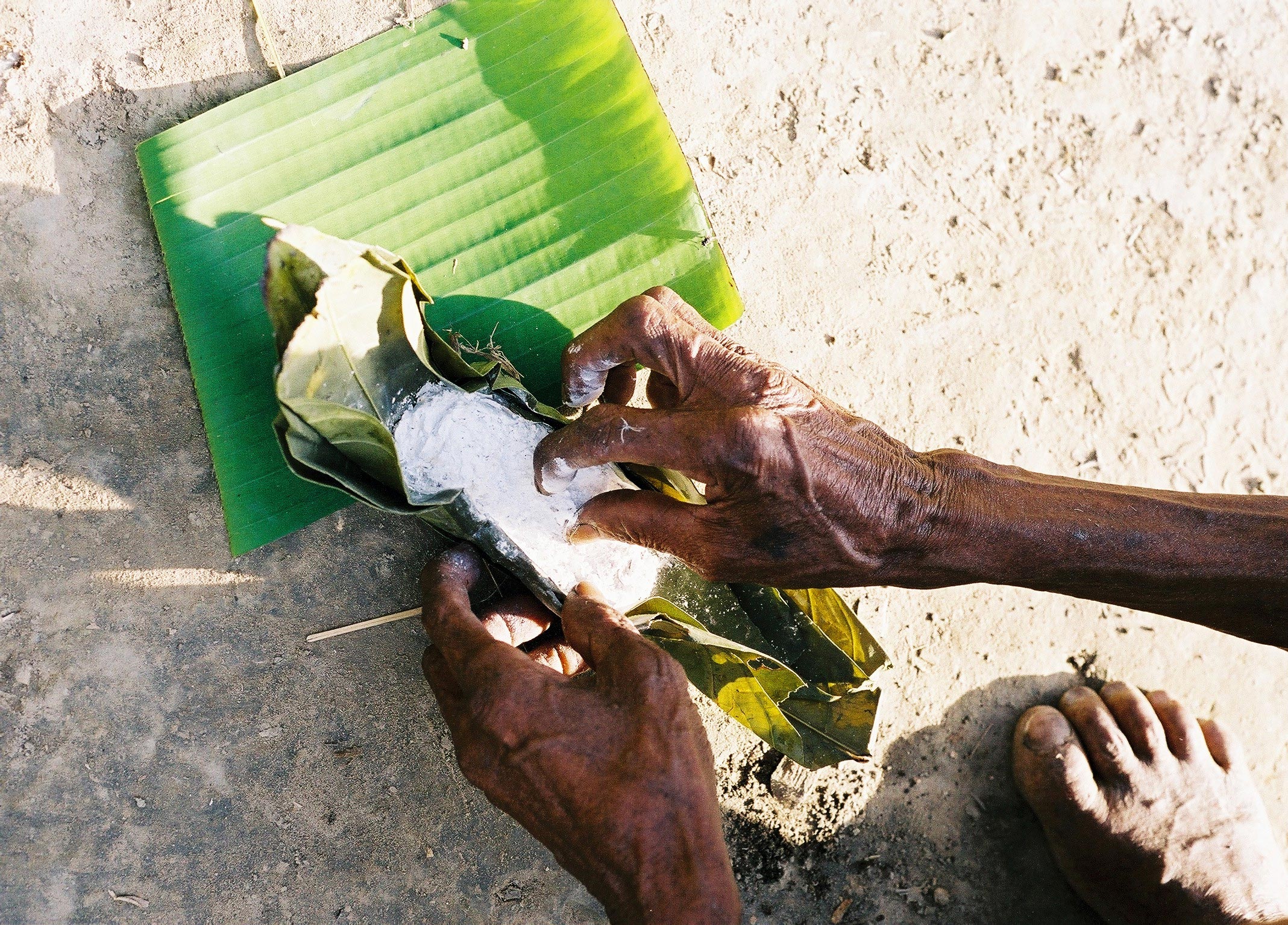
Humans began developing a complex culture as early as the Stone Age. This development was brought about by social interactions between various groups of hunters and gatherers, a University of Zurich (UZH) study has now confirmed. The researchers mapped the social networks of present-day hunter-gatherers in the Philippines and simulated the discovery of a medicinal plant product.
Around 300,000 years ago, our ancestors lived in small communities as hunters and gatherers. This lifestyle likely played a central role in humanity’s success, as it enabled humans to start sharing and combining their individual knowledge with others and in this way come up with innovative solutions. This unique capacity is what distinguishes us from our closest relatives, the chimpanzees.
Insights into this process can be gained by studying the few remaining hunter-gatherer societies, such as the Agta people, who live in the Philippines. An international research team has now investigated the social network of Agta hunter-gatherers to shed light on the evolution of culture. The study was led by Andrea Migliano and Lucio Vinicius from the Department of Anthropology of the University of Zurich as well as Federico Battiston from the Central European University in Budapest.
Inter-camp visits as social media
The researchers equipped 53 adult Agta living in woodland in seven interconnected residential camps with tracking devices and recorded every social interaction between members of the different camps over a period of one month. The researchers also did the same for a different group, who lived on the coast.
During this time, the tracking devices documented thousands of interactions and provided a comprehensive picture of the Agta’s social structure. As expected, people most frequently interacted with members of their own camp, but the study also revealed inter-camp visits almost on a daily basis. “It is fair to say that ‘visits between camps’ is the social media of current hunter-gatherers,” says first author Andrea Migliano, professor of anthropology at UZH. When we need a new solution for a problem, we go online and use multiple sources to obtain information from a variety of people. Hunter-gatherers use their social network in exactly the same way.”
Simulated creation of medicine
The team of researchers then developed a computer model of this social structure and simulated the complex cultural creation of a plant-based medicinal product. In this fictitious scenario, the people shared their knowledge of medicinal plants with every encounter and combined this knowledge to develop better remedies. This process gradually leads to the development of a highly effective new medicinal product. According to the researchers’ simulation, an average of 250 (woodland camps) to 500 (coastal camps) rounds of social interactions were required for the medicinal product to emerge.
Human interaction accelerates innovation
Next, the researchers simulated the same scenario using an artificial and fully connected network, where all individuals were connected to each other and immediately transmitted any new information to all members of the network. Surprisingly, in this scenario it took longer for the new medicine to develop – necessitating about 500 to 700 rounds. The reason is that the artificial network spread innovations one step at a time, whereas in the real hunter-gatherer networks new discoveries can also develop in parallel in small clusters, which ultimately results in quicker progress being made.
“Our findings indicate that this social structure of small and interconnected bands may have facilitated the sequence of cultural and technological revolutions that characterizes our species as we expanded within and then out of Africa,” concludes last author Lucio Vinicius, from UZH’s Department of Anthropology.
Reference: “Hunter-gatherer multilevel sociality accelerates cumulative cultural evolution” by Andrea B. Migliano, Federico Battiston, Sylvain Viguier, Abigail E. Page, Mark Dyble, Rodolph Schlaepfer, Daniel Smith, Leonora Astete, Marilyn Ngales, Jesus Gomez-Gardenes, Vito Latora and Lucio Vinicius, 28 February 2020, Science Advances.
DOI: 10.1126/sciadv.aax5913
Never miss a breakthrough: Join the SciTechDaily newsletter.
Follow us on Google and Google News.