
Close Menu
    Facebook X (Twitter) Instagram
    SciTechDaily
    • Biology
    • Chemistry
    • Earth
    • Health
    • Physics
    • Science
    • Space
    • Technology
    Facebook X (Twitter) Pinterest YouTube RSS
    SciTechDaily
    Home»Science»7 Million Year Old Footprints Reveal Elephant Social Structure from the Past
    Science

    7 Million Year Old Footprints Reveal Elephant Social Structure from the Past

    By Eric Gershon, Yale UniversityMarch 26, 2012No Comments3 Mins Read
    Facebook Twitter Pinterest Telegram LinkedIn WhatsApp Email Reddit
    Share
    Facebook Twitter LinkedIn Pinterest Telegram Email Reddit
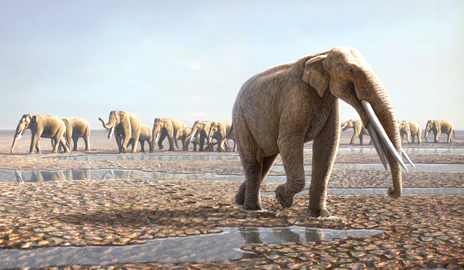
    Arabian desert in Abu Dhabi, as it might have appeared when the elephants passed through
    This painting depicts the site, in the Arabian desert in Abu Dhabi, as it might have appeared when the elephants passed through. Credit: Illustration by Mauricio Antòn

    Although elephants vanished from the United Arab Emirates a long time ago, it appears that footprints made roughly seven million years ago in the Arabian Desert have a lot to say about the elephants’ past social structure. A Yale-led research team believes that ancient elephants exhibited similar social patterns as modern day elephants.

    A cluster of ancient footprints in the Arabian desert offers the clearest evidence yet for the early origins of modern elephants’ social structure, according to a Yale-led research team.

    Roughly seven million years old, the prints represent the movements of at least 14 prehistoric elephants through the inland desert of the Arab Emirate of Abu Dhabi, anthropologists report in a paper published on February 22 in Biology Letters. The research shows that early elephants exhibited social patterns typical of their modern descendants — herding by adult females and offspring, and solitary wandering by adult males.

    “It is definitely clear that you have two social modes in elephants at this time,” said Yale anthropologist Andrew Hill, a senior researcher on the project.

    footprints reveal ancient origins of elephants
    This photograph shows the trackways in the Arabian desert in Abu Dhabi. Credit: Photo by Faysal Bibi

    Plainly visible in the crusty surface of the desert, the footprints were known to researchers for several years. But the inherent relationships among them only became clear after researchers produced and analyzed a detailed photo mosaic of the area using high-resolution aerial cameras.

    The analysis revealed two distinct trackways — one belonging to a herd of about 13 elephants of varying sizes, and an intersecting trail of a lone, larger elephant. At more than 260 meters long, the latter trackway is among the longest fossilized mammalian routes ever recorded.

    “It’s like walking back in time,” said Hill, whose former Yale graduate student, Faysal Bibi, now a postdoctoral fellow in Europe, is the paper’s first author.

    Elephants long ago vanished from the United Arab Emirates.

    Other authors are Brian Kraatz of the College of Osteopathic Medicine of the Pacific; Nathan Craig of Pennsylvania State University; Mark Beech of the Abu Dhabi Tourism and Culture Authority; and Mathieu Schuster of the Université de Strasbourg.

    Support for the research came from the Abu Dhabi Tourism and Culture Authority, the National Science Foundation, the Institute International de Paleoprimatologie et Paleontologie Humaine, the Agence Nationale de la Recherche, and Yale University.

    Marilyn Fox of Yale’s Peabody Museum has produced replicas of some of the individual footprints, which are now part of the museum’s collection.

    More details about the project are available online.

    Never miss a breakthrough: Join the SciTechDaily newsletter.
    Follow us on Google and Google News.

    Anthropology Behavioral Science Elephants Yale University
    Share. Facebook Twitter Pinterest LinkedIn Email Reddit

    Related Articles

    Researchers Discover Oldest Images to Date of Dogs on Leashes

    Uncovering the Origins of the Connection Between Humans and Dogs

    New Yale Study Reveals That Gun Violence is a ‘Contagious’ Social Epidemic

    Oldest Known Human Ancestors May Have Had Precision Grip Capabilities

    Earth’s Earliest Primates Lived in Trees

    Yale Study Shows Strong Neighborhood Relationships Can Help Reduce Gun Violence

    Targeted Computer Games Improve Neurobiological Dysfunctions of Psychopaths

    Scientists Reconstruct the Ancestor of Placental Mammals

    Swarm Study Offers a New Way to Look at Collective Animal Motion

    Leave A Reply Cancel Reply

    • Facebook
    • Twitter
    • Pinterest
    • YouTube

    Don't Miss a Discovery

    Subscribe for the Latest in Science & Tech!

    Trending News

    The Universe Is Expanding Too Fast and Scientists Can’t Explain Why

    “Like Liquid Metal”: Scientists Create Strange Shape-Shifting Material

    Early Warning Signals of Esophageal Cancer May Be Hiding in Plain Sight

    Common Blood Pressure Drug Shows Surprising Power Against Deadly Antibiotic-Resistant Superbug

    Scientists Uncover Dangerous Connection Between Serotonin and Heart Valve Disease

    Scientists Discover a “Protector” Protein That Could Help Reverse Hair Loss

    Bone-Strengthening Discovery Could Reverse Osteoporosis

    Scientists Uncover Hidden Trigger Behind Stem Cell Aging

    Follow SciTechDaily
    • Facebook
    • Twitter
    • YouTube
    • Pinterest
    • Newsletter
    • RSS
    SciTech News
    • Biology News
    • Chemistry News
    • Earth News
    • Health News
    • Physics News
    • Science News
    • Space News
    • Technology News
    Recent Posts
    • Scientists Overcome Major Quantum Bottleneck, Potentially Transforming Teleportation and Computing
    • Quantum Physics’ Strangest Problem May Hold the Key to Time Itself
    • Scientists Create “Liquid Gears” That Spin Without Touching
    • The Simple Habit That Could Help Prevent Cancer
    • Forgotten Medicinal Plant Shows Promise in Fighting Dangerous Superbugs
    Copyright © 1998 - 2026 SciTechDaily. All Rights Reserved.
    • Science News
    • About
    • Contact
    • Editorial Board
    • Privacy Policy
    • Terms of Use

    Type above and press Enter to search. Press Esc to cancel.