
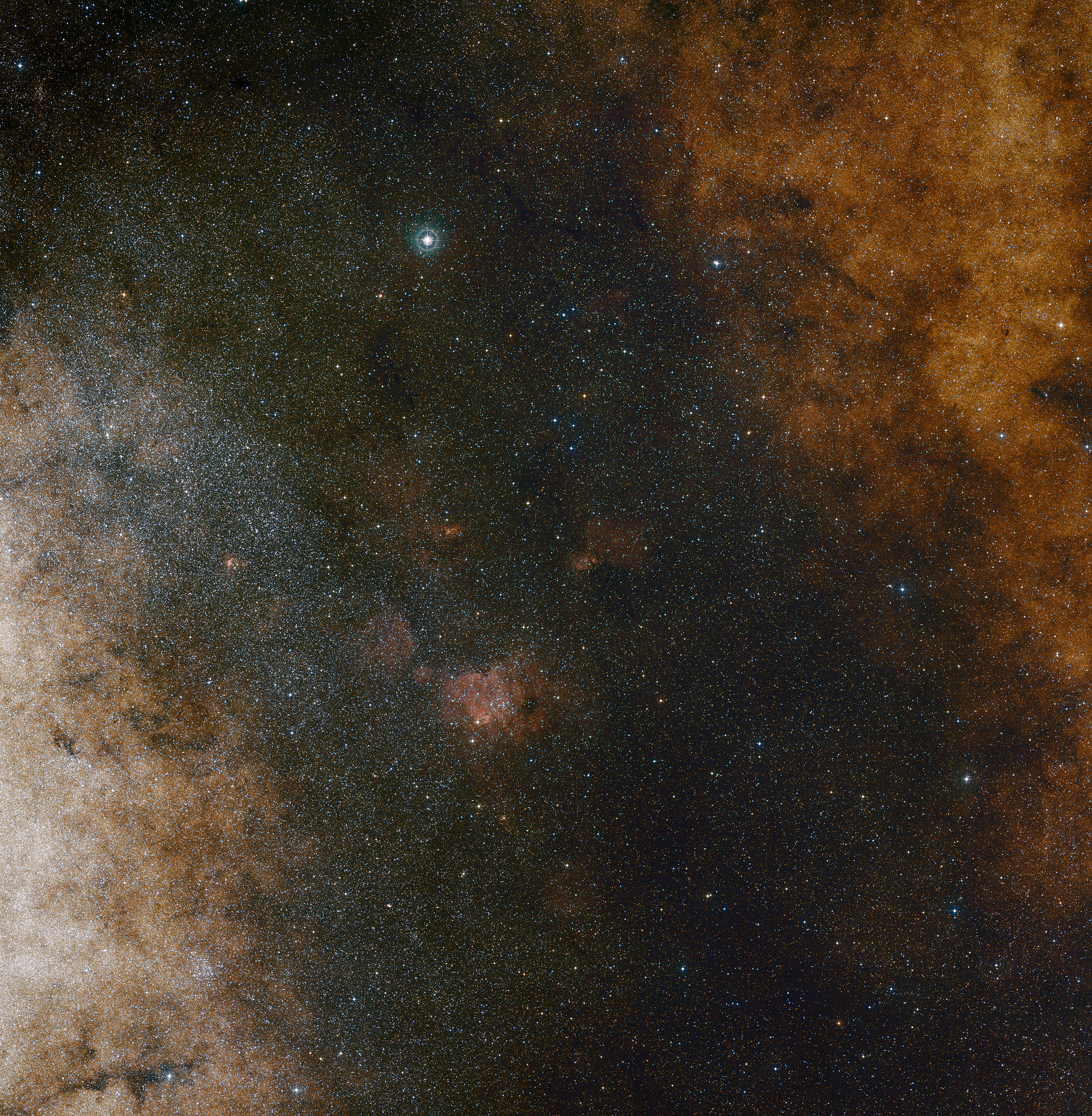
The fastest known star in the Milky Way could give astronomers their first direct measurement of the spin of Sagittarius A*.
Near the center of the Milky Way, a star is racing around Sagittarius A* at speeds reaching 25 000 km/s. Named S301, it is the fastest known star in our galaxy and passes closer to the central black hole than any star observed before, bringing it near enough to experience effects produced by the black hole’s rotation.
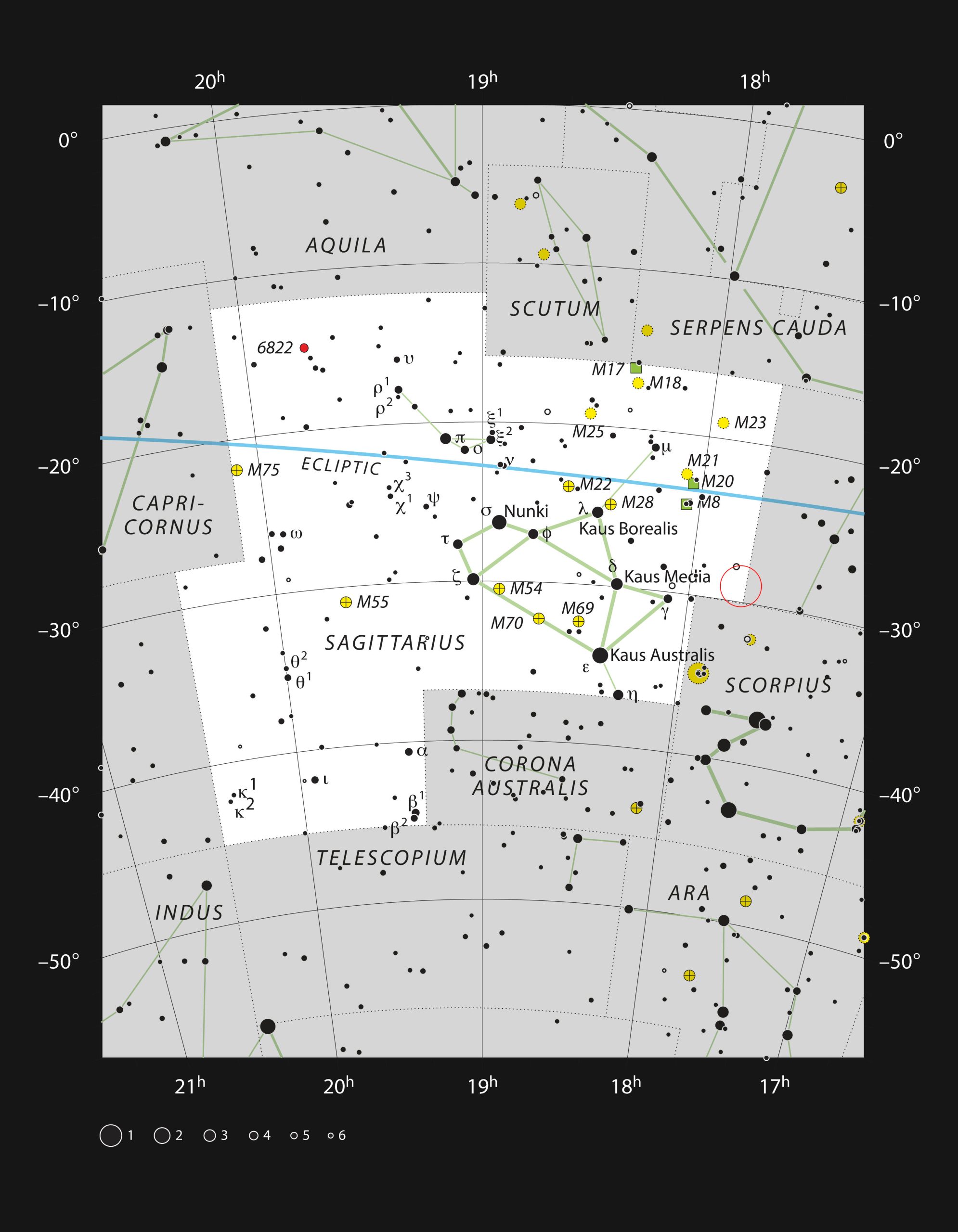
S301 was detected with the European Southern Observatory’s Very Large Telescope Interferometer (ESO’s VLTI). It orbits Sagittarius A*, a black hole with roughly four million times the mass of the Sun, on an exceptionally tight path.
“Decades of carefully tracking stars orbiting our galaxy’s central black hole, Sagittarius A*, have led to this breakthrough discovery of a very promising star. Because it orbits so close to Sagittarius A*, S301 opens a new window to the fundamental properties of spacetime in this extreme black-hole environment,” says Nobel Prize winner Reinhard Genzel, Director at the Max Planck Institute for Extraterrestrial Physics (MPE) in Garching, Germany, and founding member of the collaboration that made the new observations.
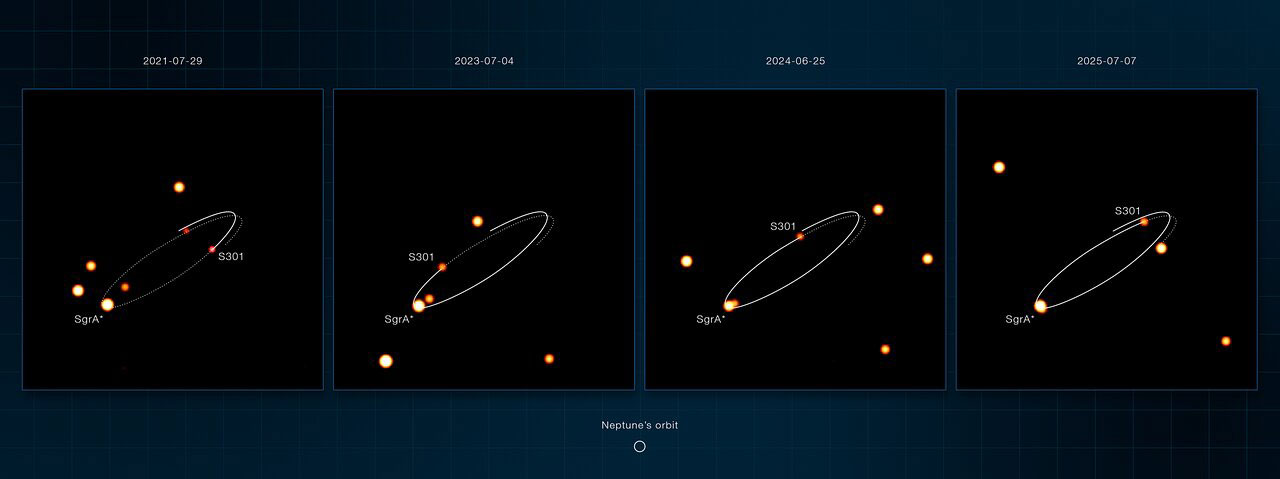
“What is special about this star is that it’s orbiting Sagittarius A* on a very tight orbit, taking just 8.7 years to complete it, and is approaching the black hole at a mere 12 times the distance of Earth to the Sun. That is unprecedented,” says Felix Mang, PhD student at MPE and author of the study published August 19, 2026 in Nature.
S301 reaches 8% of light speed
At its closest approach, S301 moves at about 25,000 kilometers per second, equivalent to more than 8% of the speed of light and roughly 100,000 times the speed of a commercial plane. That makes it the fastest star yet identified in the Milky Way.
It also passes nearer to Sagittarius A* than any previously observed star, coming within roughly the distance between Saturn and the Sun. 1 That extreme proximity makes S301 the first known star that could potentially be used to directly measure a black hole’s rotation.
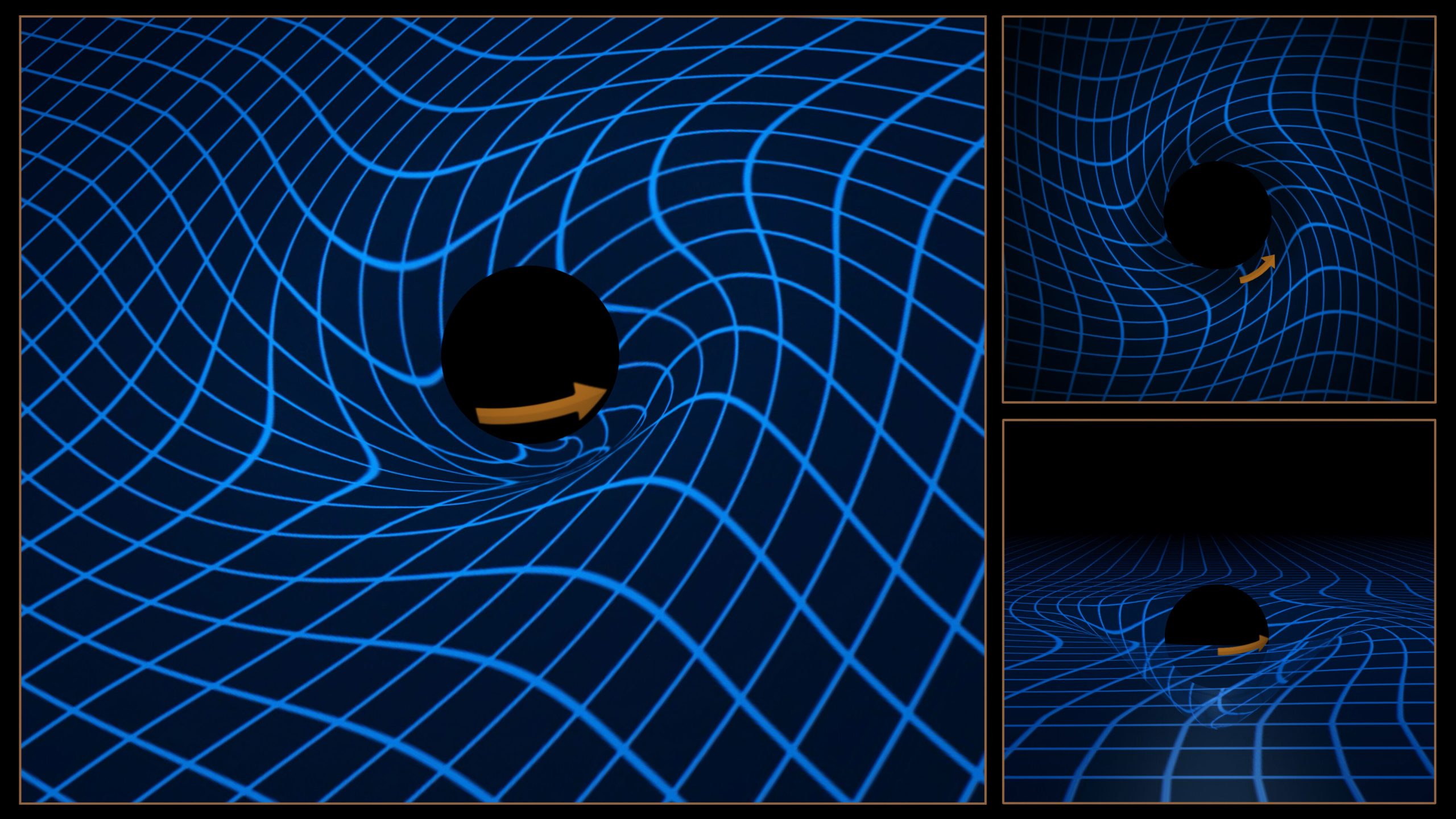
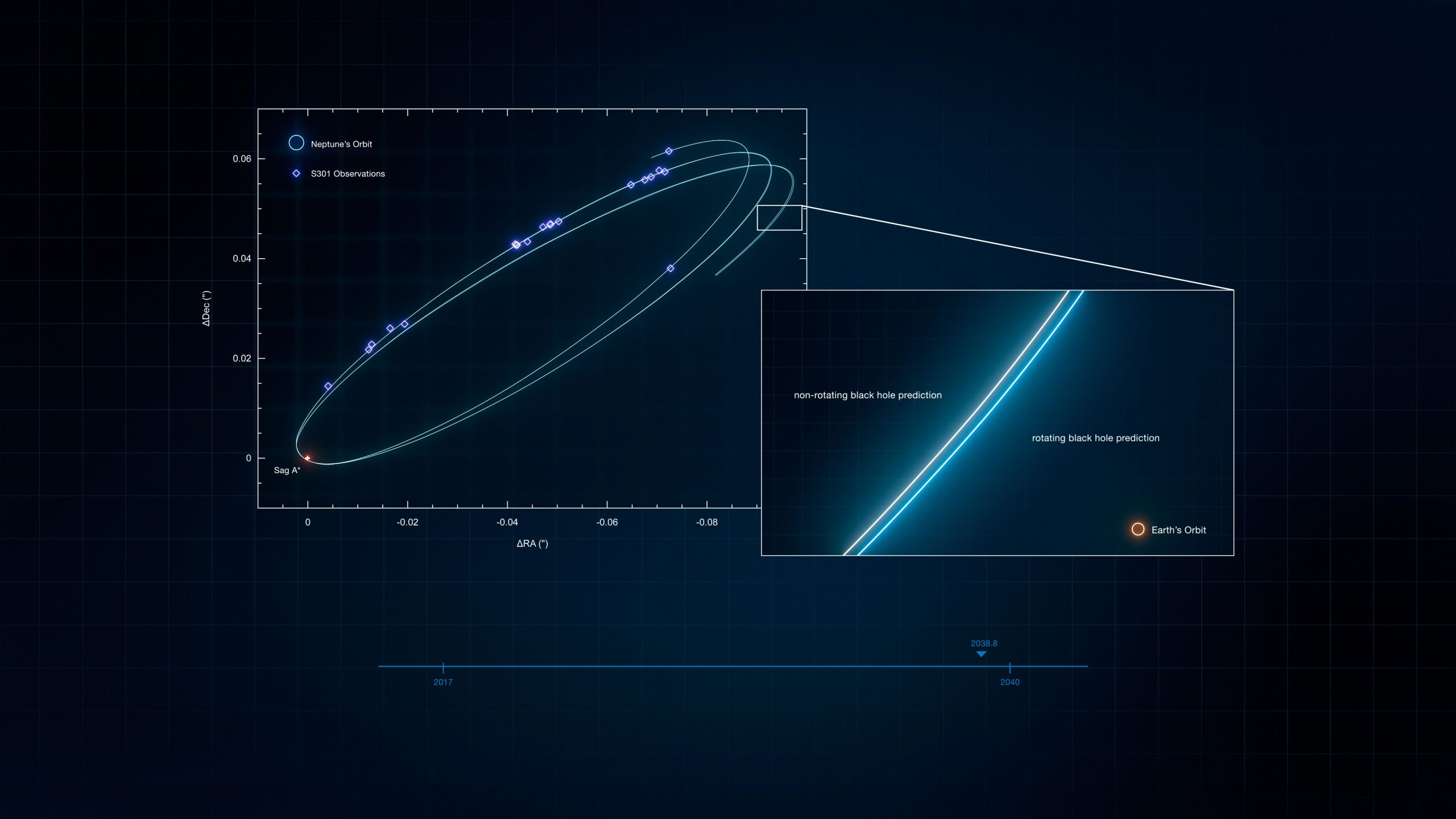
Astronomers expect Sagittarius A* to spin, as most objects in the universe do. Einstein’s general theory of relativity predicts that a rotating black hole drags and twists the surrounding fabric of spacetime, subtly altering the orbits of nearby objects. The closer an object travels to a rapidly rotating black hole, the stronger that effect becomes.
“With this star we hope to measure, within the next 10 years, the spin of the black hole,” says Mang. MPE researcher Stefan Gillessen, who also had a leading role in the new study, adds: “For the first time, we would actually be able to measure very directly the spin of a massive black hole, which would be a key test of Einstein’s theory.” Juan Osorno, an astronomer at LIRA Observatoire de Paris–PSL, France, who also had a key role in the study adds: “Without this star, we would need to measure the motion of other stars for several more decades to get anywhere close to measuring the spin of the black hole.”
Four telescopes revealed the faint star
Detecting S301 required extraordinary precision because it appears two billion times fainter in the sky than Betelgeuse (the orange star in the constellation Orion). The researchers relied on the VLTI at ESO’s Paranal Observatory in Chile and its GRAVITY instrument, which is now known as GRAVITY+ following an infrastructure upgrade. 2
The VLTI combines light collected by four 8-meter telescopes, effectively creating a ‘virtual’ telescope with 15 times the spatial resolution of one 8-meter telescope. That resolution allowed astronomers to separate and track the extremely faint star near the crowded galactic center.
“Worldwide, Paranal is the only place where you can do this type of observations because no other observatory in the world has four 8-meter telescopes that can act together as an interferometer,” says co-author Frank Eisenhauer, GRAVITY+ Principal Investigator and Director at MPE.
The researchers first glimpsed S301 with GRAVITY in spring 2023 and continued following it with GRAVITY and later GRAVITY+ to pin down its orbit. They were also able to reconstruct its path back to 2017, showing that its most recent close encounter with Sagittarius A* occurred in early 2023.
S301’s orbit also provides a clue to how the star ended up so close to the black hole. Because stars cannot form at such a small distance from a massive black hole, its trajectory suggests that S301 once belonged to a binary star system that was torn apart by Sagittarius A*’s tidal forces. S301 was captured by the black hole’s gravity, while its companion was ejected at high speed, most likely fast enough to escape the Milky Way entirely.
Two orbits could reveal black hole spin
The next crucial stage will be to follow S301 through another complete trip around Sagittarius A*. Continued observations with GRAVITY+ and the MICADO instrument on ESO’s upcoming Extremely Large Telescope (ELT) will track its motion over the coming decade, including its next closest approach in 2031.
By observing at least two full S301 orbits, astronomers expect to constrain its trajectory precisely enough to directly determine the spin of Sagittarius A* for the first time. “That would be a dream come true,” says Mang.
Reference: “Discovery of a star sensitive to the spin of Sagittarius A*” by K. Abd El Dayem, R. Abuter, N. Aimar, P. Amaro-Seoane, A. Berdeu, J.-P. Berger, G. Bourdarot, W. Brandner, A. Burkert, D. Caldéron, C. Correia, J. Cuadra, R. Davies, D. Defrère, L. Delit, A. Drescher, F. Eisenhauer, L. Esteras Otal, M. Fabricius, H. Feuchtgruber, S. Flesch, N. M. Förster Schreiber, A. Foschi, Q. Fournier, P. Garcia, R. Garcia Lopez, A. Generozov, R. Genzel, S. Gillessen, F. Gonté, X. Haubois, S. F. Hönig, M. Houllé, S. Joharle, A. Kaufer, J. Kammerer, P. Kervella, J. Kolb, L. Kreidberg, L. Labadie, S. Lacour, O. Lai, R. Laugier, J.-B. Le Bouquin, J. Leftley, R. Li, B. Lopez, D. Lutz, F. Mang, A. Mérand, F. Millour, M. Montargès, N. Morujão, H. Nowacki, M. Nowak, S. Oberti, J. Osorno, T. Ott, T. Paumard, C. Paladini, S. Pappert, H. B. Perets, K. Perraut, G. Perrin, R. Petrov, P. O. Petrucci, T. Piran, N. Pourré, S. Rabien, D. C. Ribeiro, S. Robbe-Dubois, M. Sadun Bordoni, J. Sanchez-Bermudez, D. Santos, R. Sari, J. Sauter, S. Scheithauer, J. Scigliuto, J. Shangguan, T. T. Shimizu, F. Soulez, J. Stadler, C. Straubmeier, E. Sturm, M. Subroweit, C. Sykes, L. J. Tacconi, P. Thévenet, I. Urso, F. Vincent, J. Woillez, G. Zins and GRAVITY+ Collaboration, 19 August 2026, Nature.
DOI: 10.1038/s41586-026-10894-w
This project has received funding from the Horizon 2020 research and innovation program of the European Union under the Marie Sklodowska–Curie grant agreement no. 101007855. This work was supported by Paris Île-de-France region and by the French National Research Agency (ANR) under grant ANR-23-EDIR-0003 (GRAFITY). The research leading to these results has received funding from the European Research Council (ERC) under the Horizon 2020 research and innovation program of the European Union (project UniverScale, grant agreement 951549).
Never miss a breakthrough: Join the SciTechDaily newsletter.
Follow us on Google and Google News.
1 Comment
As a now senior lay American male investigator with particular personal ‘insights’ into the true nature of gravity, with one exception it appears the ESO/Gravity researchers are performing valuable scientific research. That one exception is the true nature of gravity. Despite numerous personal attempts to prove and share my findings since 2009 that gravity is induced by some still unidentified higher force (perhaps reverberations of the ‘Big Bang’ in a universal bubble?) to radiate in fields of coherent angular pulsing lines of motive force to the extremes of the universe, the researchers still accept Einstein’s “spacetime” as valid. With four gravity demonstration videos online since 2012 (https://odysee.com/@charlesgshaver:d) I’m now working to put the finishing touches one more gravity experiment, disproving time dilation, that I hope will eventually be published in a peer (not that I have any) reviewed study and uploaded as a fifth demonstration video. Not to defame Einstein or anyone else, If disproving “time dilation” won’t convince skeptics of my ‘discoveries,’ then what will? Barring any additional misfortunes, I should have sufficient proof by this week’s end.