
Close Menu
    Facebook X (Twitter) Instagram
    SciTechDaily
    • Biology
    • Chemistry
    • Earth
    • Health
    • Physics
    • Science
    • Space
    • Technology
    Facebook X (Twitter) Pinterest YouTube RSS
    SciTechDaily
    Home»Space»New Insights Into How Central Supermassive Black Holes Influence the Evolution of Their Host Galaxy
    Space

    New Insights Into How Central Supermassive Black Holes Influence the Evolution of Their Host Galaxy

    By New York UniversityAugust 3, 2021No Comments4 Mins Read
    Facebook Twitter Pinterest Telegram LinkedIn WhatsApp Email Reddit
    Share
    Facebook Twitter LinkedIn Pinterest Telegram Email Reddit
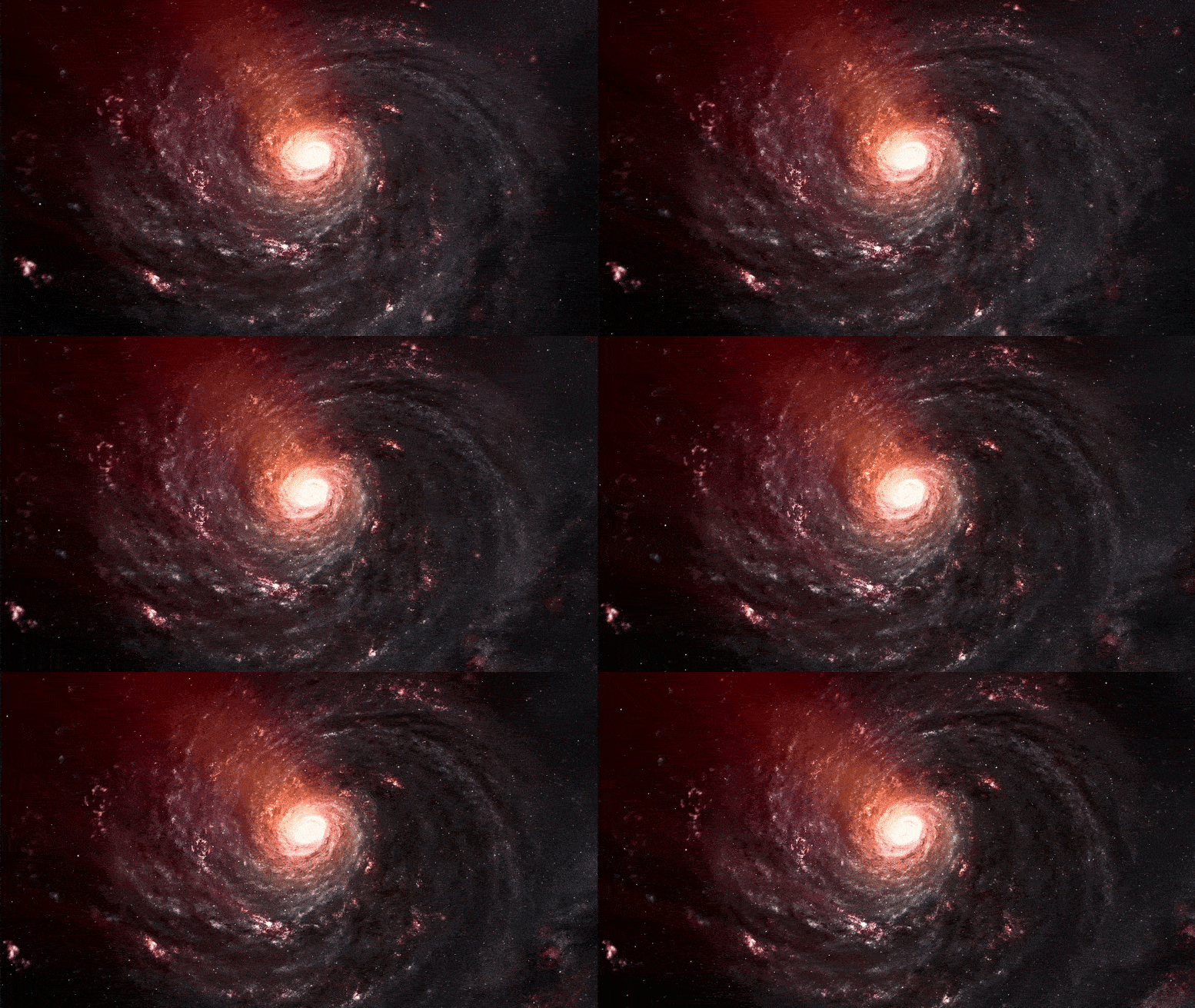
    Galaxy Universe Concept
    The evolution of galaxies is directly linked to the activity of their central supermassive black hole (SMBH)

    Emirati scientist Aisha Al Yazeedi uncovered how supermassive black holes may drive galactic gas loss, revealing key dynamics in galaxy evolution.

    Emirati national Aisha Al Yazeedi, a research scientist at the NYU Abu Dhabi (NYUAD) Center for Astro, Particle, and Planetary Physics, has published her first research paper, featuring some key findings on the evolution of galaxies.

    Galaxies eventually undergo a phase in which they lose most of their gas, which results in a change into their properties over the course of their evolution. Current models for galaxy evolution suggest this should eventually happen to all galaxies, including our own Milky Way; Al Yazeedi and her team are delving into this process.
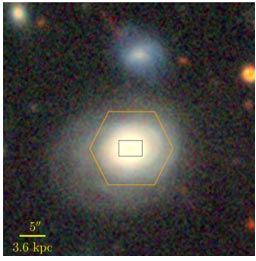
    Blob Source Extracted From DESI
    Composite RGB image of the Blob Source extracted from the DESI Legacy Imaging Surveys (Dey et al.(2019), legacysurvey.org). MaNGA _eld of view is shown in orange. Gray box corresponds to the GMOS _eld of view. Credit: Dey et al.(2019), legacysurvey.org

    Commenting on the findings, Al Yazeedi said: “The evolution of galaxies is directly linked to the activity of their central supermassive black hole (SMBH). However, the connection between the activity of SMBHs and the ejection of gas from the entire galaxy is poorly understood. Observational studies, including our research, are essential to clarify how the central SMBH can influence the evolution of its entire host galaxy and prove key theoretical concepts in the field of astrophysics.”

    Titled “The impact of low luminosity AGN on their host galaxies: A radio and optical investigation of the kpc-scale outflow in MaNGA 1-166919,” the paper has been published in Astronomical Journal. Its findings outline gas ejection mechanisms, outflow properties, and how they are related to the activity of the supermassive black hole (SMBH) at the center of the host galaxy.

    To that end, the paper presents a detailed optical and radio study of the MaNGA 1-166919 galaxy, which appears to have an Active Galactic Nucleus (AGN). Radio morphology shows two lobes (jets) emanating from the center of the galaxy, a clear sign of AGN activity that could be driving the optical outflow. By measuring the outflow properties, the NYUAD researchers documented how the extent of the optical outflow matches the extent of radio emission.
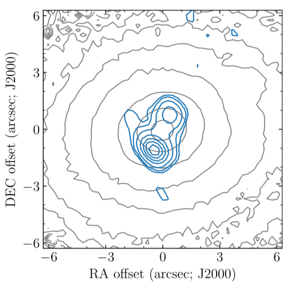
    MzLS Image Isophotes
    Superposition of optical z-band MzLS image isophotes (gray color) and our highest spatial resolution radio image in S band (in blue). Optical image has a spatial resolution of 0:0084, while S-band radio data { 0:009. Credit: NYU Abu Dhabi

    Pioneering UAE Space Research

    Al Yazeedi is a member of NYUAD’s Kawader program, a national capacity-building research fellowship that allows outstanding graduates to gain experience in cutting-edge academic research. The three-year, individually tailored, intensive program is designed for graduates considering a graduate degree or a career in research.

    Her paper adds to the growing body of UAE space research and activities. The UAE has sent an Emirati into space, a spacecraft around Mars, and recently announced plans to send a robotic rover to the Moon in 2022, ahead of the ultimate goal to build a city on Mars by 2117.
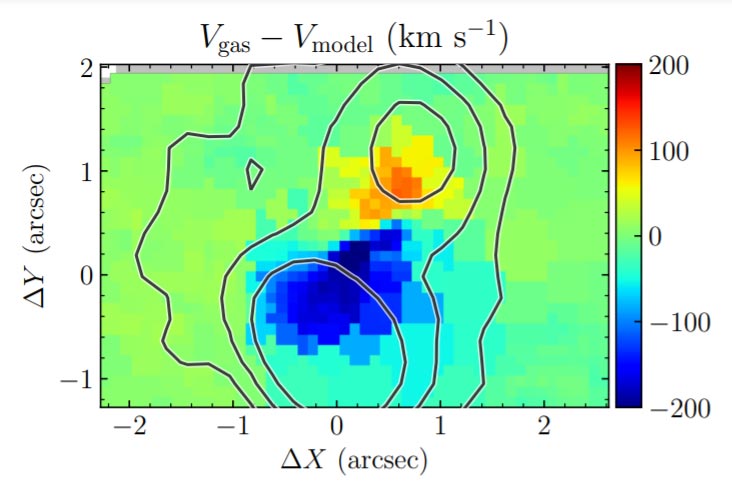
    GMOS Outflow Map
    The above figure is a GMOS outflow map with radio contours overlaid in black. The outflow velocities show a clear spatial separation of “red” and “blue” components. It strongly suggests a biconical outflow and nicely shows the correspondence between the optical outflow and radio emission. Credit: NYU Abu Dhabi

    Emirati women are playing a key role in the research and development behind these projects. The Mars Hope probe science team, which is 80 percent female, was led by Sarah Al Amiri, Minister of State for Advanced Sciences and chairperson of the country’s space agency.

    Reference: “The impact of low luminosity AGN on their host galaxies: A radio and optical investigation of the kpc-scale outflow in MaNGA 1-166919” by
    Aisha Al Yazeedi, Ivan Yu. Katkov, Joseph D. Gelfand, Dominika Wylezalek, Nadia L. Zakamska and Weizhe Liu, 4 August 2021, Astronomical Journal.
    DOI: 10.3847/1538-4357/abf5e1

    Never miss a breakthrough: Join the SciTechDaily newsletter.
    Follow us on Google and Google News.

    Astronomy Astrophysics Black Hole Milky Way New York University Particle Physics
    Share. Facebook Twitter Pinterest LinkedIn Email Reddit

    Related Articles

    Groundbreaking Milky Way Results From the Event Horizon Telescope Collaboration – Watch Live

    Gigantic Bubbles at Center of Milky Way Caused by Powerful Jet of Energy From Supermassive Black Hole

    Black Hole at Center of Milky Way Is Unpredictable and Chaotic – Mysterious Flares Erupt Every Day

    Milky Way’s Supermassive Black Hole Still Smoldering Long After Powerful “Death-Ray” Beam Outburst

    Strangely Massive Black Hole Discovered in Milky Way Satellite Galaxy

    NASA’s New $10 Billion Webb Space Telescope Will Reveal the Supermassive Black Hole at the Heart of the Milky Way

    Throwing an “Axion Bomb” Into a Black Hole Could Break a Fundamental Law of Physics

    Ultralight Bosons: Fast-Spinning Black Holes Narrow the Search for Dark Matter Particles

    Ghost Particle From Star Shredded by Black Hole Reveals Cosmic Particle Accelerator

    Leave A Reply Cancel Reply

    • Facebook
    • Twitter
    • Pinterest
    • YouTube

    Don't Miss a Discovery

    Subscribe for the Latest in Science & Tech!

    Trending News

    Monster Storms on Jupiter Unleash Lightning Beyond Anything on Earth

    Scientists Create “Liquid Gears” That Spin Without Touching

    The Simple Habit That Could Help Prevent Cancer

    Millions Take These IBS Drugs, But a New Study Finds Serious Risks

    Scientists Unlock Hidden Secrets of 2,300-Year-Old Mummies Using Cutting-Edge CT Scanner

    Bread Might Be Making You Gain Weight Even Without Eating More Calories

    Scientists Discover Massive Magma Reservoir Beneath Tuscany

    Europe’s Most Active Volcano Just Got Stranger – Here’s Why Scientists Are Rethinking It

    Follow SciTechDaily
    • Facebook
    • Twitter
    • YouTube
    • Pinterest
    • Newsletter
    • RSS
    SciTech News
    • Biology News
    • Chemistry News
    • Earth News
    • Health News
    • Physics News
    • Science News
    • Space News
    • Technology News
    Recent Posts
    • Scientists Were Wrong About This Strange “Rule-Breaking” Particle
    • Webb Space Telescope Uncovers Unexpected Ice Clouds on a Jupiter-Like World
    • 289-Million-Year-Old Reptile Mummy Reveals Origin of Human Breathing System
    • New Brain Discovery Challenges Long-Held Theory of Teenage Brain Development
    • Sharks Are Overheating as Warming Oceans Push Them to the Edge
    Copyright © 1998 - 2026 SciTechDaily. All Rights Reserved.
    • Science News
    • About
    • Contact
    • Editorial Board
    • Privacy Policy
    • Terms of Use

    Type above and press Enter to search. Press Esc to cancel.