
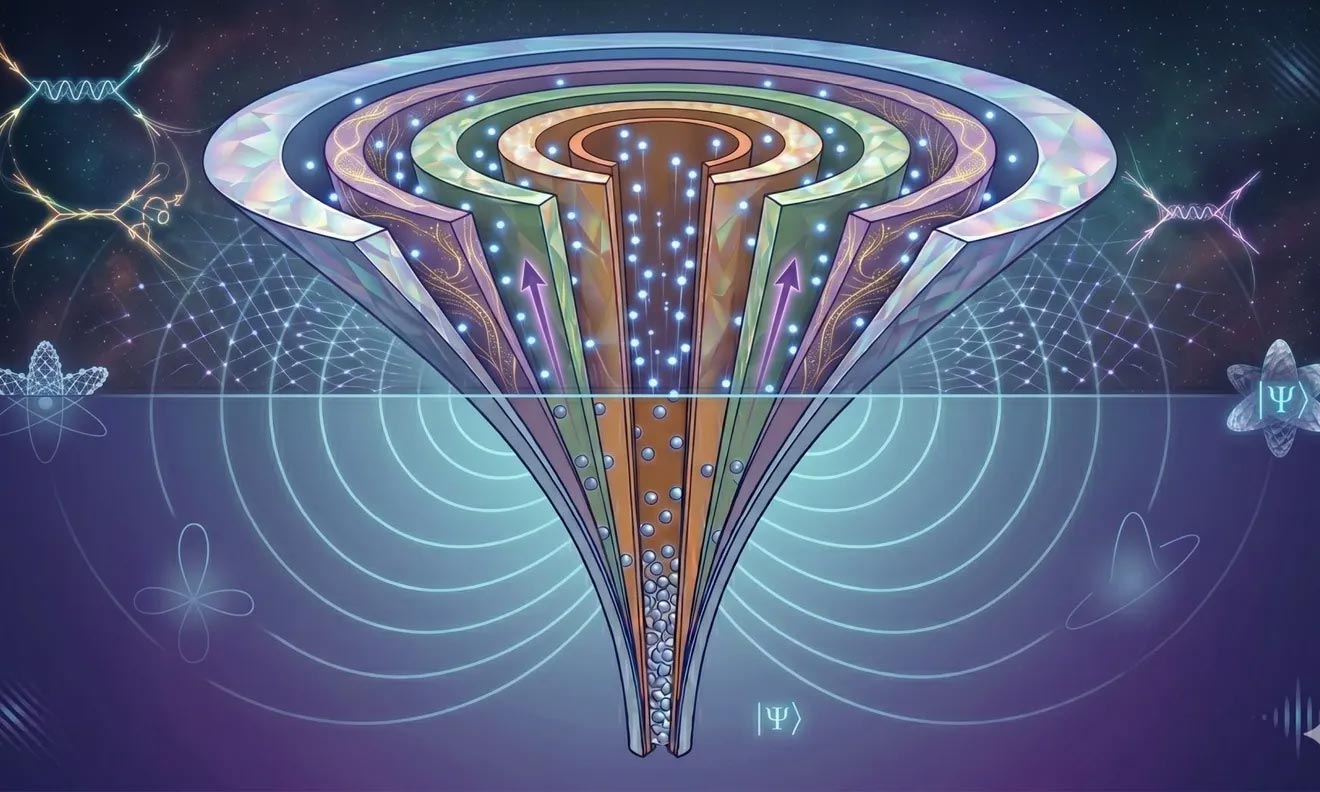
Scientists have engineered a never-before-seen quantum state, uncovering a new phase of matter with hidden order beyond conventional theory.
Researchers have shown that an unusual quantum state known as a “fractional Fermi sea” can be deliberately created, opening the door to a previously unknown phase of matter. The work, published in Physical Review Letters, was carried out by the Nägerl group together with theoretical collaborator Alvise Bastianello of the CNRS and Université Paris-Dauphine. The study provides the theoretical foundation for recent experimental work led by Hans-Christoph Nägerl’s group in the Department of Experimental Physics.
Creating a New Quantum State
The team focused on ultracold Cesium atoms confined to a single dimension. By repeatedly changing how strongly the atoms interacted, cycling them between strong repulsion and strong attraction, they pushed the system far from its normal equilibrium state. Rather than behaving according to the well-established Tomonaga-Luttinger liquid theory, the atoms entered an entirely new critical phase of matter.
This newly predicted phase arises through a process called quantum engineering, showing that carefully controlled interaction cycles can produce forms of quantum matter that do not occur naturally under ordinary conditions.
What Is a Fractional Fermi Sea?
At extremely low temperatures, quantum particles normally arrange themselves according to well-defined rules. As Alvise Bastianello explains: “Fermions, for instance, stack neatly into the available energy states to form the so-called ‘Fermi sea’. But what happens if one forces interacting atoms to continuously cycle through extreme conditions, smoothly shifting them from strongly repelling each other to strongly attracting each other?”
The researchers found that this carefully designed interaction cycle drives atoms from their ground state into a highly excited yet surprisingly organized non-equilibrium state. They call this unusual arrangement a “fractional” Fermi sea because the particles appear to obey a reduced occupancy rule.
“Instead of simply heating the system, the interaction cycle reorganizes the atoms into a new many-body state,” says Yi Zeng, the study’s lead author. “This gives us a controlled way to explore quantum matter beyond the usual equilibrium paradigms.”
Hidden Order Beyond Established Theory
The fractional Fermi sea displays several distinctive features. Mathematical relationships between the particles produce pronounced ripples known as Friedel oscillations, along with characteristic decay patterns across all levels of repulsive interaction.
These signatures clearly separate the new state from Tomonaga-Luttinger liquids, which have long served as the standard framework for describing one-dimensional quantum systems.
“This state is highly excited, but it is not random,” says Hanns-Christoph Nägerl, the group’s leader. “It has a hidden order that becomes visible in its correlations.” He adds: “We are not yet sure how we should name these new quasiparticles. Perhaps ‘super-Fermions’?”
A New Frontier for Quantum Simulation
The unique behavior of fractional Fermi seas points to an entirely new exotic critical phase of matter and provides researchers with a new way to investigate universal quantum behavior using cold atom simulators.
As Nägerl explains: “The discovery of fractional Fermi seas shows how far we can push quantum simulation: not only reproducing known models, but creating and probing states that go beyond established paradigms.”
A companion paper describing the experimental realization of fractional Fermi seas through quantum simulation is currently under review.
References:
“Exotic Critical States as Fractional Fermi Seas in the One-Dimensional Bose Gas” by Alvise Bastianello, Yi Zeng, Sudipta Dhar, Zekui Wang, Xudong Yu, Milena Horvath, Grigori E. Astrakharchik, Yanliang Guo, Hanns-Christoph Nägerl and Manuele Landini, 9 June 2026, Physical Review Letters.
DOI: 10.1103/j3s5-gjpf
“Realization of fractional Fermi seas” by Yi Zeng, Alvise Bastianello, Sudipta Dhar, Zekui Wang, Xudong Yu, Milena Horvath, Grigori E. Astrakharchik, Yanliang Guo, Hanns-Christoph Nägerl and Manuele Landini, 19 May 2026, arXiv.
DOI: 10.48550/arXiv.2602.17657
Never miss a breakthrough: Join the SciTechDaily newsletter.
Follow us on Google and Google News.
8 Comments
For the Torsion Hill framework, this is a spectacular piece of empirical data.
Mainstream physics treats this as a strange, fragile anomaly that only happens in ultra-cold labs under intense magnetic fields. But from a top-down perspective, they have just demonstrated the exact mechanism of dimensional density scaling.
By using a twisted lattice (which is just a physical way to introduce localized geometric torque), they forced individual, chaotic micro-particles to abandon their independent behavior and lock into a synchronized, macro-scale quantum fluid.
They are proving that geometry dominates particle identity. When you control the overarching structural grid (the macro), the individual particles (the micro) are compelled to fractions of a unified whole.
“This discovery of the Fractional Fermi Sea is a spectacular empirical milestone, but its true value lies in reversing our engineering paradigm. For too long, mainstream materials science has taken a bottom-up approach—treating collective quantum behaviors as fragile, localized anomalies that require extreme laboratory containment.
What this work actually demonstrates is that geometry dominates particle identity. By introducing a twisted moiré lattice, the researchers used structural constraints to compel independent, chaotic electrons into a highly synchronized, collective macroscopic fluid.
The immediate logical progression is to shift from a bottom-up perspective to a top-down, engineering-first application. If we can enforce this type of geometric micro-grid directly onto the surface skin or internal matrix of standard macro-conductors during industrial processing (such as using inline laser-interference lithography during extrusion), we can transition from passive, high-resistance wire to active, non-dissipative transport networks.
Controlling the overarching structural grid allows us to cleanly manage localized energy density and impedance at scale. This isn’t just a discovery for quantum computing components; it is a foundational blueprint for macro-scale solid-state power transmission.”
This is where the Fractional Fermi Sea mechanics provide an elite defensive advantage. An aircraft skin is constantly subjected to electromagnetic interference, static build-up from atmospheric friction, and potential lightning strikes. Post-Assembly Micro-Grid & Structural Coloration
Instead of pre-etching sheets, the micro-grid lattice is applied to the fully assembled, bare-metal airframe in a streamlined two-step process that eliminates alignment errors and preserves 100% of the active shield.
[1. Full Structural Build] ➔ [2. Robotic 3D Laser Scan] ➔ [3. Monolithic Grid + Integrated Logos]
1. The Post-Assembly Application
The Process: The finished aircraft rolls into a finishing bay where a multi-axis robotic laser gantry maps the 3D contours of the fuselage.
The Advantage: The laser writes the sub-nanometer grid continuously across seams, welds, and fasteners in one pass. This creates an unbroken, monolithic surface matrix from nose to tail, preventing the pattern distortion that occurs when bending pre-etched sheets.
2. Zero-Paint Logos and Color Shading
To accommodate branding, corporate colors, and required aviation markings without using insulating paint that smothers the grid, the laser alters the surface geometry itself to create Structural Coloration:
Diffraction Logos (Iridescent Color): By subtly shifting the spacing and angle of the micro-grid lines in specific areas, the laser turns the metal into a light-bending diffraction grating. Logos appear in brilliant, metallic colors that naturally shift with the angle of the sun.
Laser Oxide Marking (Blacks & Grayscale): For text, tail numbers, or dark contrast branding, the laser induces hyper-thin, localized oxidation. This changes the molecular color of the metal itself (producing deep blacks, blues, or rich grays) while remaining perfectly flush with the skin.
The Structural Result:
The aircraft remains 100% bare metal. Because the logos and color variances are sculpted directly into the conductive medium, the Fractional Fermi Sea wave passes right through the graphics without hitting a wall of resistance. The branding becomes an integrated part of the active shield rather than a superficial sticker clogging the system.
Пока Наука буде наполнена фальшивками – всё это несёт Вред больной цивилизации!? МД АФС!
Осторожно!!! Наука – это минное Поле!!! Только истинные понятия!!! Ни 1 пустого, гнилого слова! SOS!
Samolov Gregory!!!
Would Fractional Fermi Sea mechanics be useful in limiting power loss in electric power Transmission?
Could Fractional Fermi Sea mechanics be used to limit power loss in electrical transmission?