

Close Menu
    Facebook X (Twitter) Instagram
    SciTechDaily
    • Biology
    • Chemistry
    • Earth
    • Health
    • Physics
    • Science
    • Space
    • Technology
    Facebook X (Twitter) Pinterest YouTube RSS
    SciTechDaily
    Home»Physics»2D Quantum Freeze: Nanoparticles Cooled to Quantum Ground-State in Two Motional Dimensions
    Physics

    2D Quantum Freeze: Nanoparticles Cooled to Quantum Ground-State in Two Motional Dimensions

    By University of InnsbruckMarch 6, 2023No Comments4 Mins Read
    Facebook Twitter Pinterest Telegram LinkedIn WhatsApp Email Reddit
    Share
    Facebook Twitter LinkedIn Pinterest Telegram Email Reddit
    Abstract Cold Energy Particle Physics
    Physicists are studying glass nanoparticles trapped by lasers in a vacuum to explore the limits of the quantum world and determine when classical physics no longer applies. This is part of the ERC-Synergy project Q-Xtreme, where a team is working towards achieving the quantum ground-state by reducing the energy stored in the nanoparticle’s motion as much as possible.

    ETH Zurich researchers achieved two-dimensional ground-state cooling of glass nanoparticles, overcoming the “Dark Mode Effect.” This breakthrough enables the creation of advanced quantum sensors and highlights the potential of quantum mechanics.

    Glass nanoparticles trapped by lasers in extreme vacuum are considered a promising platform for exploring the limits of the quantum world. Since the advent of quantum theory, the question at which sizes an object starts being described by the laws of quantum physics rather than the rules of classical physics has remained unanswered.

    A team formed by Lukas Novotny (ETH Zurich), Markus Aspelmeyer (University of Vienna), Oriol Romero-Isart (University of Innsbruck), and Romain Quidant (Zurich) is attempting to answer precisely this question within the ERC-Synergy project Q-Xtreme. A crucial step on the way to this goal is to reduce the energy stored in the motion of the nanoparticle as much as possible, i.e. to cool the particle down to the so-called quantum ground-state.

    Control Over All Dimensions of Movement

    The Q-Xtreme team has been working together on ground-state cooling of nanoparticles for a long time. Several experiments in Zurich and Vienna, supported by theoretical calculations by Dr. Gonzalez-Ballestero and Prof. Romero-Isart at the University of Innsbruck, have led to the first demonstrations of such ground-state cooling of a nanoparticle, either by dampening the particle motion using electronic control (active feedback) or by placing the particle between two mirrors (cavity-based cooling). So far in experiments, the ground state has been achieved only along one of the three directions of particle motion, leaving the motion along the other two directions “hot.”
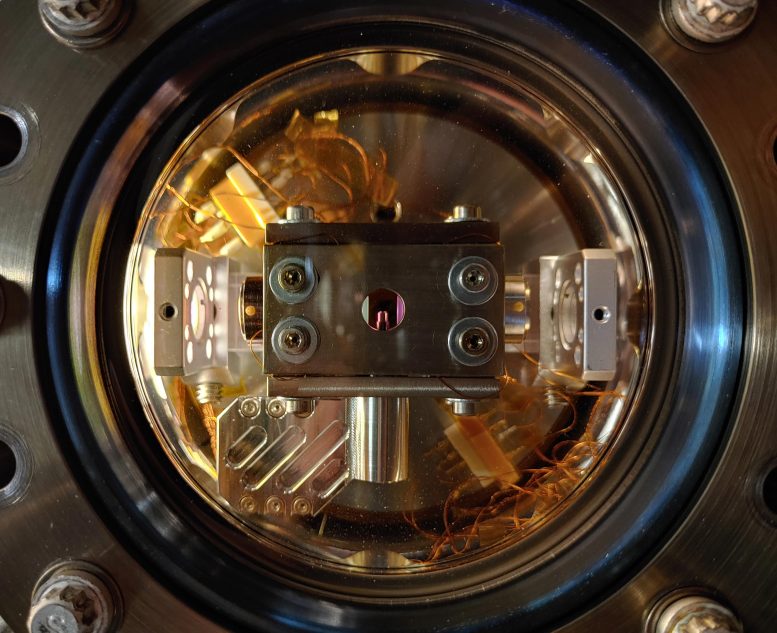
    Experimental Setup to Levitate Particle
    The vacuum chamber with the experimental setup to levitate a particle inside of a cavity. The cavity consists of two mirrors coated to be extremely reflective for infrared light. The cylindrical part in the center holds a lens at its tip to focus the infrared laser down to a point at which the particle is trapped. Credit: Johannes Piotrowski

    “Achieving ground-state cooling along more than one direction is key for exploring novel quantum physics,” emphasizes Gonzalez-Ballestero of the Institute for Quantum Optics and Quantum Information at the Austrian Academy of Sciences and the Department of Theoretical Physics at the University of Innsbruck. “But so far this achievement remained elusive as it was challenging to make the mirrors between which the particle is positioned interact efficiently with the motion along some of the three directions” The so-called “Dark Mode Effect” prevented cooling to the full ground state.

    With Different Frequencies Toward the Goal

    Now, the research at the Photonics Laboratory of ETH Zurich has succeeded for the first time in ground-state cooling of a nanoparticle along two directions of motion. A glass sphere, about a thousand times smaller than a grain of sand, is completely isolated from its environment in a high vacuum and held by a strongly focused laser beam while simultaneously being cooled to near absolute zero. Based on theoretical predictions from the Innsbruck team, the Swiss physicists were able to circumvent the dark-state problem. “To do so, we designed the frequencies at which the particle oscillates in the two directions differently and carefully adjusted the polarization of the laser light,” says Lukas Novotny of ETH Zurich.

    The work, published in Nature Physics, demonstrates that it is possible to reach the minimum energy state for the three motional directions. It also allows the creation of fragile quantum states in two directions, which could be used to create ultrasensitive gyroscopes and sensors.

    Reference: “Simultaneous ground-state cooling of two mechanical modes of a levitated nanoparticle” by Johannes Piotrowski, Dominik Windey, Jayadev Vijayan, Carlos Gonzalez-Ballestero, Andrés de los Ríos Sommer, Nadine Meyer, Romain Quidant, Oriol Romero-Isart, René Reimann and Lukas Novotny, 6 March 2023, Nature Physics.
    DOI: 10.1038/s41567-023-01956-1

    The research was financially supported by the European Research Council ERC and the European Union, among others.

    Never miss a breakthrough: Join the SciTechDaily newsletter.
    Follow us on Google and Google News.

    Nanoparticles Quantum Physics University of Innsbruck
    Share. Facebook Twitter Pinterest LinkedIn Email Reddit

    Related Articles

    Quantum Nanoparticles: Pulled and Compressed

    Atoms Don’t Like Jumping Rope: Breakthrough in Using Nanooptical Traps for Quantum Technologies

    Physicists Develop Data Bus for Quantum Computers

    Physicists Demonstrate Probing Topology by “Heating”

    Researchers Track Interactions Between Individual DNA Molecule Segments

    Physicists Encode One Qubit in Entangled States Distributed Over Several Particles

    PEPs Might Make Quantum Condensation Possible at Room Temperature

    Physicists Realize New Quasiparticle in Ultracold Quantum Gas

    Physicists Create a Condensate of Erbium

    Leave A Reply Cancel Reply

    • Facebook
    • Twitter
    • Pinterest
    • YouTube

    Don't Miss a Discovery

    Subscribe for the Latest in Science & Tech!

    Trending News

    The Universe Is Expanding Too Fast and Scientists Can’t Explain Why

    “Like Liquid Metal”: Scientists Create Strange Shape-Shifting Material

    Early Warning Signals of Esophageal Cancer May Be Hiding in Plain Sight

    Common Blood Pressure Drug Shows Surprising Power Against Deadly Antibiotic-Resistant Superbug

    Scientists Uncover Dangerous Connection Between Serotonin and Heart Valve Disease

    Scientists Discover a “Protector” Protein That Could Help Reverse Hair Loss

    Bone-Strengthening Discovery Could Reverse Osteoporosis

    Scientists Uncover Hidden Trigger Behind Stem Cell Aging

    Follow SciTechDaily
    • Facebook
    • Twitter
    • YouTube
    • Pinterest
    • Newsletter
    • RSS
    SciTech News
    • Biology News
    • Chemistry News
    • Earth News
    • Health News
    • Physics News
    • Science News
    • Space News
    • Technology News
    Recent Posts
    • Scientists Overcome Major Quantum Bottleneck, Potentially Transforming Teleportation and Computing
    • Quantum Physics’ Strangest Problem May Hold the Key to Time Itself
    • Scientists Create “Liquid Gears” That Spin Without Touching
    • The Simple Habit That Could Help Prevent Cancer
    • Forgotten Medicinal Plant Shows Promise in Fighting Dangerous Superbugs
    Copyright © 1998 - 2026 SciTechDaily. All Rights Reserved.
    • Science News
    • About
    • Contact
    • Editorial Board
    • Privacy Policy
    • Terms of Use

    Type above and press Enter to search. Press Esc to cancel.