
Close Menu
    Facebook X (Twitter) Instagram
    SciTechDaily
    • Biology
    • Chemistry
    • Earth
    • Health
    • Physics
    • Science
    • Space
    • Technology
    Facebook X (Twitter) Pinterest YouTube RSS
    SciTechDaily
    Home»Biology»Rediscovery of the Elusive Fairy Lantern: Thismia kobensis Emerges After 30 Years
    Biology

    Rediscovery of the Elusive Fairy Lantern: Thismia kobensis Emerges After 30 Years

    By Kobe UniversityMarch 6, 2023No Comments5 Mins Read
    Facebook Twitter Pinterest Telegram LinkedIn WhatsApp Email Reddit
    Share
    Facebook Twitter LinkedIn Pinterest Telegram Email Reddit
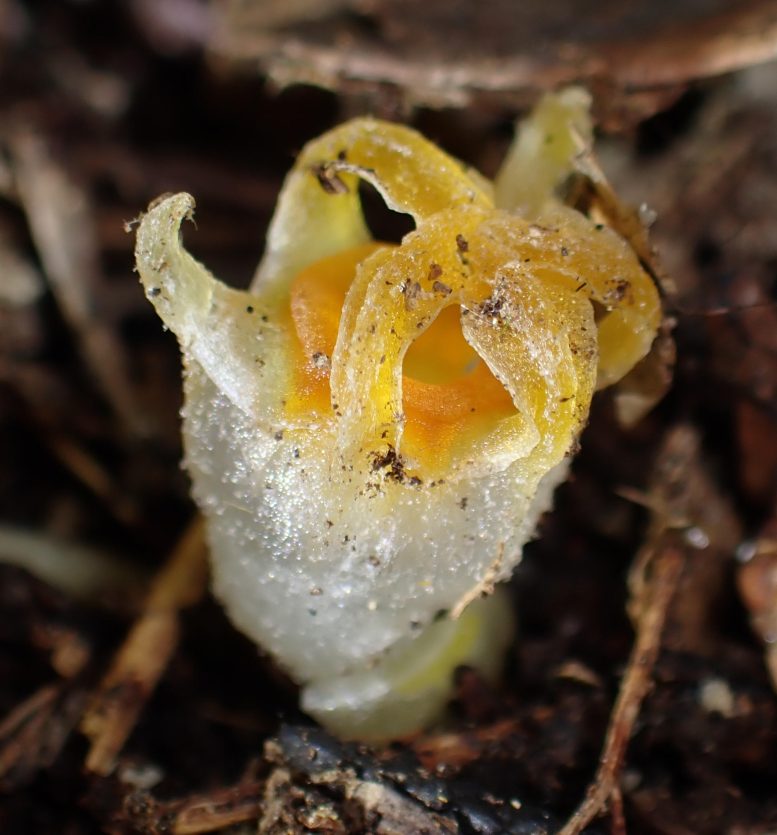
    The Rediscovered Ethereal Fairy Lantern Thismia kobensis at the New Locality
    As the moniker fairy lantern denotes, it looks like a tiny lantern that illuminates the dark forest floor. Credit: Kenji Suetsugu

    Rediscovered after 30 years, Thismia kobensis sheds light on the evolutionary links between Asian and North American fairy lanterns.

    Green leaves and the ability to photosynthesize were once considered hallmarks of plants. However, some plants have evolved to obtain their nutrients in alternative ways, such as through symbiotic relationships with other organisms. An example of such a plant is the genus Thismia, commonly known as “fairy lanterns.” These plants are known for their unique appearance, elusive nature, and lack of photosynthesis. They are considered rare and can only be found growing in specific, limited locations.

    They thrive underground, with their vibrant flowers emerging from the soil, sometimes giving them the appearance of mushrooms. Approximately 90 species of Thismia have been discovered, but many are only known from their place of origin and some may have already gone extinct.

    One such species, Thismia kobensis was originally discovered in Kobe City, Japan in 1992. Unfortunately, its habitat was destroyed by an industrial complex and it was subsequently presumed extinct. After more than 30 years, Professor Kenji Suetsugu and his colleagues report its rediscovery in Sanda City, located approximately 30 km away (Fig. 1). This unexpected find and subsequent investigations have shed new light on this remarkable genus and its evolutionary history.
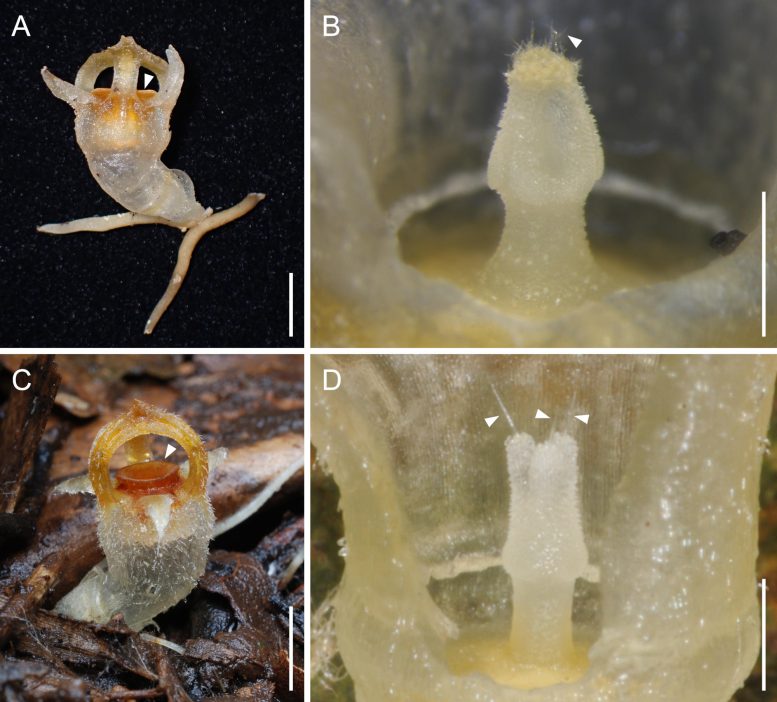
    Thismia kobensis and Its Relative Species T. huangii
    (A and C) Flower, lateral view. (B and D) Stigma lobe. Arrows indicate noticeable differences between the two (a perianth tube mouth [A and C] and hair on each stigma lobe [B and D]). Scale bars: 5 mm (A and C) and 3 mm (B and D). Credit: Kenji Suetsugu (A–B), Tian-Chuan Hsu (C) and Tsung-Hsin Hsieh (D)
    The researchers provided an updated description of Thismia kobensis to flesh out the original description that was based on an incomplete museum specimen. Their close examination highlighted how Thismia kobensis differs from the similar species Thismia huangii. The rediscovered species can be distinguished by its short and wide ring as well as the many short hairs on its stigma (Fig. 2). Based on their analysis of various characteristics, the researchers determined that Thismia kobensis is a distinct species, with unique characteristics and evolutionary history.

    The newly discovered location of Thismia kobensis makes it the northernmost known Asian fairy lantern species. This discovery may offer new insights into the systematic affinity and biogeography of the mysterious fairy lantern, Thismia americana, which was originally thought to be related to some species in Australia and New Zealand. Thismia americana discovered over 100 years ago is the only North American fairy lantern species and was observed for a few years on a prairie near Chicago, but is now considered extinct.
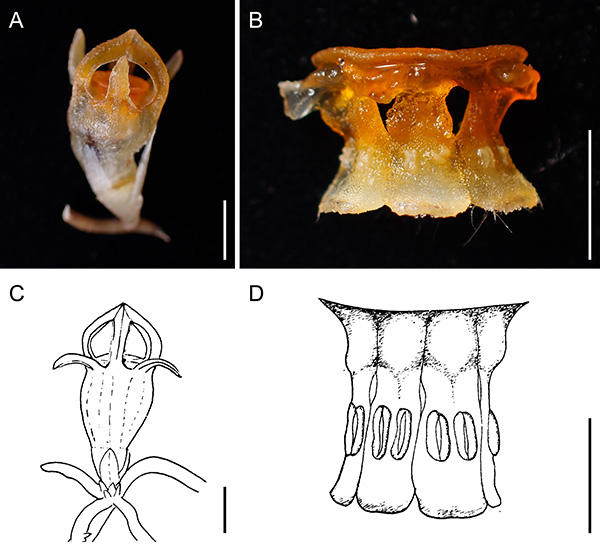
    Thismia kobensis and Its Enigmatic Relative Species T. americana
    (A and C) Flower, lateral view. (B and D) Stamen tube. The two are similar not only in their outer floral appearance but also in their internal structure. Scale bars: 5 mm (A and C) and 3 mm (B and D). Photographed by Kenji Suetsugu (A-B). Reproduced from Pfeiffer (1914; C-D). Credit: Kenji Suetsugu (A-B). C-D: Pfeiffer, N.E. (1914) Morphology of Thismia americana. Botanical gazette 57: 122–135

    The presence of the mainly tropical genus Thismia in temperate North America remains a mystery, especially since the species considered to be its closest relative, Thismia rodwayi, is found in Australia and New Zealand. This strange distribution pattern continues to puzzle botanists.

    However, a detailed morphological investigation suggested that Thismia kobensis is indeed the closest relative of Thismia americana (Fig. 3). Thus, the similarity in outer floral morphology between Thismia americana and the Australia-New Zealand species may have evolved independently based on pollinator preferences. This suggests that Thismia americana may actually be unrelated to the Australia-New Zealand species.
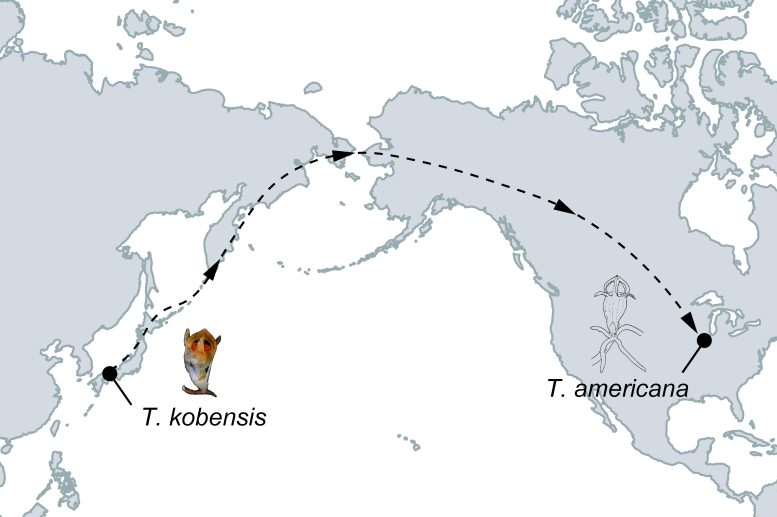
    The Proposed Range Expansion Mechanism of Fairy Lanterns
    The proposed range expansion mechanism of fairy lanterns in the present study. Credit: Kenji Suetsugu

    In contrast, the striking similarity in inner floral morphology, such as the lack of nectar glands in both species, suggests a closer relationship between Thismia americana and Thismia kobensis (Fig. 3B & D). Plant species in Eastern Asia and North America having close relationships and disjunct distributions across these regions is not uncommon and can often be attributed to migration through the Beringia land bridge. Therefore, the disjunct distribution of Thismia americana may be due to migration through Beringia (Fig. 4).

    Overall, the rediscovery of the Thismia kobensis after three decades has significantly advanced our understanding of fairy lanterns. As the northernmost species of Asian fairy lantern found so far, it also provides crucial insight into the biogeography and evolutionary history of fairy lanterns as a whole. The paper also includes information on conservation measures to help protect these rare plants from human activities.

    Reference: “Rediscovery of the presumably extinct fairy lantern Thismia kobensis (Thismiaceae) in Hyogo Prefecture, Japan, with discussions on its taxonomy, evolutionary history, and conservation” by Kenji Suetsugu, Kohei Yamana and Hidehito Okada, 27 February 2023, Phytotaxa.
    DOI: 10.11646/phytotaxa.585.2.2

    The study was funded by the Japan Science and Technology Agency

    Never miss a breakthrough: Join the SciTechDaily newsletter.
    Follow us on Google and Google News.

    Biodiversity Evolution Extinction Kobe University Plant Science Plants
    Share. Facebook Twitter Pinterest LinkedIn Email Reddit

    Related Articles

    Bizarre Plants That Quit Photosynthesis Still Find a Way to Thrive

    World’s Largest Inventory of Known Plant Species Compiled by German Researchers

    Zoonomia Project: Largest Set of Mammalian Genomes Reveals Species at Risk of Extinction

    71 New Species From 2019 Described by Scientists: From Geckos to Goblin Spiders

    Nearly 40% of Global Species Are Very Rare, at Risk for Extinction From Climate Change

    Recently Discovered Parasitic Wasp Is Enemy of Serious Alien Pest in North America

    Meet the “Extinct Species” That Was Just Rediscovered After 200 Years

    Study Finds Reasons for Plant Extinction Vary Across the World and Over Time

    1 Billion Years of Evolution Illuminated by Genetic Sequencing of 1,100 Plants

    Leave A Reply Cancel Reply

    • Facebook
    • Twitter
    • Pinterest
    • YouTube

    Don't Miss a Discovery

    Subscribe for the Latest in Science & Tech!

    Trending News

    Mezcal “Worm” in a Bottle Mystery: DNA Testing Reveals a Surprise

    New Research Reveals That Your Morning Coffee Activates an Ancient Longevity Switch

    This Is What Makes You Irresistible to Mosquitoes

    Shockingly Powerful Giant Octopuses Ruled the Seas 100 Million Years Ago

    Scientists Stunned by New Organic Molecules Found on Mars

    Rewriting Dinosaur Evolution: Scientists Unearth Remarkable 150-Million-Year-Old Stegosaur Skull

    Omega-3 Supplements Linked to Cognitive Decline in Surprising New Study

    First-of-Its-Kind Discovery: Homer’s Iliad Found Embedded in a 1,600-Year-Old Egyptian Mummy

    Follow SciTechDaily
    • Facebook
    • Twitter
    • YouTube
    • Pinterest
    • Newsletter
    • RSS
    SciTech News
    • Biology News
    • Chemistry News
    • Earth News
    • Health News
    • Physics News
    • Science News
    • Space News
    • Technology News
    Recent Posts
    • These Simple Daily Habits Can Quickly Improve Blood Pressure and Heart Risk Factors
    • A Common Nutrient May Play a Surprising Role in Anxiety
    • Doing This After 9 p.m. Could Double Your Risk of Gut Issues
    • New Research Challenges Long-Held Beliefs About How the Brain Makes Decisions
    • Breakthrough Technology Reveals New Treatment Targets for Cancer
    Copyright © 1998 - 2026 SciTechDaily. All Rights Reserved.
    • Science News
    • About
    • Contact
    • Editorial Board
    • Privacy Policy
    • Terms of Use

    Type above and press Enter to search. Press Esc to cancel.