
Close Menu
    Facebook X (Twitter) Instagram
    SciTechDaily
    • Biology
    • Chemistry
    • Earth
    • Health
    • Physics
    • Science
    • Space
    • Technology
    Facebook X (Twitter) Pinterest YouTube RSS
    SciTechDaily
    Home»Space»Jack-o-Lantern Nebula Spotted by Spitzer Telescope
    Space

    Jack-o-Lantern Nebula Spotted by Spitzer Telescope

    By NASA's Jet Propulsion LaboratoryOctober 31, 2019No Comments4 Mins Read
    Facebook Twitter Pinterest Telegram LinkedIn WhatsApp Email Reddit
    Share
    Facebook Twitter LinkedIn Pinterest Telegram Email Reddit
    Jack o Lantern Nebula
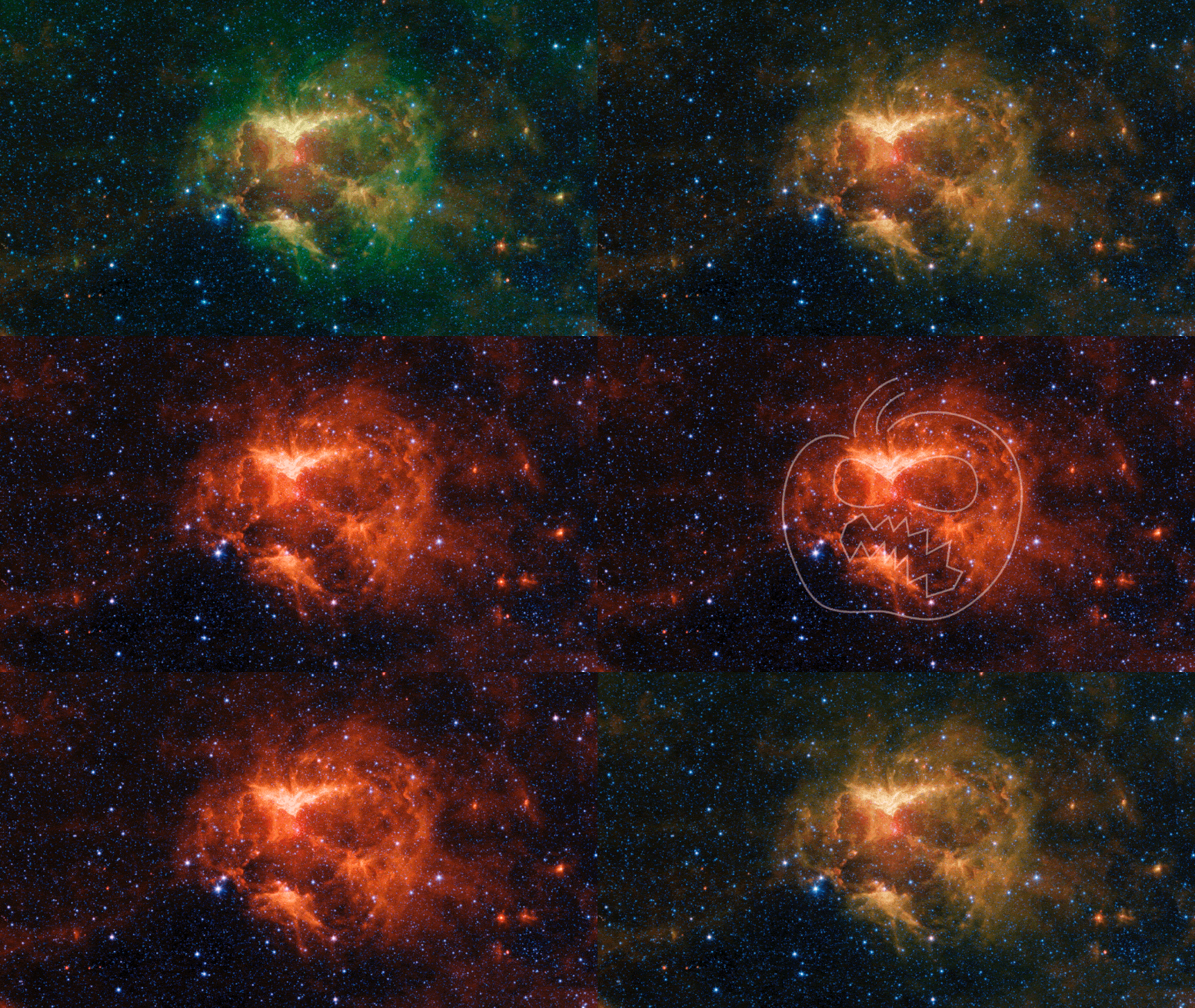
    This infrared image from NASA’s Spitzer Space Telescope shows a cloud of gas and dust carved out by a massive star. A drawing overlaid on the image reveals why researchers nicknamed this region the “Jack-o’-lantern Nebula.” Credit: NASA/JPL-Caltech

    A carved-out cloud of gas and dust looks like a celestial jack-o’-lantern in this image from NASA’s Spitzer Space Telescope.

    A massive star — known as an O-type star and about 15 to 20 times heavier than the Sun — is likely responsible for sculpting this cosmic pumpkin. A recent study of the region suggests that the powerful outflow of radiation and particles from the star likely swept the surrounding dust and gas outward, creating deep gouges in this cloud, which is known as a nebula.

    Spitzer, which detects infrared light, saw the star glowing like a candle at the center of a hollowed-out pumpkin. The study’s authors have fittingly nicknamed the structure the “Jack-o’-lantern Nebula.”

    A plethora of objects in the universe emit infrared light, often as heat, so objects tend to radiate more infrared light the warmer they are.
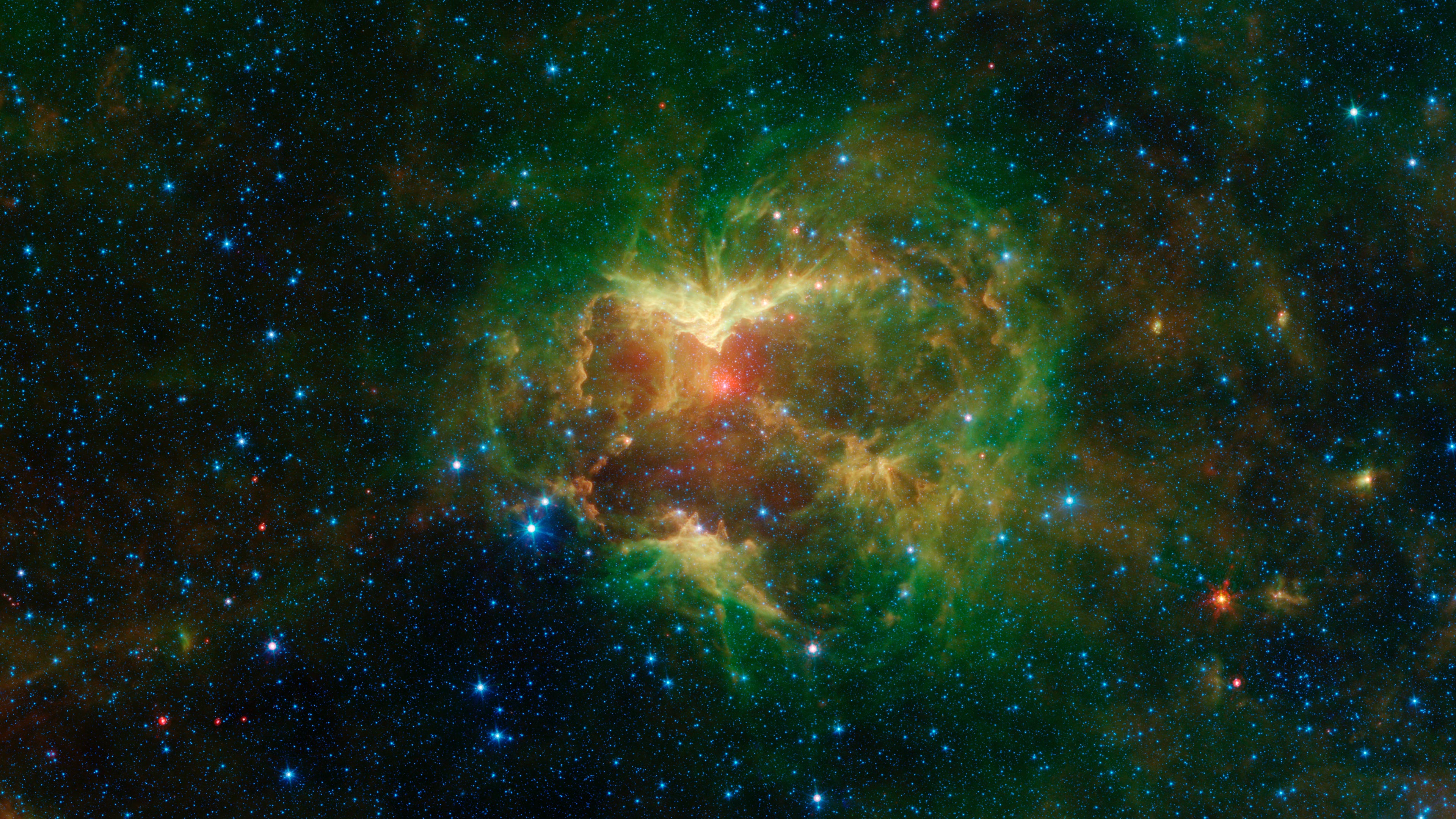
    Jack-o'-lantern Nebula Figure 1
    Jack-o’-lantern Nebula Figure 1. Credit: NASA/JPL-Caltech

    Invisible to the human eye, three wavelengths of infrared light compose the multicolor image of the nebula seen in Figure 1. Green and red represent light emitted primarily by dust radiating at different temperatures, though some stars radiate prominently in these wavelengths as well. The combination of green and red in the image creates yellow hues. Blue represents a wavelength mostly emitted, in this image, by stars and some very hot regions of the nebula, while white regions indicate where the objects are bright in all three colors. The O-type star appears as a white spot in the center of a red dust shell near the center of the scooped-out region.
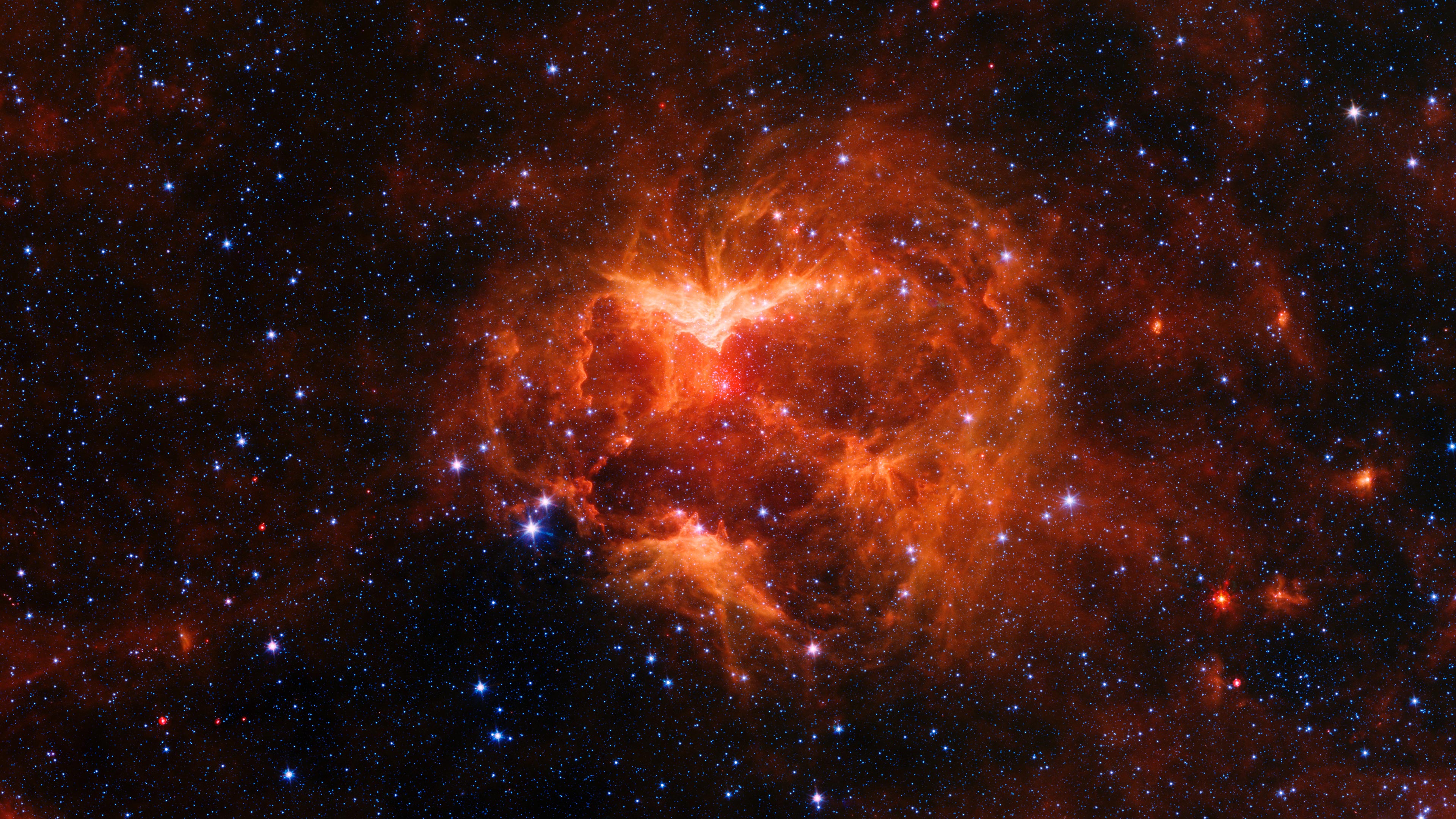
    Jack-o'-lantern Nebula Figure 2
    Jack-o’-lantern Nebula Figure 2. Credit: NASA/JPL-Caltech

    Figure 2 is a high-contrast version of the same image, which makes the red wavelength more pronounced. Together, the red and green wavelengths create an orange hue. The picture highlights contours in the dust as well as the densest regions of the nebula, which appear brightest.
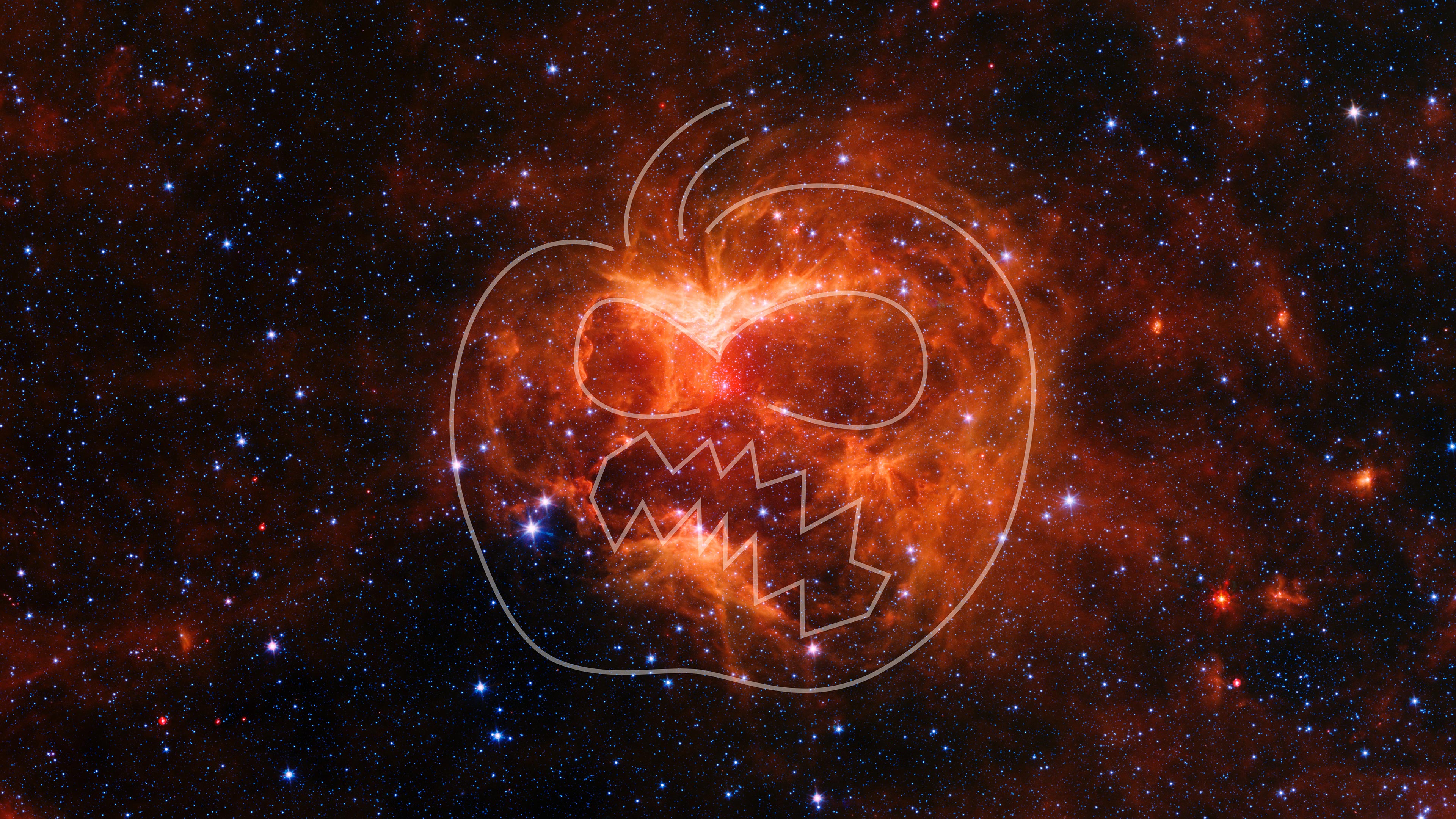
    Jack-o'-lantern Nebula Nebula Figure 3
    Jack-o’-lantern Nebula Figure 3. Credit: NASA/JPL-Caltech

    Figure 3 shows Figure 2 overlaid with a simple artist’s drawing that reveals why researchers nicknamed this region the Jack-o’-lantern Nebula.

    The study that produced these observations appears in the Astrophysical Journal and examined a region in the outer region of the Milky Way galaxy. (Our Sun is halfway to the edge of the disk-shaped galaxy.) Researchers used infrared light to count the very young stars in different stages of early development in this region. They also counted protostars — infant stars still swaddled in the dense dust clouds in which they were born. When combined with tallies of adult stars in these regions, these data will help scientists determine whether the rates of star and planet formation in the galaxy’s outer regions differ from the rates in middle and inner regions.

    Scientists already know that conditions differ slightly in those outer areas. For example, interstellar clouds of gas and dust are colder and more sparsely distributed there than they are near the center of the galaxy (which may reduce the rate of star formation). Star-forming clouds in those outer areas also contain lower amounts of heavy chemical elements, including carbon, oxygen, and other ingredients for life as we know it. Eventually, more studies like this one might also determine whether planets similar in composition to Earth are more or less common in the outer galaxy than in our local galactic neighborhood.

    The data used to create this image was collected during Spitzer’s “cold mission,” which ran between 2004 and 2009.

    Reference: “A Census of Star Formation in the Outer Galaxy: The SMOG Field” by Elaine Winston, Joseph Hora, Robert Gutermuth and Volker Tolls, July 2019, Astrophysical Journal.
    DOI: 10.3847/1538-4357/ab27c8
    arXiv: 1906.03267

    Never miss a breakthrough: Join the SciTechDaily newsletter.
    Follow us on Google and Google News.

    Astronomy JPL NASA Popular Spitzer Space Telescope
    Share. Facebook Twitter Pinterest LinkedIn Email Reddit

    Related Articles

    NASA Discovers Pair of Super-Earths With 1,000-Mile-Deep Oceans

    Godzilla Nebula: A “Monster” Star-Forming Region Spied by NASA’s Spitzer Space Telescope

    Hidden Supernova: Stars Are Exploding in Dusty Galaxies – We Just Can’t Always See Them

    NASA’s Spitzer Spies a Massive Star Factory – 2 Quadrillion Miles Across

    A New Way to Detect the Early Stages of Massive Star Formation

    Hubble & Spitzer See Weather Patterns in a Brown Dwarf

    Measuring the Expansion of Universe – A Newly Refined Value for the Hubble Constant

    New Image of the Helix Nebula Unraveling Into Space

    Searching for “Bubbles” in the Milky Way

    Leave A Reply Cancel Reply

    • Facebook
    • Twitter
    • Pinterest
    • YouTube

    Don't Miss a Discovery

    Subscribe for the Latest in Science & Tech!

    Trending News

    Monster Storms on Jupiter Unleash Lightning Beyond Anything on Earth

    Scientists Create “Liquid Gears” That Spin Without Touching

    The Simple Habit That Could Help Prevent Cancer

    Millions Take These IBS Drugs, But a New Study Finds Serious Risks

    Scientists Unlock Hidden Secrets of 2,300-Year-Old Mummies Using Cutting-Edge CT Scanner

    Bread Might Be Making You Gain Weight Even Without Eating More Calories

    Scientists Discover Massive Magma Reservoir Beneath Tuscany

    Europe’s Most Active Volcano Just Got Stranger – Here’s Why Scientists Are Rethinking It

    Follow SciTechDaily
    • Facebook
    • Twitter
    • YouTube
    • Pinterest
    • Newsletter
    • RSS
    SciTech News
    • Biology News
    • Chemistry News
    • Earth News
    • Health News
    • Physics News
    • Science News
    • Space News
    • Technology News
    Recent Posts
    • Scientists Discover a New Meteor Shower From a Mysterious Crumbling Asteroid
    • This Simple Fruit Wash Could Make Produce Safer and Last Days Longer
    • These Tiny Robots 50x Smaller Than a Hair Can Hunt and Move Bacteria
    • Simple Blood Test May Predict Alzheimer’s Years Before Brain Scans Show Signs
    • Scientists Say Adding This Unusual Seafood to Your Diet Could Reverse Signs of Aging
    Copyright © 1998 - 2026 SciTechDaily. All Rights Reserved.
    • Science News
    • About
    • Contact
    • Editorial Board
    • Privacy Policy
    • Terms of Use

    Type above and press Enter to search. Press Esc to cancel.