
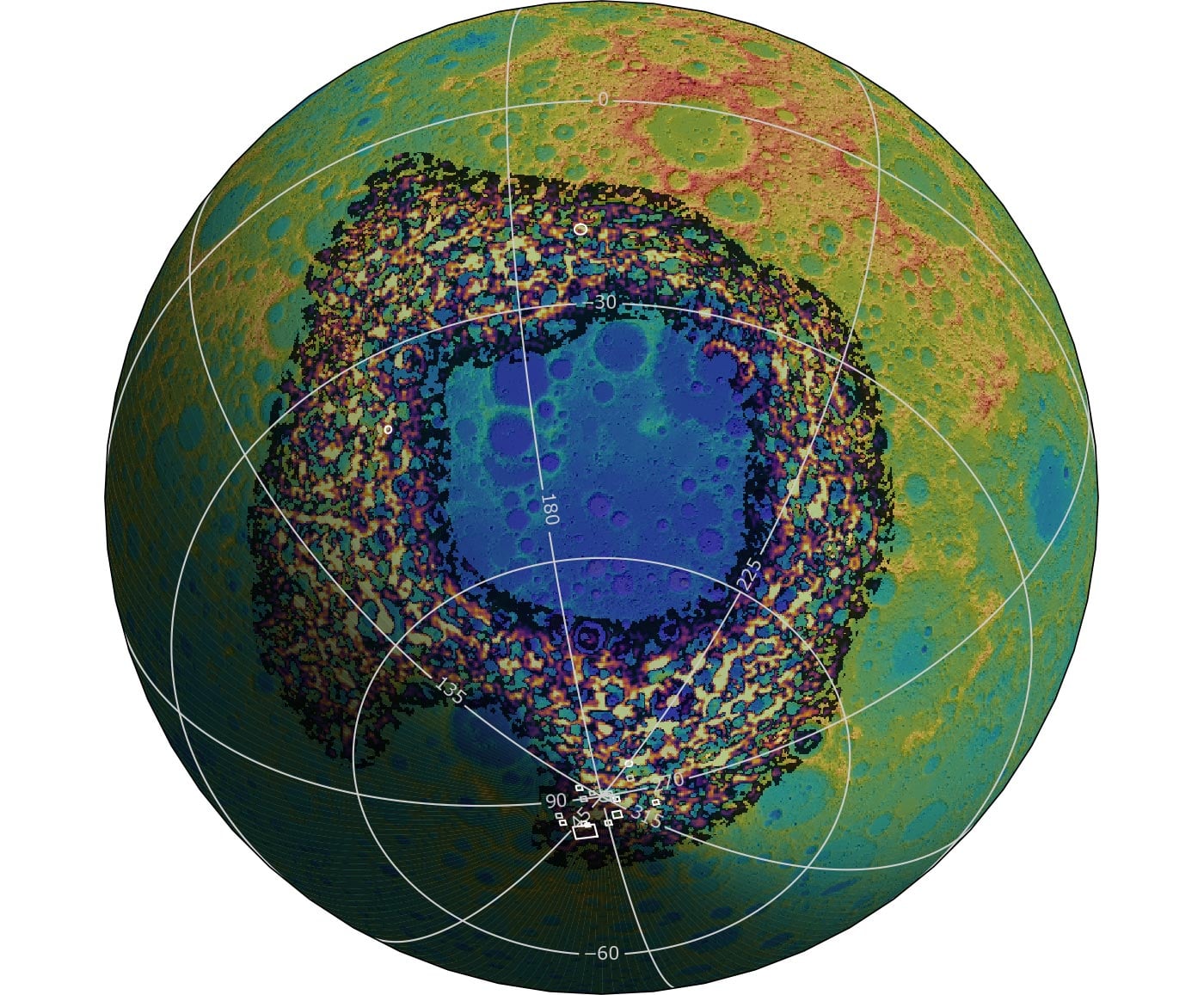
A giant impact billions of years ago may have brought rocks from deep inside the Moon to the surface near the lunar south pole.
Researchers say future Artemis astronauts could study this rare material to learn more about the Moon’s origin and evolution.
Scientists have uncovered new evidence about the violent event that created the Moon’s largest and oldest impact basin, a discovery that could help guide future Artemis astronauts searching for clues to the Moon’s earliest history. Two companion studies reveal how the enormous collision unfolded and suggest that valuable rocks from deep inside the Moon may be much closer to the surface than previously believed.
The Moon’s Largest Impact Basin Holds Ancient Clues
The research was led by scientists from the Center for Lunar Origin and Evolution (CLOE), Southwest Research Institute’s team within NASA’s Solar System Exploration Research Virtual Institute. Their work focuses on the South Pole-Aitken (SPA) basin, an enormous crater on the Moon’s far side that ranks among its oldest surviving features.
Because the SPA basin formed so early in the Moon’s history, scientists view it as a unique record of conditions in the young Solar System. The region also lies near areas being considered for NASA’s Artemis missions, making it an especially important destination for future exploration.
“The basin offers scientists a rare opportunity to study the Moon’s earliest history,” said Dr. William Bottke, director of CLOE and executive director of SwRI’s Science Directorate in Boulder, Colorado. He is a co-author of the studies. “The collision struck the lunar surface with such force that it may have excavated material from deep inside the Moon, including portions of the lunar mantle.”
Simulations Reveal How the Giant Impact Happened
To better understand how the basin formed, researchers used advanced computer models to recreate the ancient collision. Their simulations indicate that the incoming object approached from the Moon’s north and traveled south, striking the surface at a shallow angle. That trajectory explains the distinctive elongated, tapered shape of the South Pole-Aitken basin.
“Our simulation produces the right shape and nature of the impact basin. It also tells us about the projectile that created it and the direction of the impact,” said Dr. Shigeru Wakita of Purdue University, lead author of the SPA impact study.
The models also reveal that the impactor was more complex than a solid rock. It was likely a differentiated body with an iron core surrounded by rocky material, similar to a small protoplanet or a differentiated asteroid.
When it slammed into the Moon, the object carved out a deep, uneven cavity and generated intense heat that melted rock in the basin’s center. The impact blasted enormous amounts of crustal and mantle material into space before much of it fell back onto the basin floor.
Gravity Data Points to Hidden Lunar Mantle
A second study examined how this ejected material is distributed beneath and around the basin. Researchers combined high-resolution gravity measurements with models that included both crust and mantle material.
Their analysis suggests the SPA basin contains significant amounts of mantle-derived rock within its interior and mixed throughout the surrounding ejecta blanket. Later impacts inside the basin appear to have uncovered some of these buried deposits, bringing mantle material closer to the surface where future robotic missions or Artemis astronauts could potentially collect samples.
“The precise distribution of mantle material has been a big unknown,” said Dr. Gabriel Gowman of the University of Arizona, lead author of the gravity-based study. “Our models indicate that the SPA impact ejected enough deep material to form a significant deposit that should still be accessible today. Most importantly, some of that material at a trace level may exist in regions being considered for the Artemis landings.”
Artemis Could Explore Material From Deep Inside the Moon
Previous ideas suggested that the deepest material excavated by the impact remained largely confined to areas far from potential landing sites near the lunar south pole. The new simulations and gravity analysis paint a different picture.
The findings indicate that deposits containing material from the Moon’s mantle may extend across parts of the south polar region, including locations that could be visited during future Artemis missions. If confirmed, astronauts may have an opportunity to collect samples that offer an unprecedented look inside the Moon without needing to drill deep beneath the surface.
“The combination of impact and gravity modeling gives us a powerful roadmap,” Bottke said. “It tells us not just how SPA formed, but where to look for the rocks that can answer some of our biggest questions about the Moon’s origin and evolution.”
The study, “A southward differentiated impactor forms the tapered shape of the South Pole-Aitken impact basin on the Moon,” was published in Science Advances. The companion paper, “Gravity Mapping of Lunar Mantle Material in South Pole-Aitken Basin Ejecta,” appeared in the Journal of Geophysical Research: Planets.
References:
“A southward differentiated impactor forms the tapered shape of the South Pole–Aitken impact basin on the Moon” by Shigeru Wakita, Brandon C. Johnson, Jeffrey C. Andrews-Hanna, Gabriel Gowman, Thomas M. Davison, Gareth S. Collins, Carys A. Bill, Simone Marchi, Amanda M. Alexander, William F. Bottke and Alexander J. Evans, 6 May 2026, Science Advances.
DOI: 10.1126/sciadv.aea1984
“Gravity Mapping of Lunar Mantle Material in South Pole-Aitken Basin Ejecta” by Gabriel Gowman, Shigeru Wakita, Brandon C. Johnson, William F. Bottke, Simone Marchi, Daniel P. Moriarty and Jeffrey C. Andrews-Hanna, 23 April 2026, Journal of Geophysical Research: Planets.
DOI: 10.1029/2026JE009665
Never miss a breakthrough: Join the SciTechDaily newsletter.
Follow us on Google and Google News.