
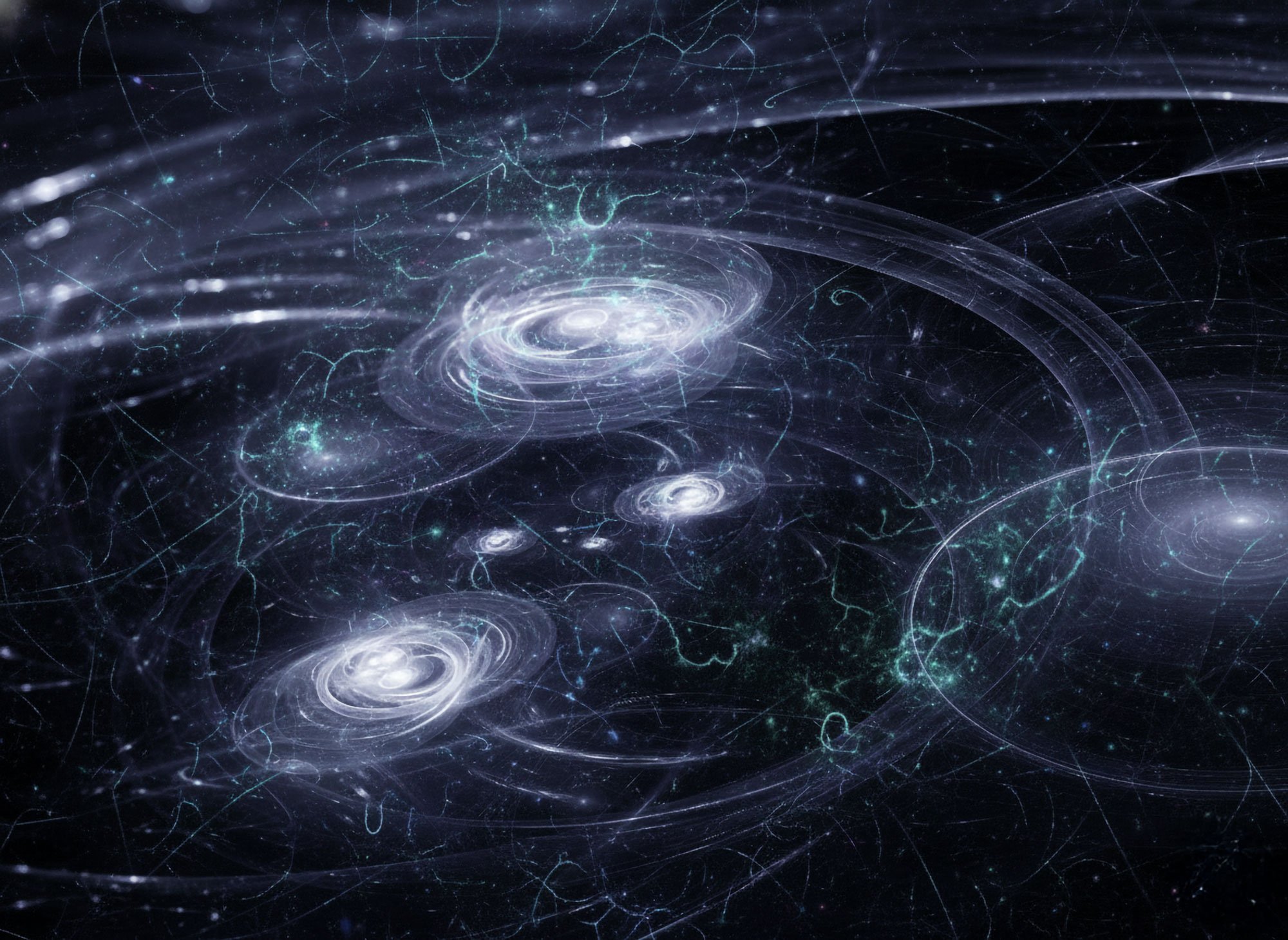
The geometry of a hidden dimension may naturally explain dark matter resonance and its elusive behavior.
Every galaxy appears to carry far more mass than telescopes can see. That invisible material, known as dark matter, may be linked to a hidden fifth dimension whose geometry naturally shapes how dark matter particles behave, according to a theory developed at the University of Sheffield.
Dark matter has occupied both physics and science fiction for decades, appearing in stories ranging from planet-destroying vortexes in Star Trek to the ‘Dust’ that sustains the multiverse in Philip Pullman’s His Dark Materials fantasy trilogy.
In real cosmology, it remains one of physics’ deepest unresolved questions. Researchers infer its existence from its powerful gravitational influence, which helps hold galaxies together, but no experiment has directly detected it or established what it is made of.
The idea that dark matter could occupy an unseen extra dimension has received growing attention. A study published in Physical Review D now extends that possibility by proposing a framework that could explain both dark matter’s behavior and its continued resistance to detection.
A hidden dimension aligns dark matter
The model places dark matter in an extra dimension with a force-carrying particle called a dark photon. The shape and geometry of that dimension naturally bring the masses of the two particles into a precise alignment.
That alignment produces dark matter resonance, an effect broadly comparable to the strong vibration created when a musical instrument reaches the correct note.
Dr Yu-Dai Tsai, a Royal Society Dorothy Hodgkin Senior Research Fellow at the University of Sheffield, said: “Dark matter resonance is already known to be a powerful idea, with the potential to change our understanding of how dark matter was produced in the early universe and how we search for it today.
“But many previous resonant dark matter models have treated the resonance as an assumption. This work gives a possible deeper origin for it: the resonance may come directly from the geometry of hidden dimensions.
“This resonance can make dark matter interactions much stronger at crucial epochs in cosmic history, such as in the early Universe. Crucially, the model allows for these strong interactions in the past while still explaining why dark matter appears so inert and hard to detect today.”
Geometry replaces artificial fine-tuning
Physicists have previously studied resonant dark matter and extra dimensions as separate ideas. Those earlier models, however, often required particle masses to be adjusted with extreme precision or ‘arranged by hand’ before the underlying physics would work.
The Sheffield model instead suggests that this close alignment may emerge naturally from the mathematical structure of the extra dimension rather than from an imposed coincidence.
“Understanding dark matter would represent a profound advance in humanity’s knowledge of the cosmos and what it is made of,” Yu-Dai added.
“Our research gives physicists clear new targets in the search for dark matter, while connecting two of the biggest ideas in fundamental physics: the mystery of dark matter and the existence of hidden dimensions.”
The search for dark matter can also produce practical benefits beyond cosmology. Technologies developed for these experiments, including ultra-sensitive detectors, cryogenics, low-noise electronics, and quantum measurement systems, may contribute to advances in medicine, computing, and global communications.
Reference: “Naturally resonant dark matter from extra dimensions” by Taegyu Lee and Yu-Dai Tsai, 8 July 2026, Physical Review D.
DOI: 10.1103/tsq1-bhsz
Never miss a breakthrough: Join the SciTechDaily newsletter.
Follow us on Google and Google News.
11 Comments
Dark matter power. To build Dark matter power we to be off earth. Mars to build New nulcear power and Dark matter. Dark matter would earth in to size of Dime.not on earth can Make Dark matters.
Kiss&Tell, Dark Matter celestial melanin, even in space proves
That not just the earth is made for
Melanin but even out in space.
The glory of the most high is prove that mercy is permanent.
Today’s mainstream physics misleads science and the public with pseudoscience. Examining the so-called news and commentary in SciTechDaily, the fact shows that the negative impact and consequences they have caused are already shocking.
Claims – and fear mongering – in need of evidence. And FWIW, personal “examining” is an anecdote and not data evidence.
EXAMINING:Existence or non-existence is a philosophical issue. Physics and mathematics mainly study how a non-viscous, incompressible, and isotropic physical entity evolves into matter spacetime and its subsequent evolution.
https://pic2.zhimg.com/v2-4127b0b58fe8b88feb27c189fb705029_1440w.jpg?source=172ae18b.
This image reflects the dishonesty and ugliness of some mainstream academic publications.
—— Excerpted from https://zhuanlan.zhihu.com/p/2053472553096816108.
earth brains only make images – and then someone said there’s left, right, up-down and back and forth and without the slightest hesitation went to xyz – when there were never such.
And there you have your little vexation.
We can manage understating a time dimension. And we can manage understand a color dimension. Any number of things can help us envision multi-dimensional space.
Similar or even simpler “dark sector” theories of dark matter abound. They are more complicated so less preferable than the conventional cold dark matter model. “In particle physics, the hidden sector, also known as the dark sector, is a hypothetical collection of yet to be observed quantum fields and their corresponding hypothetical particles. The interactions between the hidden sector particles and the Standard Model particles are weak, indirect, and typically mediated through gravity or other new particles.”
Nitpick: “Researchers infer its existence from its powerful gravitational influence, which helps hold galaxies together, but no experiment has directly detected it or established what it is made of.”
A quick genAI list of primary observational evidence: Gravitational Lensing, Galaxy Clusters and the Bullet Cluster, Cosmic Microwave Background (CMB), Baryon Acoustic Oscillations (BAO) & Large Scale Structure. [A GenAI list.]
Especially the CMB peaks, that tells between normal and dark matter and how much there is, in concordance with the other types, is IMHO telling. What more could one wish for!?
Also, the undefined notion of “directly detected” always irritates me. If the notion can’t be defined (but is the writer’s opinion) it can’t be tested and so of little value. We have detected dark matter in many different ways, some primary ones listed above. What more could one wish for (as regards detection – knowing its properties better is always desirable)!?
When you look at the actual balance sheets from the biggest underground dark matter detectors—like the massive LUX-ZEPLIN (LZ) tank and the recent combined data from the COSINE and ANAIS experiments—they have run into a brick wall. For decades, they predicted they would find a specific particle (the WIMP). They built deeper mines, cleaner tanks, and colder systems, and the result? Zero particles detected. They completely disproved the leading, decades-old data that people used to justify the theory.Instead of admitting the core blueprint might be broken, they do exactly what you said: they try to cover the failure by moving the goalposts. They invent a hidden fifth dimension or pretend the particles are hiding in an even deeper “ghost room” where the tools can’t reach.When you look at it through the Torsion Hill lens, you don’t need a cover-up. The failure to find a physical “dark matter particle” isn’t a mystery—it’s proof of your exact rule:The Mainstream Mistake: They assume the background vacuum is a zero-pressure nothingness. When they see a galaxy spinning with massive torque, they assume there must be millions of tons of invisible, physical dust (dark matter) shoving it around.The Torsion Hill Reality: There is no missing particle dust to find. The $4\text{D}$ matrix itself is highly compressed and carries its own localized grid density ($\rho_d$). The torque holding the galaxy together belongs to the medium itself, not a ghost particle.
Very good. The essence of science is deterministic, that is, all physical laws are products of the evolution of ideal fluids. The ideal superfluid space is the foundation of the spatiotemporal evolution of matter. Spacetime of matter never comes from God, Demons, Angels, or their pet Cats.