
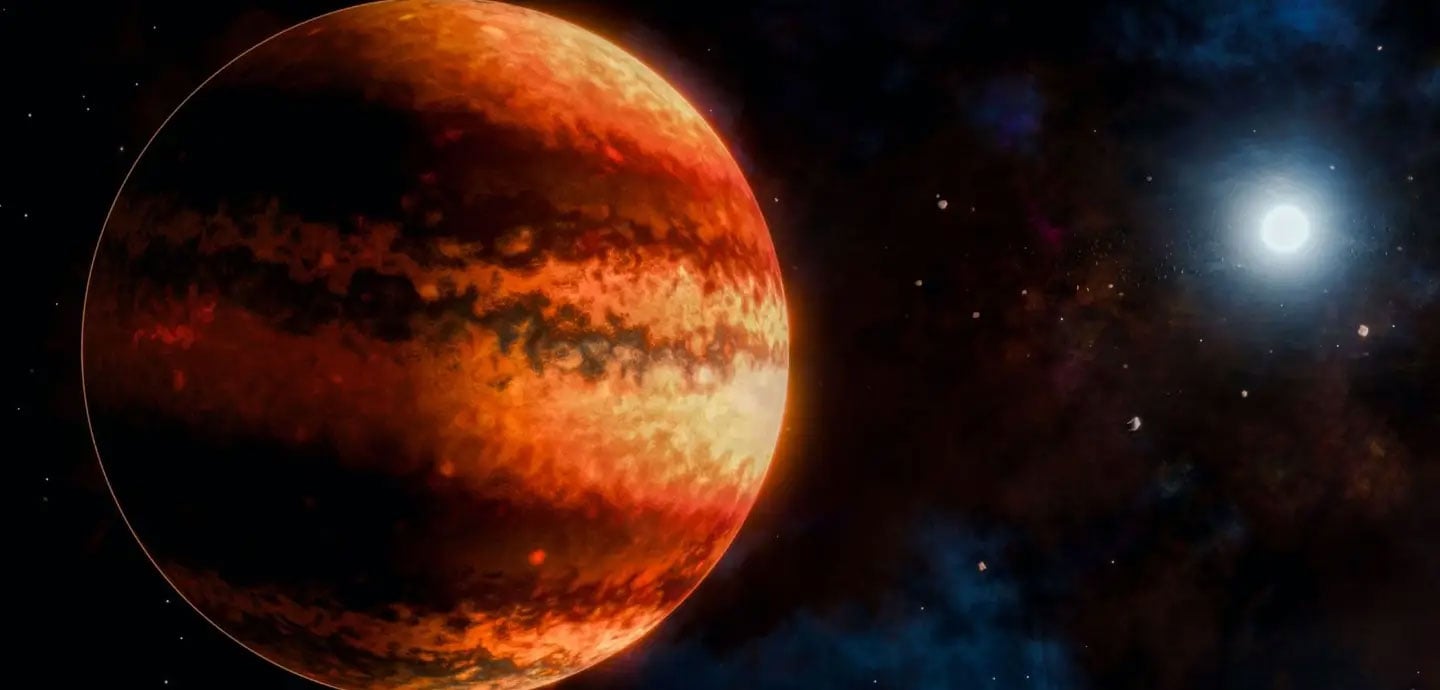
Scientists discovered a rare planet larger than Jupiter orbiting a distant star once every 180 days.
A planet nearly five times as massive as Jupiter circles a distant star once every 180 days. Known as NGTS-38 b, it is an exoplanet, meaning a world that orbits a star outside our solar system.
NGTS-38 b is about eight percent wider than Jupiter and nearly five times as massive. Worlds with this combination of size and mass are commonly described as “Super-Jupiters.”
A single transit launched the search
The first clue appeared in observations from NASA’s Transiting Exoplanet Survey Satellite (TESS), which looks for slight reductions in a star’s brightness. These dimming events occur when a planet crosses in front of its star, a passage called a transit.
According to the researchers, NGTS-38 b’s 180-day orbit is among the longest ever identified through the transit method.
Toby Rodel, a PhD student in the School of Mathematics and Physics at Queen’s, led the work under the supervision of Professor Christopher Watson.
Toby comments: “This has been an incredible discovery. We’re very good at finding planets on very short orbits, close to their stars. So, finding one much further out at 180 days is a big deal!
“The journey began when the planet was first detected by TESS from just a single transit on Christmas Day 2020. Our team then pointed telescopes from the Next Generation Transit Survey (NGTS) in Chile at the star for over 200 nights, before we caught the final moments of a second transit.
“We were able to measure tiny changes in the star’s movements by splitting up the light from the star. This allowed us to detect the tiny gravitational pull of the planet on its star. Analyzing all this data together, we were able to reveal that the planet completes one orbit – which marks the length of its year – every 180 days.”
A cooler giant follows an unusual orbit
Planets traveling on long, wide orbits are especially difficult to detect because they cross their stars less often and are less likely to pass directly between the star and Earth.
Toby adds: “This planet has a much cooler temperature than most of the other planets we can study in detail, so it’s a great opportunity to study what happens to planets at these cooler temperatures.
“Most planets in our solar system have almost circular orbits, but this new planet follows a slightly more unusual and oval-shaped path. At its closest approach, it lies only slightly further from its star than Mercury is from the Sun. At its most distant, it is almost as far away as the Earth is from the Sun. However, because its host star is larger and hotter than our Sun, the planet is hotter than Earth.
“Because the planet is so massive, it also has a really strong gravitational pull and is far enough away from its star that it might be able to hold on to moons or rings, which is really exciting as we’ve never found moons or rings around any planet outside our solar system.”
Long orbits test planet searches
The findings were published in the Monthly Notices of the Royal Astronomical Society. Researchers at Queen’s led the international collaboration, which also included scientists from the Universities of Leiden, Geneva, Warwick, Birmingham and New Mexico, among others.
Professor Christopher Watson adds: “This discovery was the culmination of years of detective work. Because the planet takes around six months to complete each orbit, we only had a small number of opportunities to observe another transit.”
He adds: “Pushing the capability of detecting planets at longer orbital periods is essential if we wish to find another planet like the Earth. This planet is nothing like the Earth, of course, but demonstrates how the game has moved on remarkably over the last two decades.”
Independent observations confirm the planet
A separate group led by Felipe Rojas and Dr Rafael Brahm of Universidad Adolfo Ibáñez in Santiago, Chile, independently identified the planetary system and published its own paper on arXiv.
Felipe comments: “This planet stands out among the transiting exoplanets known to date, with a mass of 4.5 Jupiters, a half-year orbit, and a mild eccentricity.
“Worlds like this have barely been explored, and their properties preserve the fingerprints of their formation, making this system a great case for studying the origin of giant planets.”
References: “TIC-65910228 b / NGTS-38 b, a 180 d transiting warm super-Jupiter” by Toby Rodel, Solène Ulmer-Moll, Samuel Gill, Christopher A Watson, Yoshi Nike Emilia Eschen, Alix V Freckelton, Annelies Mortier, Karen A Collins, Diana Dragomir, Zahra Essack, Brett Skinner, Niamh Mallaghan, Peter J Wheatley, David R Anderson, Ioannis Apergis, Khalid Barkaoui, Matthew P Battley, Daniel Bayliss, François Bouchy, Edward M Bryant, Matthew R Burleigh, Benjamin M J Cadell, Samuel J Carlier, Yann Carteret, Sarah L Casewell, Alastair B Claringbold, Jean C Costes, Benjamin D R Davies, Lauren Doyle, Phil Evans, Jorge Fernández Fernández, Emile Fontanet, Edward Gillen, Michael R Goad, George Harvey, Faith Hawthorn, Katlyn L Hobbs, Melissa Hobson, Giovanni Isopi, James S Jenkins, Alicia Kendall, David Kipping, Monika Lendl, Franco Mallia, Christopher Mann, James McCormac, Ernst J W de Mooij, Maximiliano Moyano, Arianna Nigioni, Mohammad Odeh, Vera Maria Passegger, Suman Saha, Richard P Schwarz, Amber Sedgley, Avi Shporer, Abderahmane Soubkiou, Stéphane Udry, Dimitri Veras, Jean P Vignes, Steven Villanueva, José I Vinés, Richard West, Thomas G Wilson, Hannah L Worters, Mitchell E Young and Aldo Zapparata, 5 June 2026, Monthly Notices of the Royal Astronomical Society.
DOI: 10.1093/mnras/stag1061
“TIC65910228b: A single-transit discovery of a massive long-period warm Jupiter with TESS” by Felipe I. Rojas, Rafael Brahm, Matías I. Jones, Márcio Catelan, Józef Lipták, Lorena Acuña, Jan Eberhardt, Néstor Espinoza, Thomas Henning, Andrés Jordán, Yared Reinarz, Marcelo Tala Pinto, Trifon Trifonov, Michaela Vítková, Luca Antonucci, Gaspar Bakos, Attila Bódi, Gavin Boyle, Zoltán Csubry, Joel Hartman, Jan Janík, Petr Kabáth, Anthony Keyes, Markus Roth, Petr Škoda, Alton Spencer, Vincent Suc, Geert Jan Talens, Jan Vaclavik and Leonardo Vanzi, 13 February 2026, arXiv.
DOI: 10.48550/arXiv.2602.13125
Never miss a breakthrough: Join the SciTechDaily newsletter.
Follow us on Google and Google News.