
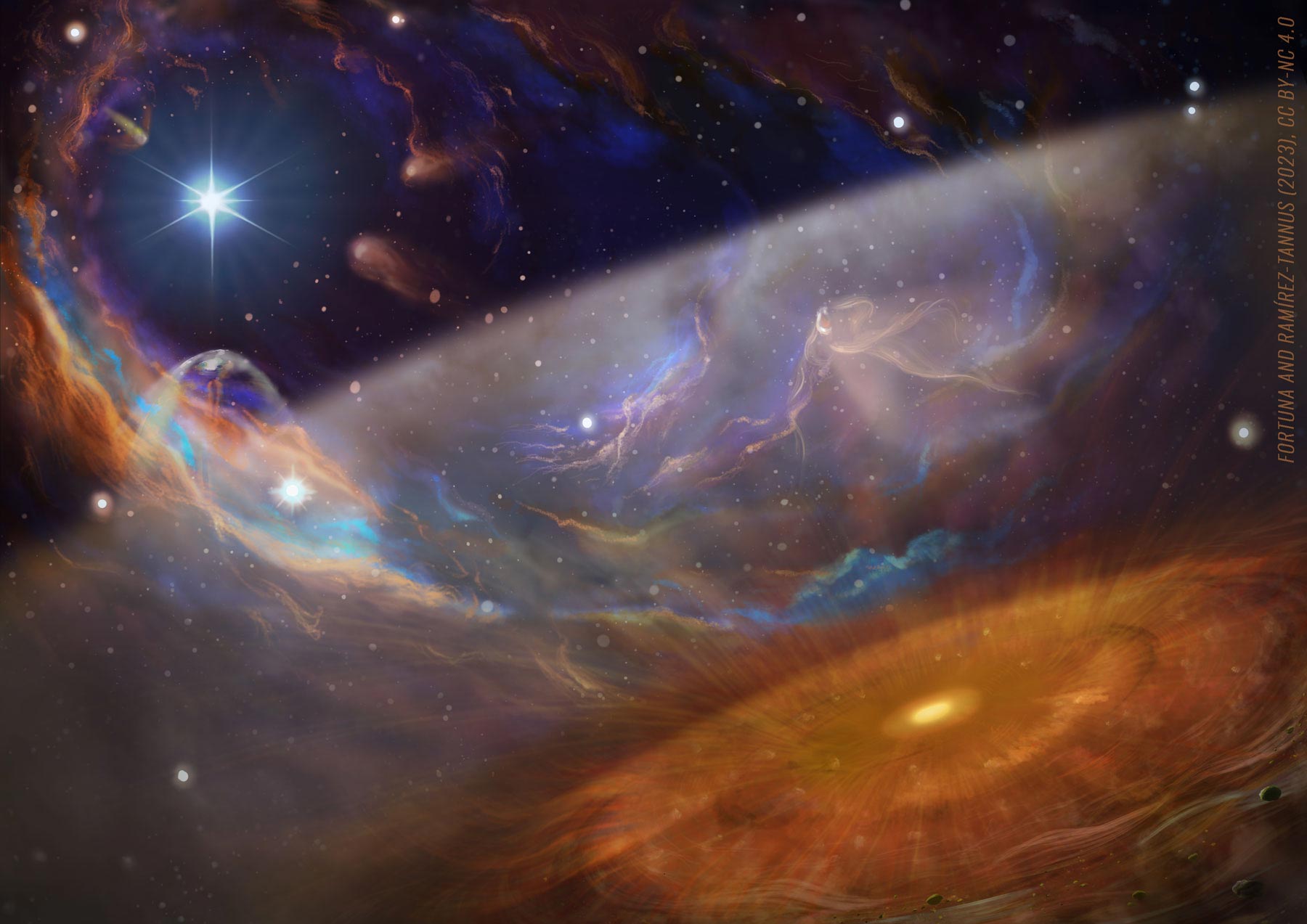
Penn State astronomers are using data from NASA’s James Webb Space Telescope, combined with theoretical models, to investigate a distant, radiation-bathed protoplanetary disk.
The basic ingredients needed to build planets can survive even in regions flooded with intense ultraviolet radiation, according to new research led by Penn State astronomers in collaboration with an international team.
Using NASA’s James Webb Space Telescope (JWST) alongside advanced thermochemical models, the scientists examined a protoplanetary disk, which is the ring of dust and gas that forms around a young star and has the potential to develop into planets and other celestial objects. Their investigation focused on one of the most extreme environments in our galaxy.
The study was recently published in The Astrophysical Journal.
“Astronomers have long sought to understand how planets form within the swirling disks of gas and dust that encircle young stars,” said Bayron Portilla-Revelo, a postdoctoral researcher in astronomy and astrophysics in the Eberly College of Science at Penn State and lead author of the study. “These structures — referred to as protoplanetary disks — are the birthplaces of extrasolar systems, like our own solar system, which formed 4.5 billion years ago. Protoplanetary disks often form in proximity to massive stars that emit substantial amounts of ultraviolet (UV) radiation, potentially disrupting the disks and affecting their capability to form planets. While significant progress has been made by studying protoplanetary disks in nearby star-forming regions, these regions lack the intense UV radiation present in more massive and common stellar nurseries.”
The Harsh Light of the Lobster Nebula
Ultraviolet (UV) radiation is a type of light that cannot be seen by the human eye and carries more energy than visible light. On Earth, it can damage living cells, causing effects that range from sunburn to skin cancer. In outer space, where there is no atmosphere to provide protection, UV radiation is even more powerful.
The researchers centered their study on a young star similar in mass to the Sun, called XUE 1, which lies about 5,500 light-years away in the Lobster Nebula (NGC 6357). This nebula contains more than 20 massive stars, including two of the largest in the Milky Way, both of which release extreme amounts of ultraviolet radiation. Within the same region, the team also identified around a dozen smaller young stars that each possess protoplanetary disks, all exposed to intense UV light.
Combining JWST observations with sophisticated astrochemical models, the researchers identified the composition of tiny dust grains in the protoplanetary disk around XUE 1 that will eventually grow to form rocky planets. They found that the disk contains sufficient solid material to potentially form at least 10 planets, each with a mass comparable to that of Mercury. The authors also determined the spatial distribution in the disk of a variety of previously detected molecules, including water vapor, carbon monoxide, carbon dioxide, hydrogen cyanide, and acetylene.
“These molecules are expected to contribute to the formation of the atmospheres of emerging planets,” said Konstantin Getman, research professor in the Department of Astronomy and Astrophysics at Penn State and co-author of the study. “The detection of such reservoirs of dust and gas suggests that the fundamental building blocks for planet formation can exist even in environments with extreme ultraviolet radiation.”
Evidence of Disk Erosion
Moreover, based on the absence of certain molecules that serve as tracers of UV irradiation in the light detected by JWST, the team inferred that the protoplanetary disk is compact and devoid of gas in its outskirts. It extends only about 10 astronomical units — a measure based on the average distance between the Earth and sun — from the host star, roughly the distance from the sun to Saturn. This compactness is likely a result of the external UV radiation eroding the outer regions of the disk, according to the research team.
“These findings support the idea that planets form around stars even when the natal disk is exposed to strong external radiation,” said Eric Feigelson, distinguished senior scholar and professor of astronomy and astrophysics and of statistics at Penn State. “This helps explain why astronomers are finding that planetary systems are very common around other stars.”
The study of XUE 1 represents a pivotal step in understanding the impact of external radiation on protoplanetary disks, the researchers said. It lays the groundwork for future observational campaigns with both space- and ground-based telescopes aimed at building a more comprehensive picture of planet formation across different cosmic environments. This research underscores the transformative capabilities of NASA’s James Webb satellite observatory in probing the intricacies of planet formation and highlights the resilience of protoplanetary disks in the face of formidable environmental challenges, according to Portilla-Revelo.
Reference: “XUE: Thermochemical Modeling Suggests a Compact and Gas-depleted Structure for a Distant, Irradiated Protoplanetary Disk” by Bayron Portilla-Revelo, Konstantin V. Getman, María Claudia Ramírez-Tannus, Thomas J. Haworth, Rens Waters, Arjan Bik, Eric D. Feigelson, Inga Kamp, Sierk E. van Terwisga, Jenny Frediani, Thomas Henning, Andrew J. Winter, Veronica Roccatagliata, Thomas Preibisch, E. Sabbi, Peter Zeidler and Michael A. Kuhn, 20 May 2025, The Astrophysical Journal.
DOI: 10.3847/1538-4357/adc91d
NASA funded the research, with additional support from the Center for Exoplanets and Habitable Worlds at Penn State, the Deutsche Forschungsgemeinschaft, the international Gemini Observatory — a program of NSF NOIRLab, which is managed by the Association of Universities for Research in Astronomy under a cooperative agreement with the U.S. National Science Foundation, the Royal Society Dorothy Hodgkin Fellowship and UKRI guaranteed funding for a Horizon Europe ERC consolidator grant, the Swedish National Space Agency, the German Aerospace Center, the German Federal Ministry for Economic Affairs and Energy, the European Union’s Horizon 2020 research and innovation program, and the European Research Council via the ERC Synergy Grant “ECOGAL.”
Never miss a breakthrough: Join the SciTechDaily newsletter.
Follow us on Google and Google News.
2 Comments
Astronomers have long sought to understand how planets form within the swirling disks of gas and dust that encircle young stars.
VERY GOOD.
Based on the topological vortex theory (TVT), space with ideal fluid characteristics (inviscid, incompressible, and isotropic) can form spacetime vortices through topological phase transitions. The rotation of spacetime vortices is spin, which can form extremely complex spacetime structures through self-organization and interaction. Spins can create all things and shape the world.
An entire generation has been severely misled and poisoned by so-called peer-reviewed publications. In today’s physics, the so-called peer-reviewed journals—including Physical Review Letters, Nature, Science, and others—stubbornly insist on and promote the following:
1. Even though θ and τ particles exhibit differences in experiments, physics can claim they are the same particle. This is science.
2. Even though topological vortices and antivortices have identical structures and opposite rotational directions, physics can define their structures and directions as entirely different. This is science.
3. Even though two sets of cobalt-60 rotate in opposite directions and experiments reveal asymmetry, physics can still define them as mirror images of each other. This is science.
4. Even though vortex structures are ubiquitous—from cosmic accretion disks to particle spins—physics must insist that vortex structures do not exist and require verification. Only the particles that like God, Demonic, or Angelic are the most fundamental structures of the universe. This is science.
5. Even though everything occupies space and maintains its existence in time, physics must still debate and insist on whether space exists and whether time is a figment of the human mind. This is science.
6. Even though space, with its non-stick, incompressible, and isotropic characteristics, provides a solid foundation for the development of physics, physics must still insist that the ideal fluid properties of space do not exist. This is science.
And so on.
The so-called peer-reviewed journals—including Physical Review Letters, Nature, Science, and others openly define differences as sameness, sameness as differences, existence as nonexistence, and nonexistence as existence—all while deceiving and fooling the public with so-called “impact factors (IF),” never knowing what shame is.
The universe is not a God, nor is it merely Particles. Moreover, it is not Algebra, Formulas, or Fractions. The universe is the superposition, deflection, entanglement, and locking of spacetime vortex geometries, the interaction and balance of topological vortices and their fractal structures. Topological invariants are the identical intrinsic properties between two isomorphic topological spaces. Different civilizations may create distinct mathematical codes or tools to describe the universality and specificity of these topological invariants under different physical laws.
Topology provides stability blueprints, but specific physics (spatial features, gravitational collapse, fluid viscosity, quantum measurement) dictates vortex generation, evolution, and decay. If researchers are interested in this, please visit https://zhuanlan.zhihu.com/p/1933484562941457487 and https://zhuanlan.zhihu.com/p/1925124100134790589.
Lobster Nebula (NGC 6357) – I remember a TV commercial where a lobster jumped out of a cook-pot, grabbing a Steam Beer in mid air and jockeyed its way out into the street, so good was Steam Beer.
“spacetime” is a poor name, from the old physics (not yet vacated). What’s a better name? As obviously it is a single property in which ‘time’ and ‘space’ are simply poor concepts poorly applied.