
The symmetry of vanadium’s crystal structure acts as a switch for hydrogen’s quantum behavior.
Inside a vanadium crystal, hydrogen can travel in two very different ways. It may move as a conventional particle that needs enough energy to jump between locations, or behave like a quantum wave that passes through barriers. Researchers have now identified the structural change that determines which route it takes.
The finding could matter as demand grows for materials that can safely store and transport hydrogen as a source of cleaner energy. Vanadium is a promising candidate because it absorbs hydrogen readily and allows the atoms to move through its crystal lattice, although the reason for their changing behavior had remained uncertain.
Researchers from the Institute of Industrial Science at The University of Tokyo combined measurements of hydrogen structure and diffusion with quantum mechanical calculations. Their results, published in Nature Communications, show that the symmetry of the vanadium crystal controls whether hydrogen displays quantum or classical behavior.
Symmetry determines hydrogen’s route
Hydrogen travels through vanadium by moving among small open spaces within the crystal lattice. In the classical process, an atom must acquire enough thermal energy to cross the barrier separating one site from the next.
Quantum mechanics allows another possibility. Through tunneling, hydrogen can behave like a wave and pass through an energy barrier rather than climbing over it. Determining what controls this shift could help scientists design materials that store hydrogen and regulate its movement more efficiently.
“Our results show that crystal symmetry is key to controlling hydrogen’s quantum behavior,” says corresponding author Takahiro Ozawa. “Highly symmetric structures allow hydrogen to tunnel, while distorted structures suppress this effect.”
At low hydrogen concentrations, the vanadium lattice remains highly symmetrical. Neighboring sites are structurally equivalent under these conditions, allowing hydrogen atoms to tunnel between them and form delocalized quantum states that extend across several atomic locations.
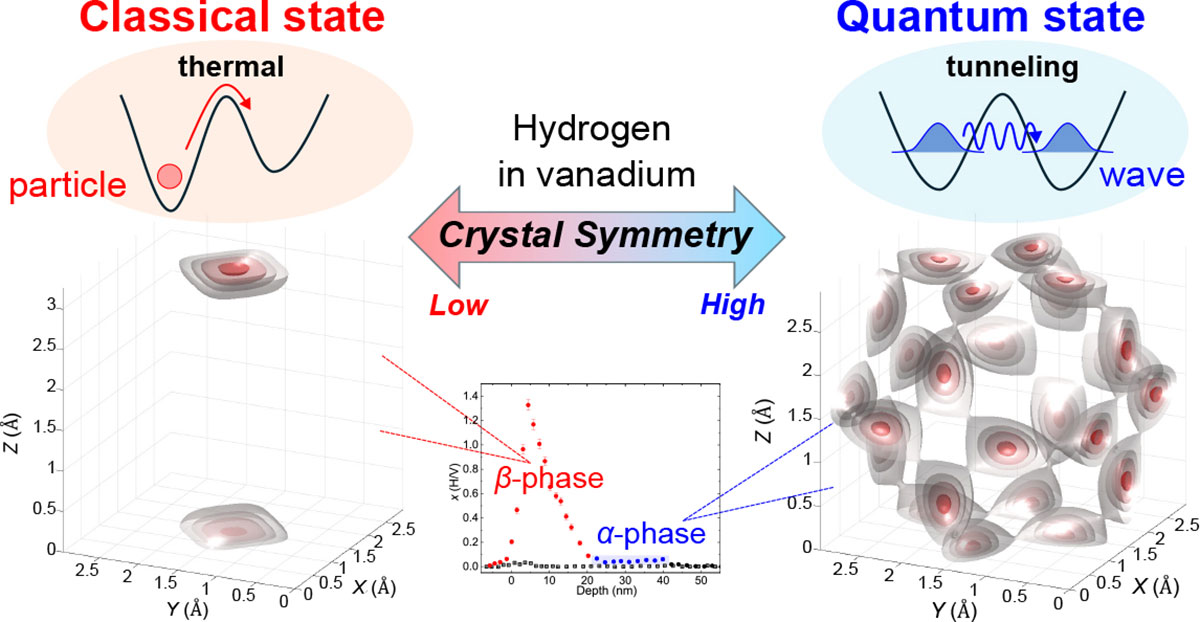
As more hydrogen enters the material, the lattice becomes distorted. The loss of symmetry shuts down the equivalent pathways needed for tunneling, causing hydrogen to act more like a classical particle that depends on thermal energy to move.
“Crystal symmetry is the underlying switch that turns quantum behavior on or off,” explains senior author Katsuyuki Fukutani. “In a symmetric structure, hydrogen finds equivalent pathways that allow it to tunnel between sites. Distort that symmetry — as happens at higher hydrogen concentrations — and tunneling is suppressed, forcing hydrogen to rely on thermal energy to hop between sites instead.”
Atomic control could improve hydrogen materials
The discovery suggests that researchers could regulate hydrogen movement by designing materials with carefully controlled crystal symmetry. Adjusting that internal structure could determine whether hydrogen spreads through a material by quantum tunneling or slower, temperature-dependent hopping.
“The ability to control how hydrogen behaves could improve materials used for hydrogen storage and diffusion control,” remarks Sudhansu Sekhar Das, lead author. “These advances may benefit a wide range of hydrogen-based technologies involving transport and purification.”
As hydrogen technologies develop, controlling individual atoms inside storage and transport materials will become increasingly important. By identifying crystal symmetry as the switch between quantum and classical motion, the study provides a clearer foundation for designing materials that manage hydrogen more precisely.
Reference: “Impact of crystal symmetry lowering on proton tunneling” by S. S. Das, T. Ozawa, T. Kawauchi, H. Nakanishi and K. Fukutani, 15 July 2026, Nature Communications.
DOI: 10.1038/s41467-026-75020-w
This work was supported by JSPS KAKENHI Grant Numbers JP18H05518, JP21H04650, JP24K17612, and JP25K24643; by JST PRESTO, Japan, Grant Number JPMJPR2504; and by the First Place Honor, Yayoi Award, Institute of Industrial Science, The University of Tokyo.
Never miss a breakthrough: Join the SciTechDaily newsletter.
Follow us on Google and Google News.