
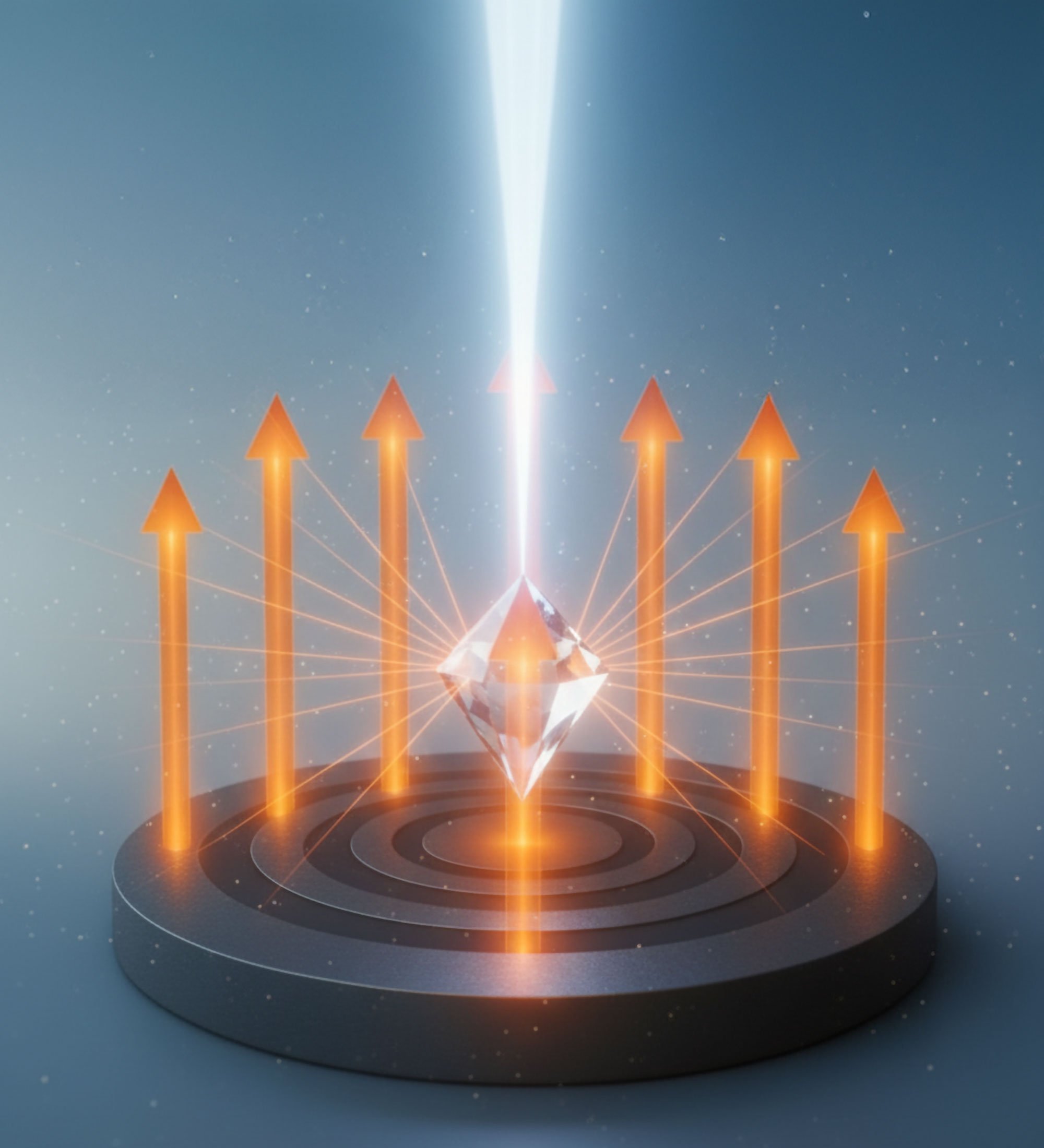
Researchers engineered nanodiamond-antenna systems that capture nearly all light from diamond defects, unlocking a major step toward practical quantum communication and sensing technologies.
Scientists from the Hebrew University of Jerusalem and Humboldt University in Berlin have discovered a method to capture nearly all the light emitted by microscopic flaws in diamonds, known as color centers. Their approach involves placing nanodiamonds into specially designed hybrid nanoantennas with extraordinary precision.
This technique allowed the team to achieve record-breaking photon collection at room temperature, a crucial milestone for advancing quantum technologies such as quantum sensors and secure quantum communications. The research was recognized as a Featured Article in APL Quantum.
Diamonds have always been admired for their brilliance, but this study shows how their sparkle can serve a far more advanced purpose. Working together, the teams from Jerusalem and Berlin managed to achieve an almost perfect collection of the faintest signals of light—individual photons—emitted from nitrogen-vacancy (NV) centers. These defects in diamond crystals play a vital role in developing next-generation quantum computers, ultra-sensitive sensors, and communication systems designed for the quantum era.
The Role of NV Centers
NV centers are microscopic imperfections in the diamond structure that can act like quantum “light switches.” They emit single particles of light (photons) that carry quantum information. The problem, until now, has been that much of this light is lost in all directions, making it hard to capture and use.
The Hebrew University team, together with their research partners from Berlin, solved this challenge by embedding nanodiamonds containing NV centers into specially designed hybrid nanoantennas.
These antennas, built from layers of metal and dielectric materials in a precise bullseye pattern, guide the light in a well-defined direction instead of letting it scatter. Using ultra-precise positioning, the researchers placed the nanodiamonds exactly at the antenna center—within a few billionths of a meter.
Record-Breaking Results
Featured in APL Quantum, the results are significant: the new system can collect up to 80% of the emitted photons at room temperature. This is a dramatic improvement compared to previous attempts, where only a small fraction of the light was usable.
Prof. Rapaport explained, “Our approach brings us much closer to practical quantum devices. By making photon collection more efficient, we’re opening the door to technologies such as secure quantum communication and ultra-sensitive sensors.”
Dr. Lubotzky added, “What excites us is that this works in a simple, chip-based design and at room temperature. That means it can be integrated into real-world systems much more easily than before.”
The research demonstrates not just clever engineering, but also the potential of diamonds beyond jewelry. With quantum technologies racing toward real-world applications, this advance could help pave the way for faster, more reliable quantum networks.
Reference: “Approaching unity photon collection from NV centers via ultra-precise positioning of nanodiamonds in hybrid nanoantennas” by Boaz Lubotzky, Hamza Abudayyeh, Niko Nikolay, Oliver Benson and Ronen Rapaport, 17 September 2025, APL Quantum.
DOI: 10.1063/5.0272913
Never miss a breakthrough: Join the SciTechDaily newsletter.
Follow us on Google and Google News.
2 Comments
With quantum technologies racing toward real-world applications, this advance could help pave the way for faster, more reliable quantum networks.
VERY GOOD!
Ask the researchers:
What is the quantum?
The term “quantum” originates from the Latin “quantus,” meaning “how much.” It was first introduced into physics by Planck in 1900 to describe the minimum unit of energy exchange. Planck proposed that the energy of blackbody radiation is emitted in discrete packets, or energy quanta. Einstein further applied the quantum concept to the photoelectric effect, establishing the particle nature of light. However, the essence of the “quantum” is not simply particulate, but the discrete manifestation of energy or angular momentum. In topological vortex theory, this discreteness originates from the topological constraints of the vortex structure; that is, the spin modes of the vortex form stable discrete states within the continuous medium, thereby explaining the origin of the quantum.
By re-examining the Schrödinger equation through topological vortex theory, we find that the essence of the quantum is the spin of a topological vortex, and the superposition state is the geometric manifestation of the rotational perspective of the vortex. Geometric topology, as a bridge between mathematics and physics, should be the core of theoretical development. Current physics needs to return to mathematical rigor and avoid building theories based on imagined particles to ensure the healthy development of science. Future research should deeply explore the integration of topological vortices and quantum field theory, providing a new path for a unified physical theory.
With quantum technologies racing toward real-world applications, this advance could help pave the way for faster, more reliable quantum networks.
Scientists are requested to think deeply:
What is the quantum technologies?
Since its birth in the early 20th century, quantum mechanics has used the Schrödinger equation as a core tool for predicting the behavior of microscopic systems. However, the physical interpretation of this equation remains controversial, particularly the concepts of wave function collapse and superposition states. Topological vortex theory (TVT), as an emerging geometric-physical framework, starts from vortex motion in a continuous medium and offers a new perspective for understanding quantum phenomena.
By re-examining the Schrödinger equation through topological vortex theory, we find that the essence of the quantum is the spin of a topological vortex, and the superposition state is the geometric manifestation of the rotational perspective of the vortex. Geometric topology, as a bridge between mathematics and physics, should be the core of theoretical development. Current physics needs to return to mathematical rigor and avoid building theories based on imagined particles to ensure the healthy development of science. Future research should deeply explore the integration of topological vortices and quantum field theory, providing a new path for a unified physical theory.