
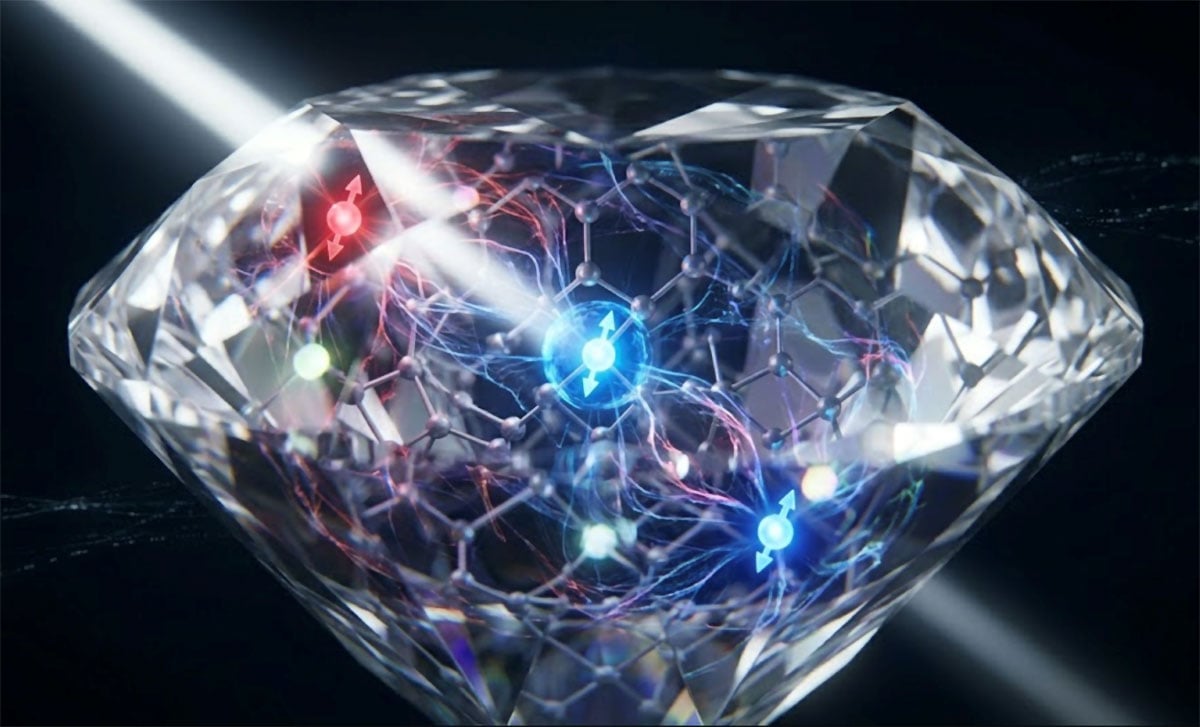
A subtle mechanical adjustment reveals a powerful way to control the quantum behavior of embedded defects.
Researchers have identified a new method to control the quantum behavior of tiny imperfections in diamond by gently stretching or compressing the crystal. This approach could lead to a new generation of sensors capable of detecting pressure, temperature, and other physical changes with exceptional precision.
These imperfections, known as “color centers,” are already widely used in quantum technologies, including highly sensitive sensors and developing quantum communication systems. One type, the silicon-vacancy (SiV) center, is especially promising because it produces bright and stable light, making it well suited for quantum devices.
In this study, an international team led by scientists from the Singapore University of Technology and Design (SUTD) and Yangzhou University in China examined how SiV centers behave when the diamond lattice around them is either compressed or stretched. Using detailed computational models, the researchers analyzed how the defect’s atomic structure and optical properties change under different mechanical conditions.
The team observed complex behavior. Under compression, the defect remains stable and keeps its original symmetry. However, when stretched beyond a critical limit of about 4% expansion, it undergoes a structural shift. This change breaks its symmetry and results in a new atomic arrangement.
Optical Signatures and Sensing Potential
This structural shift also alters how the defect interacts with light. The researchers found that important optical features, such as the color and brightness of emitted light, change gradually and predictably as strain is applied.
Professor Yunliang Yue from Yangzhou University said: “These optical changes act like a built-in ruler. By simply measuring the light emitted from the defect, we can infer how much the material is being compressed or stretched.”
Because of this consistent response, SiV centers show strong potential as nanoscale sensors. Their optical signals vary continuously with deformation, which could allow highly precise measurements of pressure or strain, even at the scale of individual nanostructures.
The study also explored the defect’s magnetic properties, which are relevant for techniques like electron spin resonance. These properties shift in a predictable way under strain, providing another way to detect changes and expanding the system’s sensing capabilities.
The researchers also explain the underlying physics behind these effects. As the diamond lattice expands or contracts, the defect’s electronic structure changes. This directly influences how it interacts with light and magnetic fields, helping connect fundamental quantum behavior with real-world applications.
Toward Tunable Quantum Technologies
The results indicate that SiV centers could become reliable and adjustable components for quantum sensing, especially in situations where materials experience mechanical stress, such as high-pressure research, nanoscale devices, and advanced materials.
“By showing how mechanical deformation can precisely control the quantum properties of silicon-vacancy centers, we open up new opportunities for designing multifunctional quantum sensors,” said Assistant Professor and the Kwan Im Thong Hood Choo Temple Early Career Chair Professor Yee Sin Ang from SUTD. “This work provides both fundamental understanding and practical guidance for engineering quantum defects in real-world applications.”
Dr. Shibo Fang, SUTD Research Fellow, added, “What is particularly exciting is the predictability of the response. The defect behaves in a highly controllable way under strain, which is exactly what is required for reliable sensing technologies. Our study lays the groundwork for future experiments and device integration.”
The team suggests that combining mechanical control with quantum defects could enable new types of quantum devices, including adaptive sensors and hybrid systems that respond in real time to changes in their surroundings.
Reference: “Effects of hydrostatic compression and tension on silicon-vacancy centers in diamond” by Yunliang Yue, Min Wang, Yaxuan Liu, Runxi Guo, Han Zhang, Huamu Xie, Yee Sin Ang and Shibo Fang, 4 February 2026, Applied Physics Letters.
Never miss a breakthrough: Join the SciTechDaily newsletter.
Follow us on Google and Google News.