

A hidden group of bladder nerves may detect UTIs and trigger symptoms that help the body clear bacteria.
The pain and urgent need to urinate during a urinary tract infection (UTI) may be more than unpleasant symptoms. Australian researchers have identified a little-understood group of nerves near the bladder lining that appears to detect infection and activate responses that help remove bacteria.
These nerves act as an early warning system for UTIs, helping the body recognize bacteria and inflammation. Their response may limit how severe an infection becomes and how far it spreads, while also offering a possible target for future treatments for bladder pain.
UTIs rank among the world’s most common bacterial infections, with more than 400 million cases reported annually. Nearly one third of women experience a UTI before age 24, while many older adults and people with bladder problems related to spinal cord injuries develop several infections within a single year.
Common symptoms include frequent urination, a sudden and intense urge to urinate, pain during urination, and pelvic discomfort. For some patients, these effects can be debilitating.
Dr. Luke Grundy of Flinders University says researchers have long understood how nerves monitor the bladder as it fills and signal when it needs to be emptied. The purpose of a specialized group of nerves positioned near the bladder lining, however, has remained uncertain.
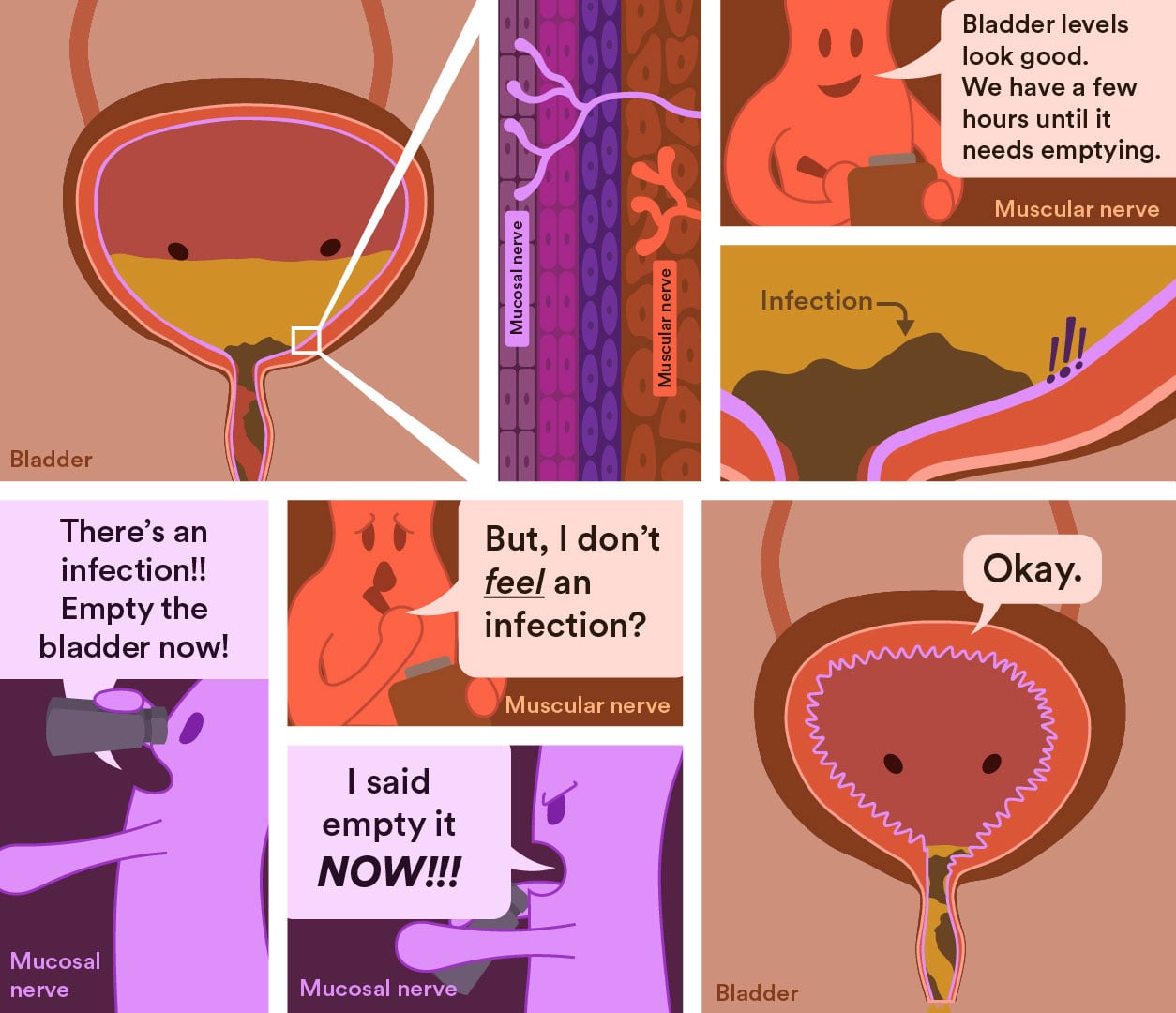
Hidden nerves detect infection early
“Most bladder nerves act like a fuel gauge, telling the brain when the bladder is filling up and needs emptying,” says Dr Grundy, Head of the NeuroUrology Research Group at Flinders University.
“The nerves we studied in this research are different. They sit close to the bladder lining and appear to act more like an early warning system, detecting infection and inflammation.
“They don’t just sense infection. They help coordinate the body’s response to it by triggering pain and urinary frequency, behaviors that appear to help clear bacteria from the bladder as part of the body’s defense system.”
Dr Cindy Tay, the lead author and a recently graduated PhD student, says the findings change the understanding of these nerves.
“These mucosal nerves have puzzled scientists for almost two decades because they stay quiet while the bladder fills and empties, which is the main job of the bladder,” says Dr. Tay.
“What we’ve found is that they have a hidden job—acting as an early warning system that springs into action the moment infection takes hold.”

Infection switches quiet nerves on
The researchers developed a new method that allowed them to selectively examine this specialized group of sensory nerves in the bladder lining of mice. The experiments showed that the nerves contribute little to ordinary bladder function but become highly responsive when a UTI develops, helping detect bacteria and inflammation.
“When the bladder is healthy, these nerves are relatively quiet, but during a urinary tract infection, they become highly sensitive and respond to the presence of bacteria and inflammation,” says Dr. Grundy.
“It may feel unpleasant, but urinating more frequently actually helps clear the infection by flushing out the harmful bacteria.”
Damaged signaling may raise UTI risk
The findings may also help explain why recurrent or severe UTIs are more common among people with medical conditions that impair nerve function.
“If the nerves that detect infection aren’t working properly, the body may not respond as effectively,” says Dr Grundy.
Building on earlier research, the study provides a clearer picture of how UTIs affect both the nervous system and bladder function. The results could support treatments that act on these nerves to reduce symptoms associated with infection.
“Our findings provide new insight into how the bladder detects and responds to infection, helping explain the biological processes that drive the pain, urgency, and discomfort commonly experienced during UTIs,” says Dr Grundy
The next challenge is to find ways to relieve UTI-related pain and urgency without interfering with the protective role these nerves appear to play in clearing infection.
Reference: “Bladder mucosal afferents detect UTI and aid pathogen clearance” by Cindy Tay, Harman Sharma, Stewart Ramsay, Georgia Bourlotos, Sarah K. Manning, Natalie E. Stevens, Sophie J. Miller, Geraint B. Rogers, David J. Lynn, Feargal J. Ryan, Andrea M. Harrington, Vladimir Zagorodnyuk, Steven L. Taylor and Luke Grundy, 3 August 2026, Proceedings of the National Academy of Sciences.
DOI: 10.1073/pnas.2604124123
This work was funded by a Flinders Foundation Fellowship (L.G) and a Flinders Foundation Health Seed Grant (L.G. S.L.T). S.L.T and F.J.R were supported by NHMRC Investigator Grants (2008625 and 2017404 respectively).
Never miss a breakthrough: Join the SciTechDaily newsletter.
Follow us on Google and Google News.