
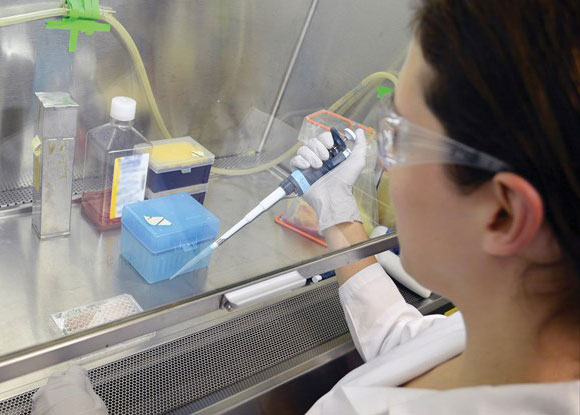
New research from Yale University is exploring how beneficial bacteria that live in the gut might trick the body into an autoimmune reaction known as antiphospholipid syndrome.
Doctors often describe the body’s immune system in military terms.
Physical barriers such as skin and mucus prevent invasion by disease-causing pathogens such as bacteria and viruses. If the obstacles fail, the body fires off an immediate general attack to deprive the invaders of shelter. In advanced organisms, the body sends specialized cells to target and kill the infiltrating microbes, forming a memory of their adversary for future battles.
But sometimes this memory proves faulty. The body attacks its own cells, mixing them up with the invaders. Such cases of mistaken identity comprise what are called autoimmune diseases that can result in serious complications.
“We don’t know exactly how the immune system decides between what is foreign and not,” said Dr. Martin Kriegel, an Assistant Professor of Immunobiology and of Medicine at Yale School of Medicine. “The immune system can be confused, and then the body reacts against itself.”
Two years after obtaining a Women’s Health Research at Yale seed grant, Kriegel has leveraged his findings to obtain substantially greater funding from the National Institutes of Health to continue exploring how beneficial bacteria that live in the gut might trick the body into an autoimmune reaction known as antiphospholipid syndrome.
Known as APS, the disorder can create life-threatening blood clots that might travel to the lung and cause strokes and heart attacks. Affecting up to 5 percent of the general population and more common in women, APS can cause pregnancy complications and miscarriages.
“The NIH estimates some 23.5 million Americans and rising suffer from autoimmune disease, compared to 9 million with cancer and 22 million with heart disease,” said Dr. Carolyn M. Mazure, Director of Women’s Health Research at Yale. “Among those with APS, between 75 and 90 percent are women who must learn to live with the threat of sudden death. Dr. Kriegel’s ongoing research seeks to better understand the causes of their diseases and possibly develop treatments that can offer a lifeline of hope for these women.”
For Kriegel, that lifeline finds anchor among the microorganisms that share our bodies in numbers 10 times higher than the number of cells that actually make up our bodies.
“We are full of bacteria,” Kriegel said, describing what’s called the body’s microbiome. “We are walking culture dishes.”
While this genetically diverse microbiome serves a mutually beneficial purpose in healthy humans, imbalances have been implicated in depression, anxiety, and even autism — as well as traditional autoimmune illnesses such as type 1 diabetes, multiple sclerosis, and lupus.
In exploring the origins of APS, Kriegel has identified a promising gut bacterium, R. intestinalis, that contains bits and pieces similar to the body’s natural protein, which then is mistakenly targeted by the immune cells in APS.
In subjects with a certain genetic predisposition, the researchers have found good evidence of what is called cross-reactivity, a phenomenon in which the body’s pathogen-targeting immune cells called lymphocytes mistake a self-protein as foreign. Confusing a natural response to gut bacteria with the self may trigger an unnecessary and damaging immune response outside of the gut.
“Our key bacterial candidate seems to tickle the system, activate these self-reactive lymphocytes,” Kriegel said.
Kriegel’s lab has begun testing this bacterial candidate in cultures. They’ve found an antibiotic that prevents death of mice with APS. And because the standard blood-thinning therapy to treat patients with APS can lead to bleeding and only deals with the effects of the disease, Kriegel hopes microbiome research will lead to therapies that prevent the events that lead to autoimmunity in the first place.
“It is still early,” Kriegel said of the growing field of research. “But this work and these findings are very promising.”
Never miss a breakthrough: Join the SciTechDaily newsletter.
Follow us on Google and Google News.