
Close Menu
    Facebook X (Twitter) Instagram
    SciTechDaily
    • Biology
    • Chemistry
    • Earth
    • Health
    • Physics
    • Science
    • Space
    • Technology
    Facebook X (Twitter) Pinterest YouTube RSS
    SciTechDaily
    Home»Space»ALMA Images Molecular Outflow from Luminous Galaxy NGC 6240
    Space

    ALMA Images Molecular Outflow from Luminous Galaxy NGC 6240

    By T. Saito, Harvard-Smithsonian Center for AstrophysicsMarch 9, 2018No Comments3 Mins Read
    Facebook Twitter Pinterest Telegram LinkedIn WhatsApp Email Reddit
    Share
    Facebook Twitter LinkedIn Pinterest Telegram Email Reddit
    ALMA Images the Molecular Outflows of NGC 6240
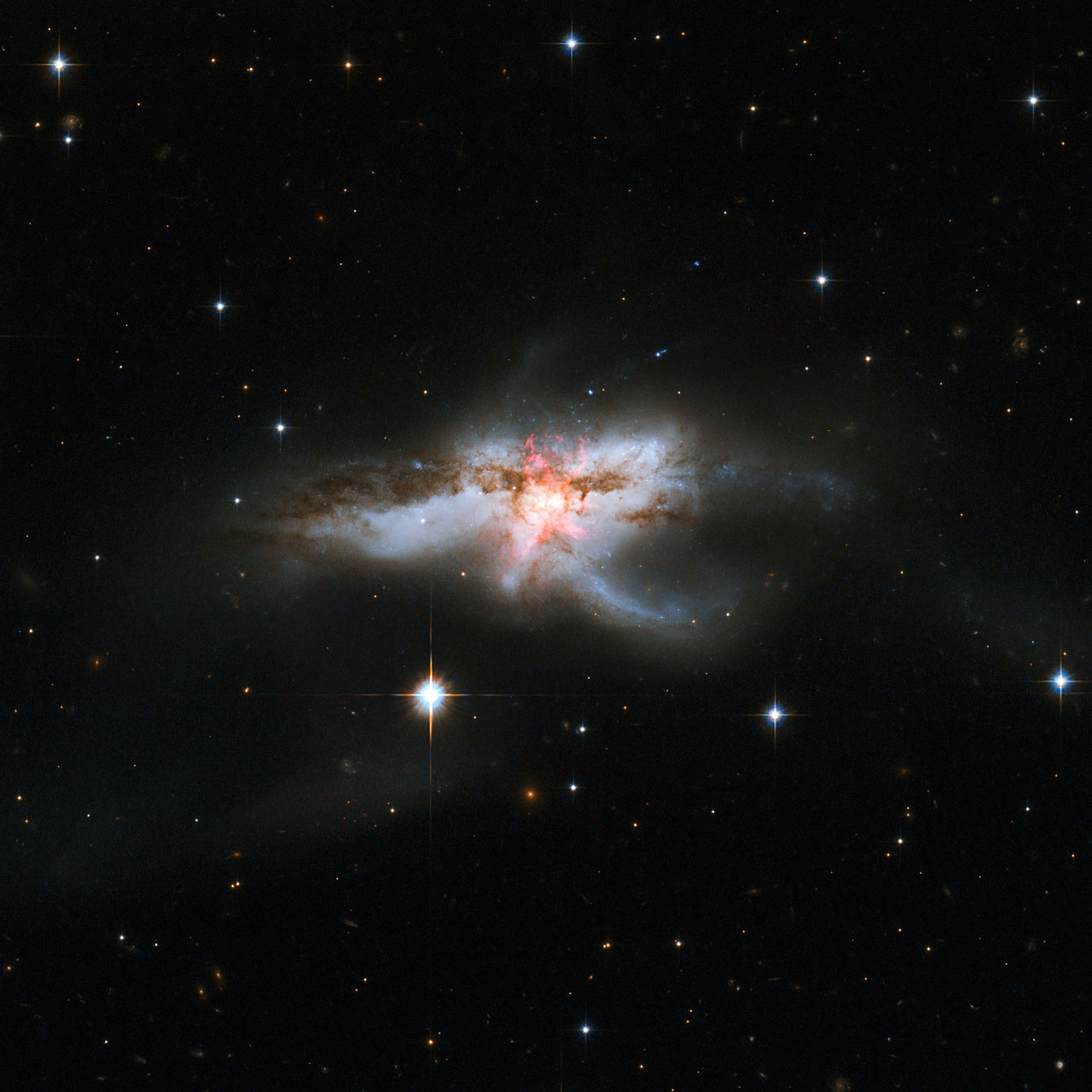
    A Hubble image of the merging galaxies NGC 6240. Like other luminous mergers, this one hosts a rapid flow of molecular gas. Astronomers have now imaged the carbon monoxide gas in the central regions and found it forms jet-like outflows driven by activity around the black holes. NASA/HST

    A merger between galaxies can trigger intense radiation from bursts of star formation and from the accretion of gas onto the two supermassive black holes at their centers. Astronomers have observed a strong statistical correlation between the masses of these black holes and other properties of the galaxies like their velocity structure or luminosity, and have concluded that there must be a connection. Feedback of some kind seems most likely to explain these correlations, and astronomers have been working to identify its source and nature. One prominent suggestion for feedback is an outflow of molecular gas; once turned on, it would deplete the galaxy of the raw material needed for making new stars and from further enhancing the black hole’s mass. Evidence for molecular outflows has been reported in far infrared lines of molecules, but these spectral results lack the convincing spatial information needed to associate the activity with the nuclei themselves.

    CfA astronomer Junko Ueda is a member of a team of fifteen astronomers who used the ALMA submillimeter telescope facility, with its superb spatial imaging capabilities, to study the outflow in the luminous galaxy NGC 6240, known to be a luminous merger in its late stages. Its double nuclei, separated by a modest two thousand light-years, has already been seen at wavelengths from the X-ray to the radio. The astronomers used one of the spectral lines from the abundant molecule carbon monoxide to probe the inner region of the galaxy. The line also revealed the presence of gas motions of up to two thousand kilometers per second, consistent with a powerful wind driving a massive flow of material out of the galaxy.

    The new images were able to identify for the first time several regions of outflow activity located only a few thousand light-years from the black holes and aligned as though they were driven by processes associated with the nuclear black holes. Moreover, these regions are spatially coincident with other indicators of general activity like shocked gas and X-rays. The new results are one of the first demonstrations that the widely seen molecular outflow activity does originate from black hole feedback mechanisms.

    Reference: “Imaging the Molecular Outflows of the Prototypical ULIRG NGC 6240 with ALMA” by T Saito, D Iono, J Ueda, D Espada, K Sliwa, K Nakanishi, N Lu, C K Xu, T Michiyama, H Kaneko, T Yamashita, M Ando, M S Yun, K Motohara and R Kawabe, 27 December 2017, MNRAS.
    DOI: 10.1093/mnrasl/slx207

    Never miss a breakthrough: Join the SciTechDaily newsletter.
    Follow us on Google and Google News.

    Astronomy Astrophysics Cosmology Harvard-Smithsonian Center for Astrophysics
    Share. Facebook Twitter Pinterest LinkedIn Email Reddit

    Related Articles

    Webb’s Mysterious “Little Red Dots” May Be the Cradle of the First Black Holes

    Mysterious Radio Signals Reveal What’s Hiding Between Galaxies

    Cosmic Mystery Solved: Astronomers Have Discovered the Universe’s “Missing” Matter

    Invisible Storm Lights Up Galaxy Cluster With Record-Breaking Radio Glow

    Astronomers Search for Trigger of Nearby Supernova

    Herschel Observations Help Identify the Physical Processes Underway in Cold, Dense Clouds

    CfA Scientists Measure the Rate of Expansion of the Universe

    New Study Challenges Planck Results

    Calculations Show the Ideal Time to Study the Cosmos

    Leave A Reply Cancel Reply

    • Facebook
    • Twitter
    • Pinterest
    • YouTube

    Don't Miss a Discovery

    Subscribe for the Latest in Science & Tech!

    Trending News

    Breakthrough Parkinson’s Drug Targets Disease at Its Genetic Roots

    Just 4 Weeks of Simple Diet Changes Reversed Signs of Aging in Older Adults

    Scientists May Have Finally Solved Why Humans Are Right-Handed

    NASA’s Hubble Accidentally Witnesses a Comet Shattering in Space

    Researchers Discover the Body’s Hidden “Off Switch” for Inflammation

    Scientists Discover Metformin Doesn’t Work the Way We Thought

    Tea or Coffee? Your Daily Choice Could Affect Osteoporosis Risk

    Vitamin C May Fight Cancer in a Surprising Way

    Follow SciTechDaily
    • Facebook
    • Twitter
    • YouTube
    • Pinterest
    • Newsletter
    • RSS
    SciTech News
    • Biology News
    • Chemistry News
    • Earth News
    • Health News
    • Physics News
    • Science News
    • Space News
    • Technology News
    Recent Posts
    • Ancient DNA Shatters the Simple Story of Europe’s Origins
    • Scientists Say a 59,000-Year-Old Neanderthal Tooth Shows Evidence of Surgery
    • Scientists Stunned by Hybrid California Bees That Beat Deadly Mites
    • Scientists Discover Terrifying Giant Crocodile That Hunted Human Ancestors
    • Scientists Finally Think They Know Why T. rex Had Tiny Arms
    Copyright © 1998 - 2026 SciTechDaily. All Rights Reserved.
    • Science News
    • About
    • Contact
    • Editorial Board
    • Privacy Policy
    • Terms of Use

    Type above and press Enter to search. Press Esc to cancel.