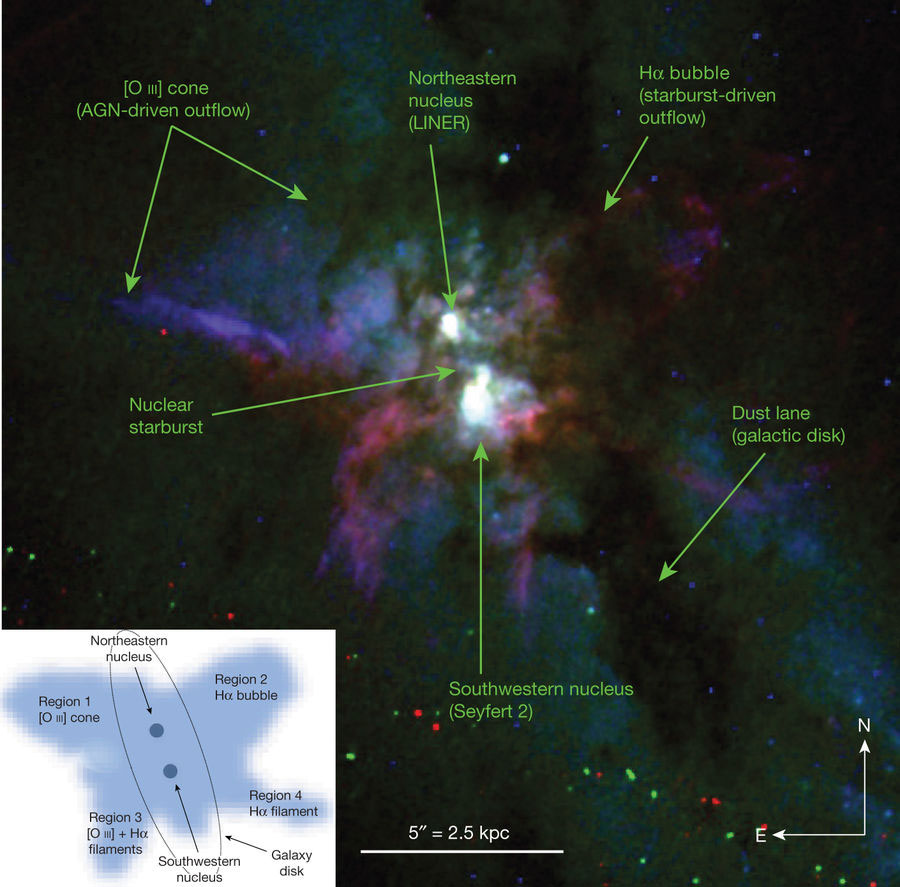
Three-color composite image of Hα (red), [O III] (blue), and V–band continuum (green) emission in NGC 6240, obtained by the HST. The major structures identified in the central 25″ × 25″ of NGC 6240 are labeled. The inset shows the morphological structures identified in the butterfly-shaped region of NGC 6240 using HST narrow-band filters. The northeastern nucleus shows a typical LINER spectrum and is about three times fainter than the southwestern nucleus, which exhibits the characteristics of a heavily obscured Seyfert 2 galaxy. The ionized gas in regions 1–4 is extraplanar. The [O III] cone extends to about 4 kpc to the northeast (which is faint in Hα), which indicates an AGN-driven outflow, whereas the Hα bubble to the northwest is indicative of a starburst-driven outflow. All physical units in this paper are based on a concordance, flat ΛCDM cosmology with a Hubble constant of 70 km s−1 Mpc−1. At the redshift of NGC 6240 (z = 0.0245), 1″ corresponds to about 0.5 kpc. Credit: Nature (2018) doi:10.1038/s41586-018-0033-2Researchers at the University of Colorado Boulder have completed an unprecedented “dissection” of twin galaxies in the final stages of merging.
The new study, led by CU Boulder research associate Francisco Müller-Sánchez, explores a galaxy called NGC 6240. While most galaxies in the universe hold only one supermassive black hole at their center, NGC 6240 contains two–and they’re circling each other in the last steps before crashing together.
The research reveals how gases ejected by those spiraling black holes, in combination with gases ejected by stars in the galaxy, may have begun to power down NGC 6240’s production of new stars. Müller-Sánchez’s team also shows how these “winds” have helped to create the galaxy’s most tell-tale feature: a massive cloud of gas in the shape of a butterfly.
“We dissected the butterfly,” said Müller-Sánchez of CU Boulder’s Department of Astrophysical and Planetary Sciences (APS). “This is the first galaxy in which we can see both the wind from the two supermassive black holes and the outflow of low ionization gas from star formation at the same time.”
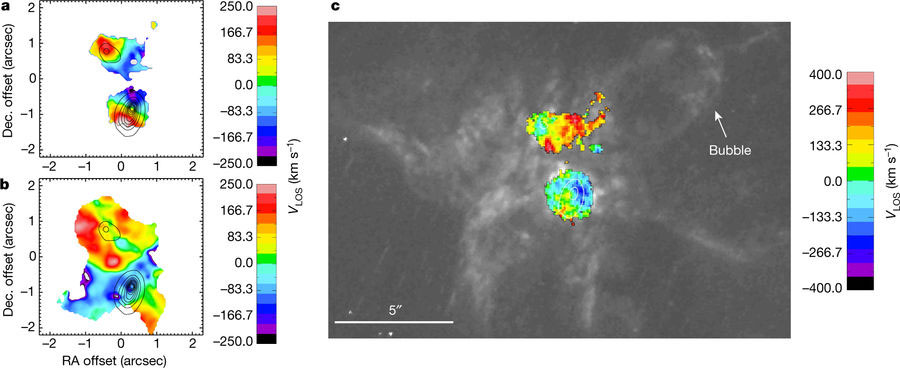
VLT/SINFONI maps of NGC 6240. a, Stellar velocity. b, H2 velocity map. c, Velocity map of Brγ overlaid on the HST image of Hα. In all panels, the contours delineate the K–band continuum emission and are spaced at 10% of the peak flux. Although two rotational components are observed in the stellar kinematics, the H2 kinematics shows one perturbed rotational component with a kinematic major axis oriented at a position angle of 22°. The Brγ kinematics of the northeastern nucleus is dominated by non-circular motions. Redshifted velocities of 360 km s−1 are observed at the base of the Hα bubble. In all maps, north is up and east is to the left. RA, right ascension; Dec., declination. The color bar indicates line-of-sight velocity (VLOS). Credit: Nature (2018) doi:10.1038/s41586-018-0033-2
The team zeroed in on NGC 6240, in part, because galaxies with two supermassive black holes at their centers are relatively rare. Some experts also suspect that those twin hearts have given rise to the galaxy’s unusual appearance. Unlike the Milky Way, which forms a relatively tidy disk, bubbles and jets of gas shoot off from NGC 6240, extending more than 30,000 light years into space and resembling a butterfly in flight.
“Galaxies with a single supermassive black hole never show such a phenomenal structure,” Müller-Sánchez said.
In research that will be published on April 18 in Nature, the team discovered that two different forces have given rise to the nebula. The butterfly’s northwest corner, for example, is the product of stellar winds, or gases that stars emit through various processes. The northeast corner, on the other hand, is dominated by a single cone of gas that was ejected by the pair of black holes–the result of those black holes gobbling up large amounts of galactic dust and gas during their merger.
Those two winds combined evict about 100 times the mass of Earth’s sun in gases from the galaxy every year. That’s a “very large number, comparable to the rate at which the galaxy is creating stars in the nuclear region,” Müller-Sánchez said.
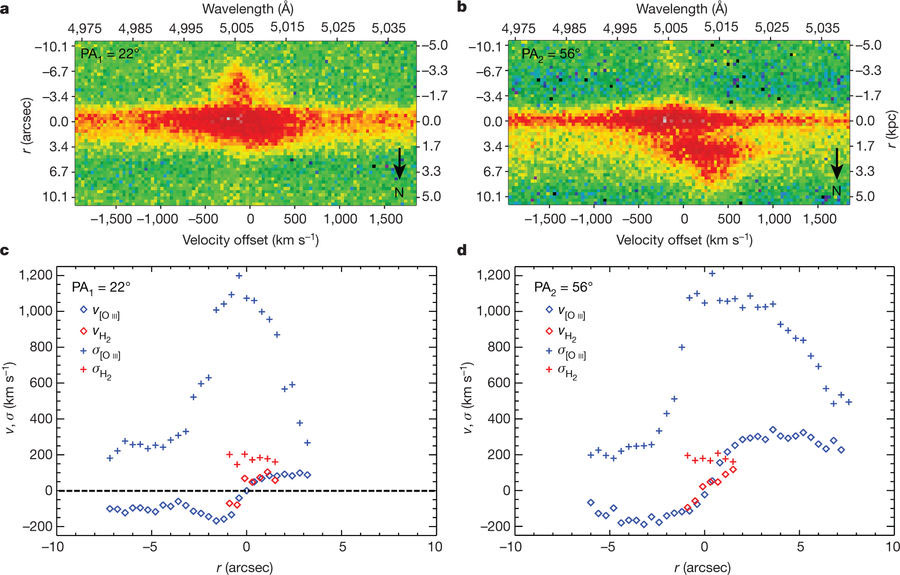
Kinematics of [O III]. a, b, Segments of the two-dimensional long-slit spectra of NGC 6240, centered at the rest wavelength of [O III]. The color scale represents flux density normalized to the peak. Cool colors (green and blue) correspond to background emission (<10% of the peak emission). Warm colors (yellow to red) correspond to sizeable flux density values (>10% of the peak of emission). c, d, Position–velocity diagrams of [O III] and H2 emission, where v is the velocity and σ is the velocity dispersion. The galaxy was observed at two position angles, 22° and 56° (see also Extended Data Fig. 1). Positive values of angular distance (vertical axis in a and b and horizontal axis in c and d) correspond to the direction north from the center of the galaxy, at the marked position angle. The number of spatial elements extracted from our long-slit observations (a, b) is 27 at PA1 = 22° (c) and 34 at PA2 = 56° (d). There are 15 spatial elements inside the [O III] cone (between 0″ < r < 7″ in d). We extracted the velocity and dispersion values for H2 at 7 different spatial positions along imaginary APO/DIS long slits oriented at 22° and 56° in the SINFONI data (Fig. 2). Credit: Nature (2018) doi:10.1038/s41586-018-0033-2Such an outflow can have big implications for the galaxy itself. He explained that when two galaxies merge, they begin a feverish burst of new star formation. Black holes and stellar winds, however, can slow down that process by clearing away the gases that make up fresh stars–much like how a gust of wind can blow away the pile of leaves you just raked.
“NGC 6240 is in a unique phase of its evolution,” said Julie Comerford, an assistant professor in APS at CU Boulder and a co-author of the new study. “It is forming stars intensely now, so it needs the extra strong kick of two winds to slow down that star formation and evolve into a less active galaxy.”
Reference: “Two separate outflows in the dual supermassive black hole system NGC 6240” by F. Müller-Sánchez, R. Nevin, J. M. Comerford, R. I. Davies, G. C. Privon and E. Treister, 18 April 2018, Nature. DOI: 10.1038/s41586-018-0033-2