
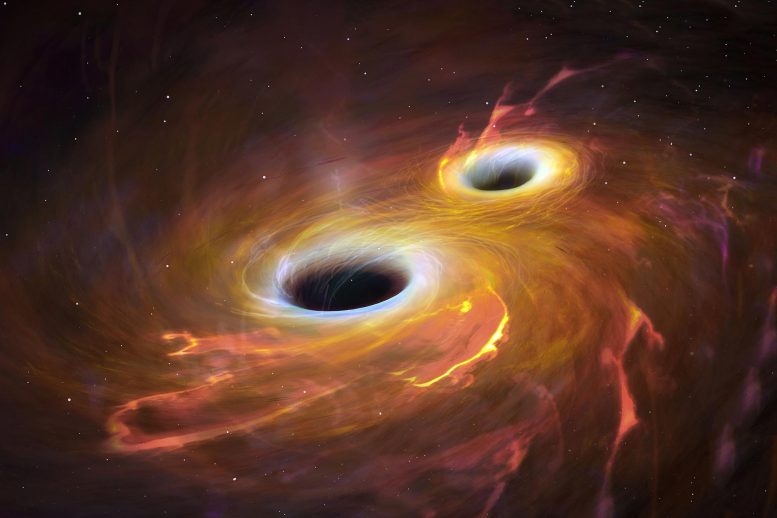
New observations and analysis reveal two Goliath black holes just 750 light-years apart and closing, as they circle each other in the aftermath of a galaxy merger.
Astronomers from Flatiron Institute and their colleagues have spotted two ghostly Goliaths en route to a cataclysmic meeting. The newfound pair of supermassive black holes are the closest to colliding ever seen, the astronomers announced on January 9 at an American Astronomical Society meeting in Seattle and in a paper published in The Astrophysical Journal Letters.
While close together in cosmological terms at just 750 light-years apart, the supermassive black holes won’t merge for a few hundred million years. In the meantime, the astronomers’ discovery provides a better estimate of how many supermassive black holes are also nearing collision in the universe.
That improved head count will aid scientists in listening for the universe-wide chorus of intense ripples in space-time known as gravitational waves, the largest of which are products of supermassive black holes close to collision in the aftermath of galaxy mergers. Detecting that gravitational-wave background will improve estimates of how many galaxies have collided and merged in the universe’s history.
The short distance between the newly discovered black holes “is fairly close to the limit of what we can detect, which is why this is so exciting,” says study co-author Chiara Mingarelli, an associate research scientist at the Flatiron Institute’s Center for Computational Astrophysics in New York City.
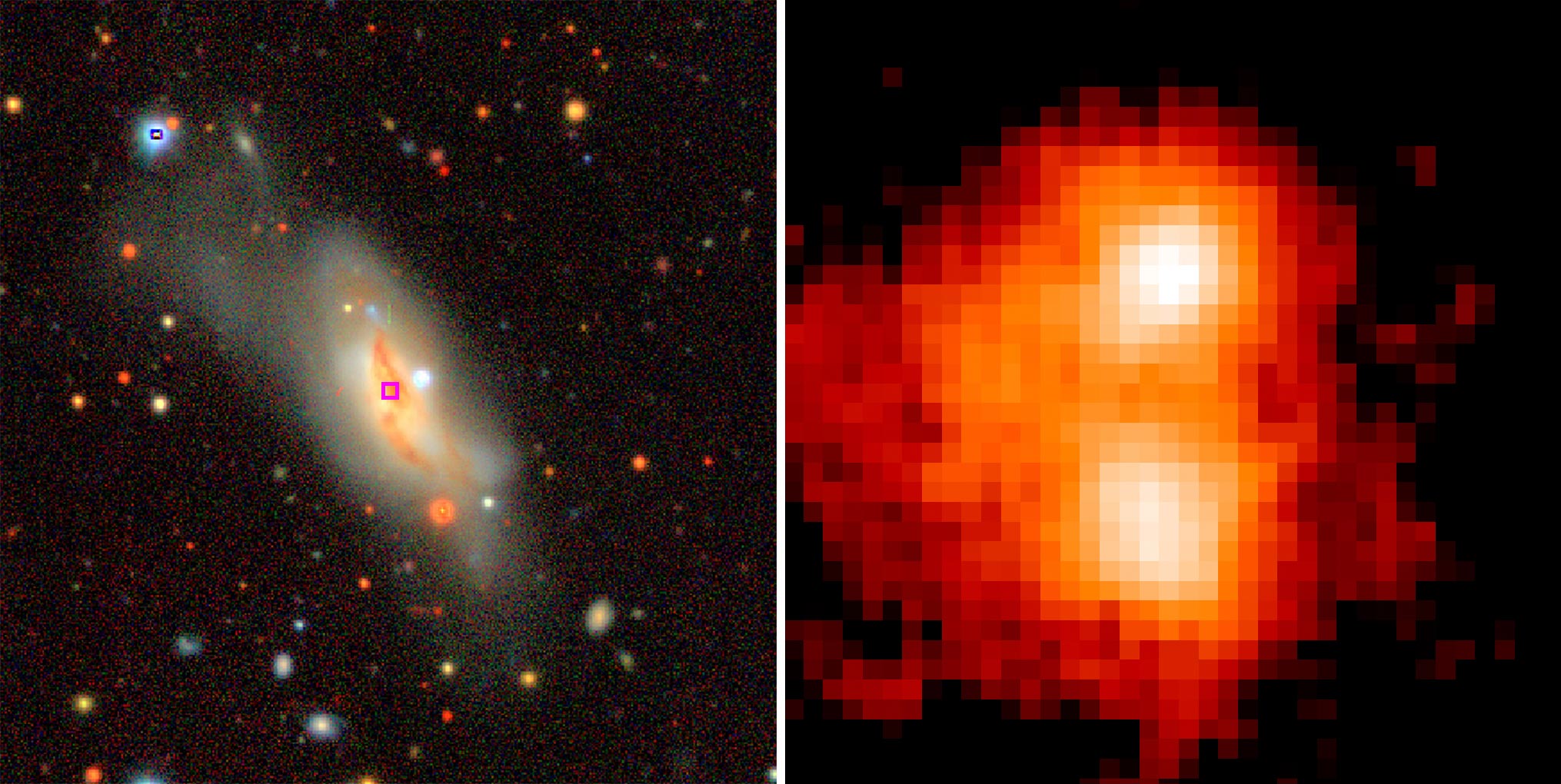
Due to the small separation between the black holes, the astronomers could only differentiate between the two objects by combining many observations from seven telescopes, including NASA’s Hubble Space Telescope. (Although supermassive black holes aren’t directly visible through an optical telescope, they are surrounded by bright bunches of luminous stars and warm gas drawn in by their gravitational pull.)
The astronomers found the pair quickly once they started looking, which means that close-together supermassive black holes “are probably more common than we think, given that we found these two and we didn’t have to look very far to find them,” Mingarelli says.
The newly identified supermassive black holes inhabit a mash-up of two galaxies that collided around 480 million light-years away from Earth. Gargantuan black holes live in the heart of most galaxies, growing bigger by gobbling up surrounding gas, dust, stars, and even other black holes. The two supermassive black holes identified in this study are true heavyweights: They clock in at 200 million and 125 million times the mass of our sun.
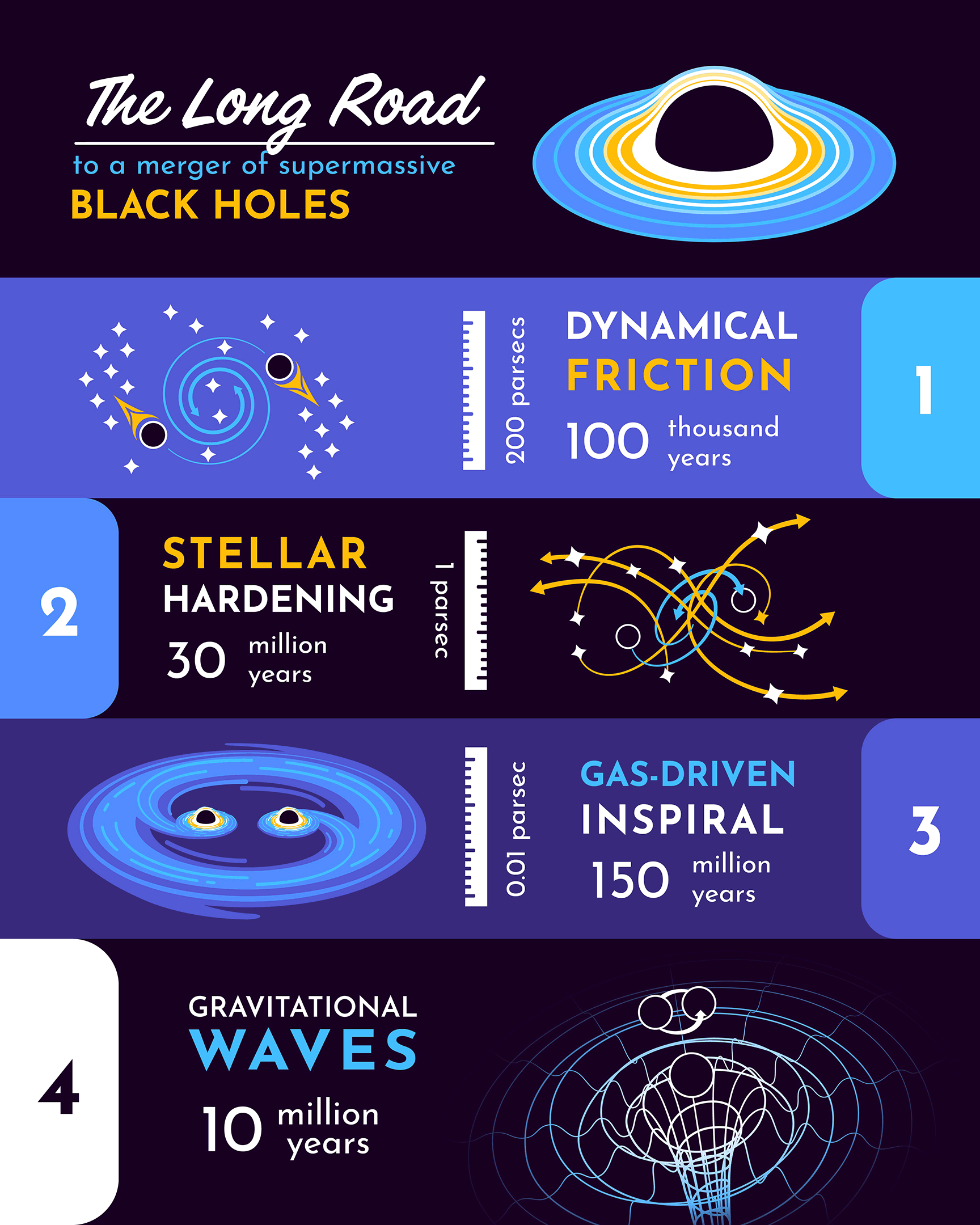
The black holes met as their host galaxies smashed into each other. Eventually they will begin circling each other, with the orbit tightening as gas and stars pass between the two black holes and steal orbital energy. Ultimately the black holes will start producing gravitational waves far stronger than any that have previously been detected, before crashing into each other to form one jumbo-size black hole.
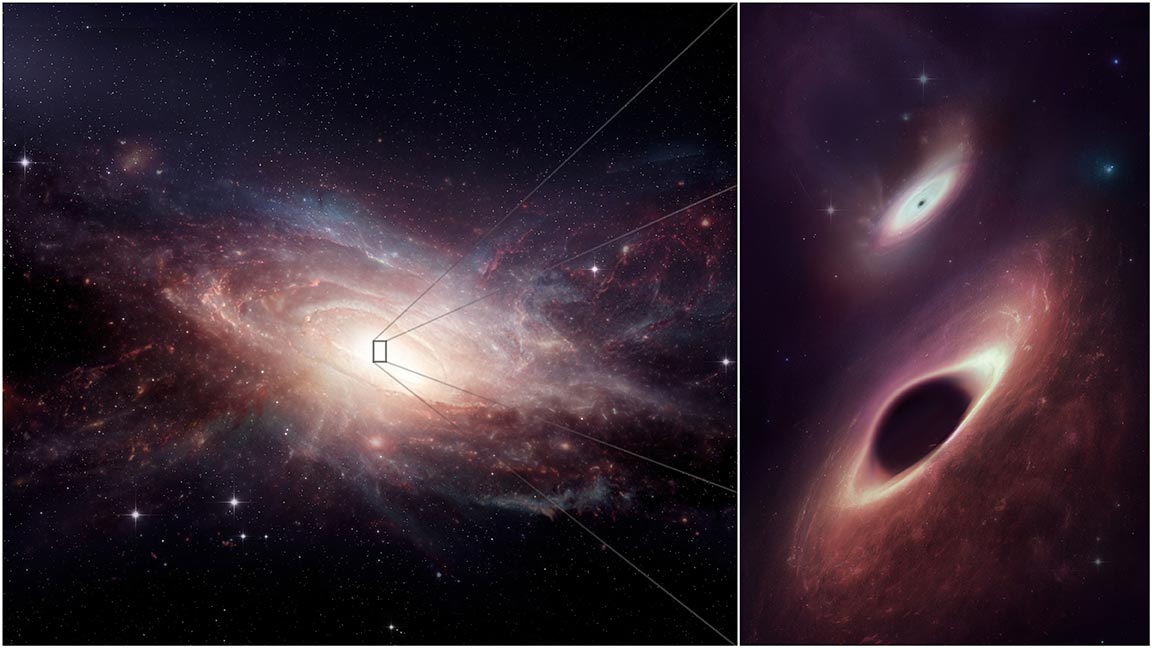
This artist’s conception shows a late-stage galaxy merger and its two newly-discovered central black holes. The binary black holes are the closest together ever observed in multiple wavelengths. Credit: ALMA (ESO/NAOJ/NRAO), M. Koss et al (Eureka Scientific), S. Dagnello (NRAO/AUI/NSF)
Prior observations of the merging galaxies saw only a single supermassive black hole: Because the two objects are so close together, scientists couldn’t definitively tell them apart using a single telescope. The new survey, led by Michael J. Koss of Eureka Scientific in Oakland, California, combined 12 observations made on seven telescopes on Earth and in orbit. Although no single observation was enough to confirm their existence, the combined data conclusively revealed two distinct black holes.
“It’s important that with all these different images, you get the same story — that there are two black holes,” says Mingarelli, when comparing this new multi-observation research with previous efforts. “This is where other studies [of close-proximity supermassive black holes] have fallen down in the past. When people followed them up, it turned out that there was just one black hole. [This time we] have many observations, all in agreement.”
She and Flatiron Institute visiting scientist Andrew Casey-Clyde used the new observations to estimate the universe’s population of merging supermassive black holes, finding that it “may be surprisingly high,” Mingarelli says. They predict that an abundance of supermassive black-hole pairs exists, generating a major amount of ultra-strong gravitational waves. All that clamor should result in a loud gravitational-wave background far easier to detect than if the population were smaller. The first ever detection of the background babble of gravitational waves, therefore, may come “very soon,” Mingarelli says.
Reference: “UGC 4211: A Confirmed Dual Active Galactic Nucleus in the Local Universe at 230 pc Nuclear Separation” by Michael J. Koss, Ezequiel Treister, Darshan Kakkad, J. Andrew Casey-Clyde, Taiki Kawamuro, Jonathan Williams, Adi Foord, Benny Trakhtenbrot, Franz E. Bauer, George C. Privon, Claudio Ricci, Richard Mushotzky, Loreto Barcos-Munoz, Laura Blecha, Thomas Connor, Fiona Harrison, Tingting Liu, Macon Magno, Chiara M. F. Mingarelli, Francisco Muller-Sanchez, Kyuseok Oh, T. Taro Shimizu, Krista Lynne Smith, Daniel Stern, Miguel Parra Tello and C. Megan Urry, 9 January 2023, The Astrophysical Journal Letters.
DOI: 10.3847/2041-8213/aca8f0
Never miss a breakthrough: Join the SciTechDaily newsletter.
Follow us on Google and Google News.
4 Comments
And the wheel goes round n round. ⚫ ⚫ = bigger then guess the floating galaxy will move, force will combine then the spiral arms. Spinning on all mass : to cool off becoming earthlike. 🤓👽👾👽🤖concer……😑I know nothing…..🛋👽🛋👽🛋👽fast forward or look to a different degrees in space🎓👽
What happens to the theoretical universes within the black holes when they merge?
Well, according to the article, the two black holes are currently dining together. Obviously, they are on a date. Once married, the female black hole’s universe will take everything from the male black hole’s universe until there is absolutely nothing left of him, not even his own identity.
Royal hole theory says they both give each other the royal flush.