
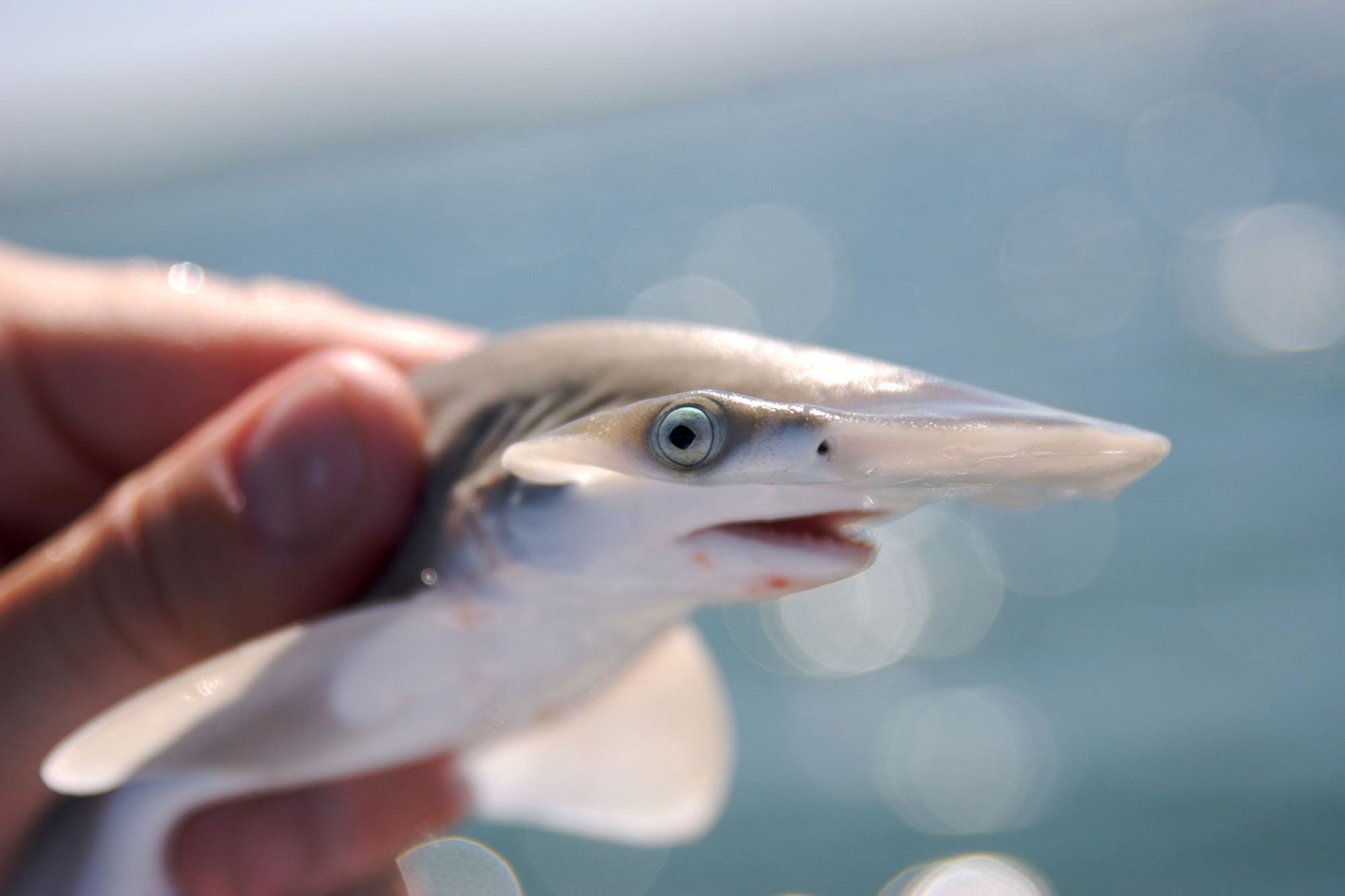
Bonnethead sharks start life with pointed heads, but females undergo a striking transformation as they mature, developing dramatically rounder snouts.
A young bonnethead shark carries a feature that appears to fade with age: a sharply defined point at the front of its shovel-shaped head. For years, scientists thought this point emerged in males as they reached sexual maturity. New research suggests the opposite is true.
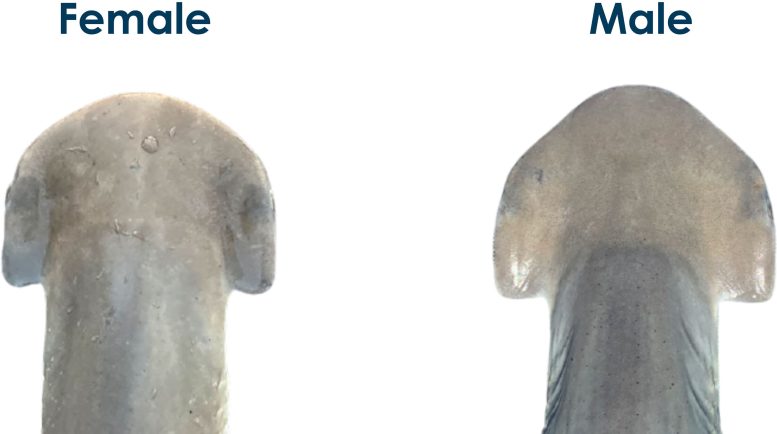
After studying bonnetheads from both coasts of Florida, researchers found that males and females begin life with relatively pointed heads. Their snouts become rounder as they grow, with the most dramatic transformation occurring in females.
The discovery challenges a long-standing explanation for one of the most unusual differences between male and female sharks.
Why Bonnethead Head Shape Matters
Bonnetheads are the smallest members of the hammerhead family and the only known shark species in which the sexes have clearly different head shapes. Adult males usually retain a noticeable projection along the front edge of the head, while females develop a smoother and more rounded profile. Biologists call this type of physical distinction sexual dimorphism.
The flattened hammerhead structure, known as a cephalofoil, is more than an unusual silhouette. In hammerhead sharks, the expanded head supports sensory organs involved in detecting prey and gives the eyes and nostrils wider spacing. Scientists are still working to understand how the bonnethead’s subtler differences in shape affect its movement, senses, or behavior.
Researchers at the University of Miami Rosenstiel School of Marine, Atmospheric, and Earth Science examined 144 bonnetheads collected in Biscayne Bay and the Tampa Bay region. The study, published in Integrative Organismal Biology, was the first detailed investigation to compare both head development and feeding ecology in Biscayne Bay bonnetheads. Including sharks from Tampa Bay allowed the team to test whether the same developmental pattern appeared in populations living on opposite sides of Florida.
“Our findings show that the pointed head shape is not a feature that develops in males when they reach maturity,” said Kathy Liu, lead author of the study, which she conducted while earning her master’s degree at the Rosenstiel School. “Younger males and females both had more pointed heads, but the head became rounder as the sharks matured. That change was much greater in females.”
Female Sharks Undergo the Biggest Change
The findings indicate that the contrast between adults is created largely by how much the female head changes, not by males suddenly developing a point.
That raises a more difficult question: Why do maturing females lose more of the pointed shape?
One possibility was food. If males and females pursued different prey or foraged in different places, their heads might experience different evolutionary or developmental pressures. Bonnetheads are especially interesting subjects for such a test because their eating habits are unlike those of any other known shark.
An Omnivorous Shark With an Unusual Diet
Although they feed heavily on crabs and other invertebrates, bonnetheads also consume and digest seagrass. Controlled feeding experiments have shown that they can absorb nutrients from plant material rather than merely swallowing it while hunting prey. This makes the bonnethead the first shark demonstrated to have an omnivorous diet.
To reconstruct the animals’ feeding patterns, the researchers analyzed carbon and nitrogen isotope signatures in muscle samples from 137 sharks. These chemical signals accumulate over time and can reveal an animal’s position within a food web, offering a broader dietary record than the contents of a recently filled stomach.
Diet Does Not Explain the Difference
The analysis showed that bonnetheads in Biscayne Bay and Tampa Bay depended on food webs with clearly different environmental signatures. Their diets also shifted as the animals grew. However, males and females living in the same bay drew on many of the same local resources.
“Our findings provided no evidence that differences in diet or foraging were driving the development of the sharks’ sex-specific head shapes,” said Liu.
By eliminating diet as the most likely explanation, the study points researchers toward other possibilities, including growth, reproduction, swimming performance, and development before birth.
“This study helps narrow the drivers of a biological trait that has puzzled scientists,” said Catherine Macdonald, a co-author of the study and an associate professor in the Department of Environmental Science and Policy and the director of the Shark Research and Conservation Program at the Rosenstiel School. “By examining body shape and diet in the same animals, we were able to assess whether diet and morphological changes co-occur. Our results suggest there is another cause behind the differences in head shape between male and female bonnetheads.”’
Measuring Shark Heads in the Field
From May 2022 to May 2023, the team sampled 105 bonnetheads in Biscayne Bay and 39 near Tampa Bay. The sharks were captured using scientific longlines in Biscayne Bay and primarily scientific gillnets in Tampa Bay.
Researchers measured each animal, removed a small muscle sample, and photographed both sides of its head against a specially designed grid. The sharks were then promptly released.
The images were processed with ImageJ software, allowing the team to compare head curvature precisely without keeping the animals out of the water for extended periods.
The Mystery of the Pointed Snout
The purpose of the pointed snout remains uncertain. The researchers suggest that it could improve swimming performance in young, small sharks. As females grow larger to support reproduction and gestation, the advantage may become less important, or a rounder head may better suit their changing bodies.
For now, that explanation remains a hypothesis. Experiments measuring swimming efficiency could determine whether younger sharks gain a hydrodynamic benefit from a sharper head. Studies of embryos and newborns could also reveal when males and females begin to follow different developmental paths.
Applying the same photographic method to bonnetheads elsewhere could show whether the pattern is consistent across the species’ range. Regional comparisons may also uncover populations with distinct growth, feeding, or reproductive characteristics, information that could help scientists design conservation strategies around local conditions.
Reference: “A Head of the Curve: Bonnethead Shark (Sphyrna tiburo) Cephalofoil Morphology and Trophic Ecology” by K Liu, J R Graham, H Ro, S L Kim, T R Wiley, J M Gardiner, L J Baker and C Macdonald, 27 July 2026, Integrative Organismal Biology.
DOI: 10.1093/iob/obag024
The research was supported by Field School and the University of Miami Shark Research and Conservation Program. Tampa Bay fieldwork was supported by the Tampa Bay Environmental Restoration Fund and Disney Conservation Fund. Stable isotope analysis was supported by the University of California, Merced, and partial project support was provided by the Maxwell/Hanrahan Foundation.
Never miss a breakthrough: Join the SciTechDaily newsletter.
Follow us on Google and Google News.
1 Comment
Okay, that is so cute I want one ^_^