
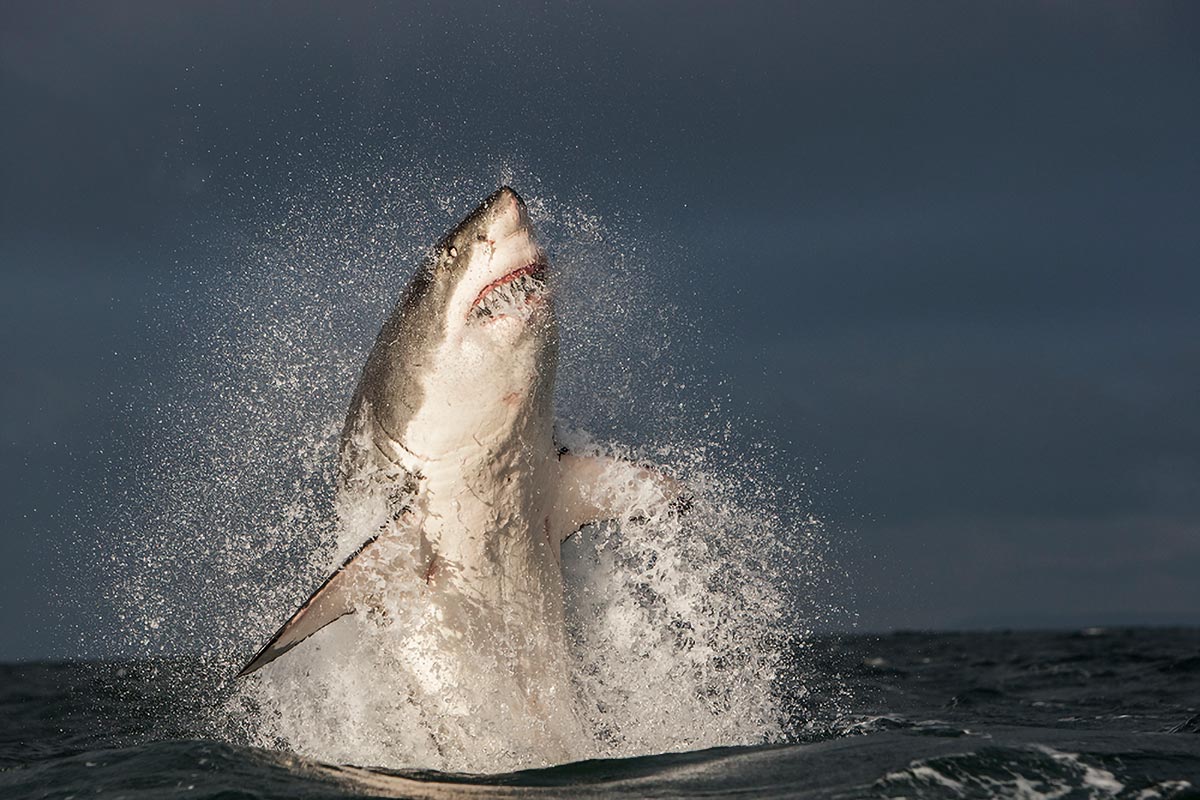
Renowned for their incredible ability to breach the water while hunting, the disappearance of Great white sharks from False Bay, South Africa, has sparked concern among scientists and conservationists about the rippling impacts on the local ecosystem.
A new study published in Frontiers in Marine Science reveals significant ecosystem disruptions following the disappearance of Great White Sharks (Carcharodon carcharias) from False Bay, South Africa.
Conducted by researchers at the University of Miami’s Rosenstiel School of Marine, Atmospheric, and Earth Science, the study spans more than 20 years and highlights the cascading ecological effects caused by the loss of this apex predator—emphasizing its critical role in maintaining the balance and health of marine ecosystems.
Key Findings:
- Decline of Great white sharks: Historically abundant in False Bay, Great white sharks have experienced a dramatic decline and subsequent disappearance. Potential factors contributing to their loss include decades of unsustainable captures in nets intended to protect bathers and some recent instances of predation by Orcas.
- Ecosystem Disruption: The absence of Great White sharks has led to an increase in Cape fur seals (Arctocephalus pusillus) and sevengill sharks (Notorynchus cepedianus) and an associated decline in fish that the seals feed on and smaller shark species that the sevengills prey on, illustrating the ripple effect of losing an ocean top predator.
- Empirical Evidence: The study provides real-world evidence of food web cascades driven by the loss of top-down predation pressure from great white sharks, consistent with ecological theory and laboratory experiments.
Using a combination of long-term boat-based surveys of shark sightings, citizen science observations on Cape fur seals, and Baited Remote Underwater Video Surveys (BRUVS) of fishes and small sharks, the study provides evidence that the absence of Great white sharks has triggered significant shifts in the marine food web.

“The loss of this iconic apex predator has led to an increase in sightings of Cape fur seals and sevengill sharks, which in turn has coincided with a decline in the species that they rely on for food,” said Neil Hammerschlag, Ph.D., the study’s lead author. Hammerschlag conducted the research while at the Shark Research and Conservation Program at the University of Miami Rosenstiel School. “These changes align with long established ecological theories that predict the removal of a top predator, leads to cascading effects on the marine food web.”
Changes in Animal Behavior and Ecosystem Structure
“The use of underwater video surveys conducted more than a decade apart provided us with a snapshot of the food web both before and after the disappearance of white sharks from False Bay,” said Yakira Herskowitz, a co-author of the study and a Rosenstiel School former graduate student that analyzed underwater video data. “The number of individuals of a given species recorded on the videos not only informs us about their numerical abundance, but also their behavior, as species under increased predation risk often become more elusive and are thus less likely to be detected on our cameras”
The researchers say the study provides empirical evidence that the disappearance of Great white sharks creates profound consequences for marine ecosystems. “Without these apex predators to regulate populations, we are seeing measurable changes that could have long-term effects on ocean health,” Hammerschlag added.
The findings emphasize the importance of global shark conservation efforts, as their loss could have long-term consequences on marine ecosystems. Given the global reliance on healthy oceans for food, recreation, and ecosystem services, protecting large sharks is essential to maintaining biodiversity.
Reference: “Evidence of cascading ecosystem effects following the loss of white sharks from False Bay, South Africa” by Neil Hammerschlag, Yakira Herskowitz, Chris Fallows and Thiago B. A. Couto, 24 March 2025, Frontiers in Marine Science.
DOI: 10.3389/fmars.2025.1530362
Funding for this study was provided by the Isermann Family Foundation and the Shark Research Foundation.
Never miss a breakthrough: Join the SciTechDaily newsletter.
Follow us on Google and Google News.
3 Comments
orcas the cause?
Could over fishing be the cause of a change of feeding patterns
I also believe Orcas/Killer Whales are further fueling n driving the collapse of ocean ecosystems by killing great whites. Orcas need to be eradicated or depopulated (population control) to help slow n reverse the collapse. Of course, this is just one action of many that need to be taken.