
Close Menu
    Facebook X (Twitter) Instagram
    SciTechDaily
    • Biology
    • Chemistry
    • Earth
    • Health
    • Physics
    • Science
    • Space
    • Technology
    Facebook X (Twitter) Pinterest YouTube RSS
    SciTechDaily
    Home»Biology»Great White Shark Have a More Varied Diet Than Previously Thought
    Biology

    Great White Shark Have a More Varied Diet Than Previously Thought

    By SciTechDailyOctober 8, 2012No Comments3 Mins Read
    Facebook Twitter Pinterest Telegram LinkedIn WhatsApp Email Reddit
    Share
    Facebook Twitter LinkedIn Pinterest Telegram Email Reddit
    great-white-shark
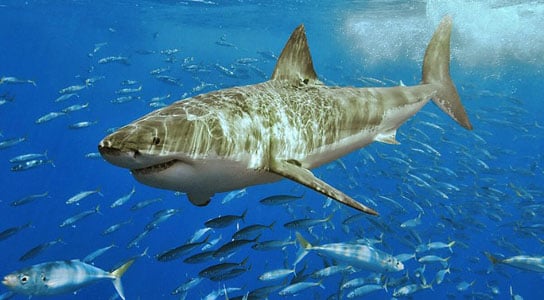
    A great white shark. Credit: Photo by Terry Goss, image from Wikipedia

    It might seem that Carcharodon carcharias choose seals and sea lions as their preferred prey, but studies indicate that great white sharks consume different prey based upon their age, size and location. When they are juveniles, they seek out a wider variety of foods before culminating into the more well-known options.

    Scientists published their findings in the journal PLoS ONE. Sora Kim, from the University of Wyoming and colleagues, used chemical clues in great white shark vertebrae to track the different feeding preferences among individuals, between 1957 and 2000. This technique has been used previously to outline the diet of other creatures. As animals feed, chemical tracers in the form of carbon and nitrogen isotopes are incorporated into their teeth and bones. There is a correspondence between certain carbon isotope ratios and particular food sources. Once they are matched, researchers can reconstruct an animal’s diet.
    maimed-elephant-seal-shark
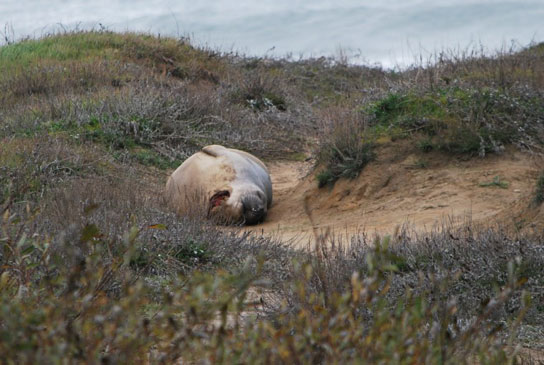
    A shark-bitten elephant seal rests on an Año Nuevo State Park Beach. Credit: Photo by Brian Switek

    Shark vertebrae contain long-running records of these isotopes. The vertebrae of great white sharks accrete new rings on a yearly schedule as they grow. Each ring holds a chemical snapshot from a year in the life of the shark. This has allowed researchers to track the diets of individual sharks during their lives.

    Contrary to assertions that pinnipeds are a great white shark staple food, the sharks sampled in this study showed a highly variable diet. Some sharks showed no difference between juvenile and adult diets; but others showed large variations, shifting from a diet of fish and small prey to marine mammals and other more substantial fare at about age four. Many of the Pacific great white sharks sampled were generalists who took varying prey in different locations. Some preferred marine mammals located near shore, but others were more flexible in their foraging approaches.

    This study raises new questions about the biology of the great white shark. Competition could be the key to determining the individual diets of sharks. By being flexible with their diets, great white sharks may lessen competition with their own kind.

    Further isotopic studies and satellite tracking programs are needed to help marine biologists better understand the great white shark.

    Reference: “Ontogenetic and Among-Individual Variation in Foraging Strategies of Northeast Pacific White Sharks Based on Stable Isotope Analysis” by Sora L. Kim,
    M. Tim Tinker, James A. Estes and Paul L. Koch, 28 September 2012, PLoS ONE.
    DOI: 10.1371/journal.pone.0045068

    Never miss a breakthrough: Join the SciTechDaily newsletter.
    Follow us on Google and Google News.

    Diet Marine Biology Popular Sharks
    Share. Facebook Twitter Pinterest LinkedIn Email Reddit

    Related Articles

    Sharks Use Earth’s Magnetic Fields to Guide Them Like a Map – “It Really Is Mind Blowing”

    Whale Sharks Extraordinary Ability to Quickly Recover From Serious Injuries

    New Climate Change Research: Future Too Warm for Baby Sharks

    Prehistoric Shark Hid Its Largest, Sharpest Teeth

    Whale Shark Girls Overtake the Boys to Become World’s Largest Fish

    Unexpected Discovery of a 410-Million-Year-Old Fossil Forces Rethink of Shark Evolution

    Scientists Surprised When They Examine Stomach Contents of Great White Sharks and Find Out What They Really Eat

    Legacy of Cold War Nuclear Bomb Tests Solves Whale Shark Mystery

    Relationships of Male Dolphins from Shark Bay Determined by Slow Swimming

    Leave A Reply Cancel Reply

    • Facebook
    • Twitter
    • Pinterest
    • YouTube

    Don't Miss a Discovery

    Subscribe for the Latest in Science & Tech!

    Trending News

    Scientists Uncover Potential Brain Risks of Popular Fish Oil Supplements

    Scientists Discover a Surprising Way To Make Bread Healthier and More Nutritious

    After 60 Years, Scientists Uncover Unexpected Brain Effects of Popular Diabetes Drug Metformin

    New Research Uncovers Hidden Side Effects of Popular Weight-Loss Drugs

    Scientists Rethink Extreme Warming After Surprising Ocean Discovery

    Landmark Study Links Never Marrying to Significantly Higher Cancer Risk

    Researchers Discover Unknown Beetle Species Just Steps From Their Lab

    Largest-Ever Study Finds Medicinal Cannabis Ineffective for Anxiety, Depression, PTSD

    Follow SciTechDaily
    • Facebook
    • Twitter
    • YouTube
    • Pinterest
    • Newsletter
    • RSS
    SciTech News
    • Biology News
    • Chemistry News
    • Earth News
    • Health News
    • Physics News
    • Science News
    • Space News
    • Technology News
    Recent Posts
    • Early Warning Signals of Esophageal Cancer May Be Hiding in Plain Sight
    • Researchers Have Discovered a THC-Free Cannabis Compound That May Replace Opioids
    • Common Blood Pressure Drug Shows Surprising Power Against Deadly Antibiotic-Resistant Superbug
    • Students Build Dark Matter Detector and Set New Experimental Limits
    • Scientists Discover Caffeine Can Repair Key Memory Circuits After Sleep Loss
    Copyright © 1998 - 2026 SciTechDaily. All Rights Reserved.
    • Science News
    • About
    • Contact
    • Editorial Board
    • Privacy Policy
    • Terms of Use

    Type above and press Enter to search. Press Esc to cancel.