
Close Menu
    Facebook X (Twitter) Instagram
    SciTechDaily
    • Biology
    • Chemistry
    • Earth
    • Health
    • Physics
    • Science
    • Space
    • Technology
    Facebook X (Twitter) Pinterest YouTube RSS
    SciTechDaily
    Home»Technology»Licking a Tootsie Roll Sensor To Monitor Your Health
    Technology

    Licking a Tootsie Roll Sensor To Monitor Your Health

    By American Chemical SocietyOctober 26, 2021No Comments3 Mins Read
    Facebook Twitter Pinterest Telegram LinkedIn WhatsApp Email Reddit
    Share
    Facebook Twitter LinkedIn Pinterest Telegram Email Reddit
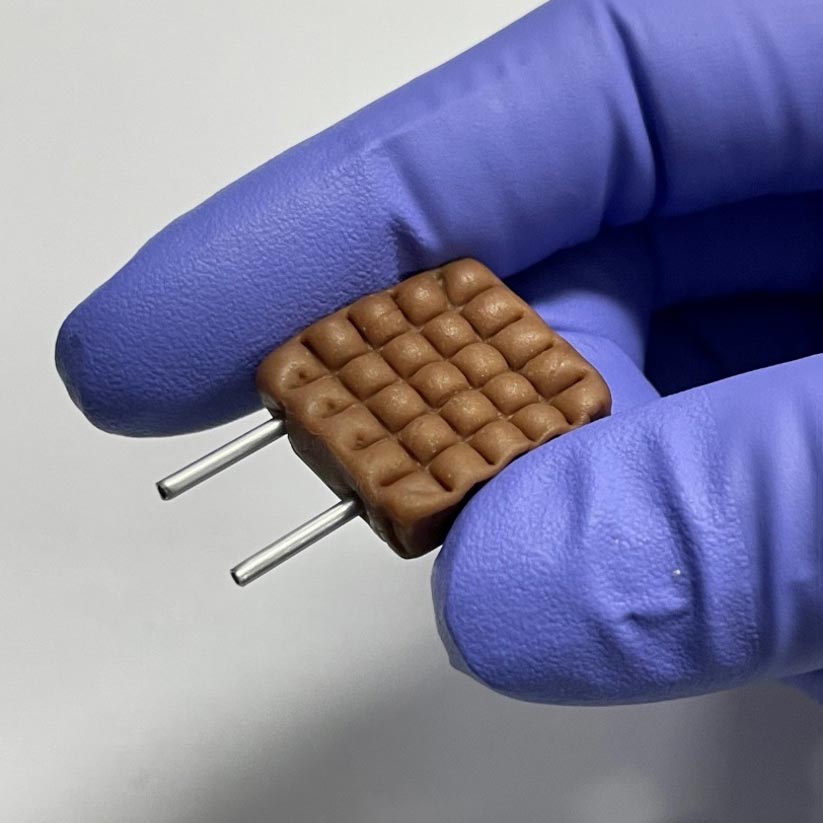
    Tootsie Roll Sensor
    An electrode made with a molded Tootsie Roll® and aluminum tubes can help monitor ovulation status and kidney health. Credit: Adapted from ACS Applied Materials & Interfaces 2021, DOI: 10.1021/acsami.1c11306

    Scientists built a low-waste saliva sensor from Tootsie Roll® candy to monitor health conditions like ovulation and kidney function.

    Single-use diagnostic tests often aren’t practical for health professionals or patients in resource-limited areas, where cost and waste disposal are big concerns. So, researchers reporting in ACS Applied Materials & Interfaces have turned to a surprising material, Tootsie Roll® candy, to develop an inexpensive and low-waste device. The candy was used as an electrode, the part of the sensor that detects salt and electrolyte levels in saliva, to monitor ovulation status or kidney health. 

    Disposable test strips have advanced the speed and accuracy of at-home health monitoring. For example, ovulation predictor kits measure luteinizing hormone levels, and there are test strips that measure creatinine levels for patients with chronic kidney disease. However, their costs add up quickly and, between the packaging and the strips themselves, there’s a lot of waste that needs to be disposed of. Previous researchers have indicated that simple measurements of a person’s salivary salt and electrolyte content could be appropriate for managing some conditions. So, Beelee Chua and Donghyun Lee wanted to repurpose unconventional and widely available materials, including electrically conductive soft candies, into an easily accessible, low-waste sensor that could simply be licked by patients to analyze their saliva. 

    How a Tootsie Roll Becomes a Sensor

    To make the prototype sensor, the researchers first flattened a Tootsie Roll® and pressed crevices into its surface in a crosshatched pattern to hold the saliva sample. Then, they inserted two thin, reusable aluminum tubes, which acted as electrical contacts, connecting the candy electrode into a circuit with a current source and an output voltage detector.

    In preliminary tests, the device could measure salt levels that were physiologically relevant for health monitoring in a salt-water solution and artificial saliva. For example, when covered in diluted artificial saliva, the sensor could reliably measure a change in voltage low enough to detect the 10-30% drop in salts that occurs when a person ovulates.

    While the maximum salt content in the artificial saliva samples was similar to that of a healthy adult, the researchers used calculations to estimate that conductivities three times higher, which signal a problem with the kidneys, would be within the measurable range of the device.

    Although testing with real human samples is still needed, the researchers say that using soft candy as electrodes opens up the possibility for low-waste, inexpensive electrochemical sensors and circuits in the future.

    Reference: “Soft Candy as an Electronic Material Suitable for Salivary Conductivity-Based Medical Diagnostics in Resource-Scarce Clinical Settings” by Donghyun Lee and Beelee Chua, 10 September 2021, ACS Applied Materials & Interfaces.
    DOI: 10.1021/acsami.1c11306

    The authors acknowledge funding from the National Research Foundation of Korea.

    Never miss a breakthrough: Join the SciTechDaily newsletter.
    Follow us on Google and Google News.

    American Chemical Society Biomedical Engineering Materials Science Sensor
    Share. Facebook Twitter Pinterest LinkedIn Email Reddit

    Related Articles

    Engineers 3D Print Programmed Cells Into Living Devices

    Supercomputers Explore Optical Properties of Plasmonic Nanovesicles for Drug Delivery

    Harvard Engineers Create the First Fully 3D-Printed Heart-on-a-Chip

    Engineers Design Calcium-Based Multi-Element for Liquid Batteries

    Engineers Design Nanoparticles to Track Cells and Interactions Within Them

    New Process for 3D Printing of Highly Stretchable and Tough Hydrogels

    Scientists Develop Graphene-Coated Silicon Supercapacitor

    Scientists Develop a New Nanobiocomposite Material

    New Fabric Works Like Human Skin, Drains Sweat

    Leave A Reply Cancel Reply

    • Facebook
    • Twitter
    • Pinterest
    • YouTube

    Don't Miss a Discovery

    Subscribe for the Latest in Science & Tech!

    Trending News

    Mezcal “Worm” in a Bottle Mystery: DNA Testing Reveals a Surprise

    New Research Reveals That Your Morning Coffee Activates an Ancient Longevity Switch

    This Is What Makes You Irresistible to Mosquitoes

    Shockingly Powerful Giant Octopuses Ruled the Seas 100 Million Years Ago

    Scientists Stunned by New Organic Molecules Found on Mars

    Rewriting Dinosaur Evolution: Scientists Unearth Remarkable 150-Million-Year-Old Stegosaur Skull

    Omega-3 Supplements Linked to Cognitive Decline in Surprising New Study

    First-of-Its-Kind Discovery: Homer’s Iliad Found Embedded in a 1,600-Year-Old Egyptian Mummy

    Follow SciTechDaily
    • Facebook
    • Twitter
    • YouTube
    • Pinterest
    • Newsletter
    • RSS
    SciTech News
    • Biology News
    • Chemistry News
    • Earth News
    • Health News
    • Physics News
    • Science News
    • Space News
    • Technology News
    Recent Posts
    • NASA’s Webb Space Telescope Reveals a Dark Airless Super-Earth That Looks Like Mercury
    • These Simple Daily Habits Can Quickly Improve Blood Pressure and Heart Risk Factors
    • A Common Nutrient May Play a Surprising Role in Anxiety
    • Doing This After 9 p.m. Could Double Your Risk of Gut Issues
    • New Research Challenges Long-Held Beliefs About How the Brain Makes Decisions
    Copyright © 1998 - 2026 SciTechDaily. All Rights Reserved.
    • Science News
    • About
    • Contact
    • Editorial Board
    • Privacy Policy
    • Terms of Use

    Type above and press Enter to search. Press Esc to cancel.