
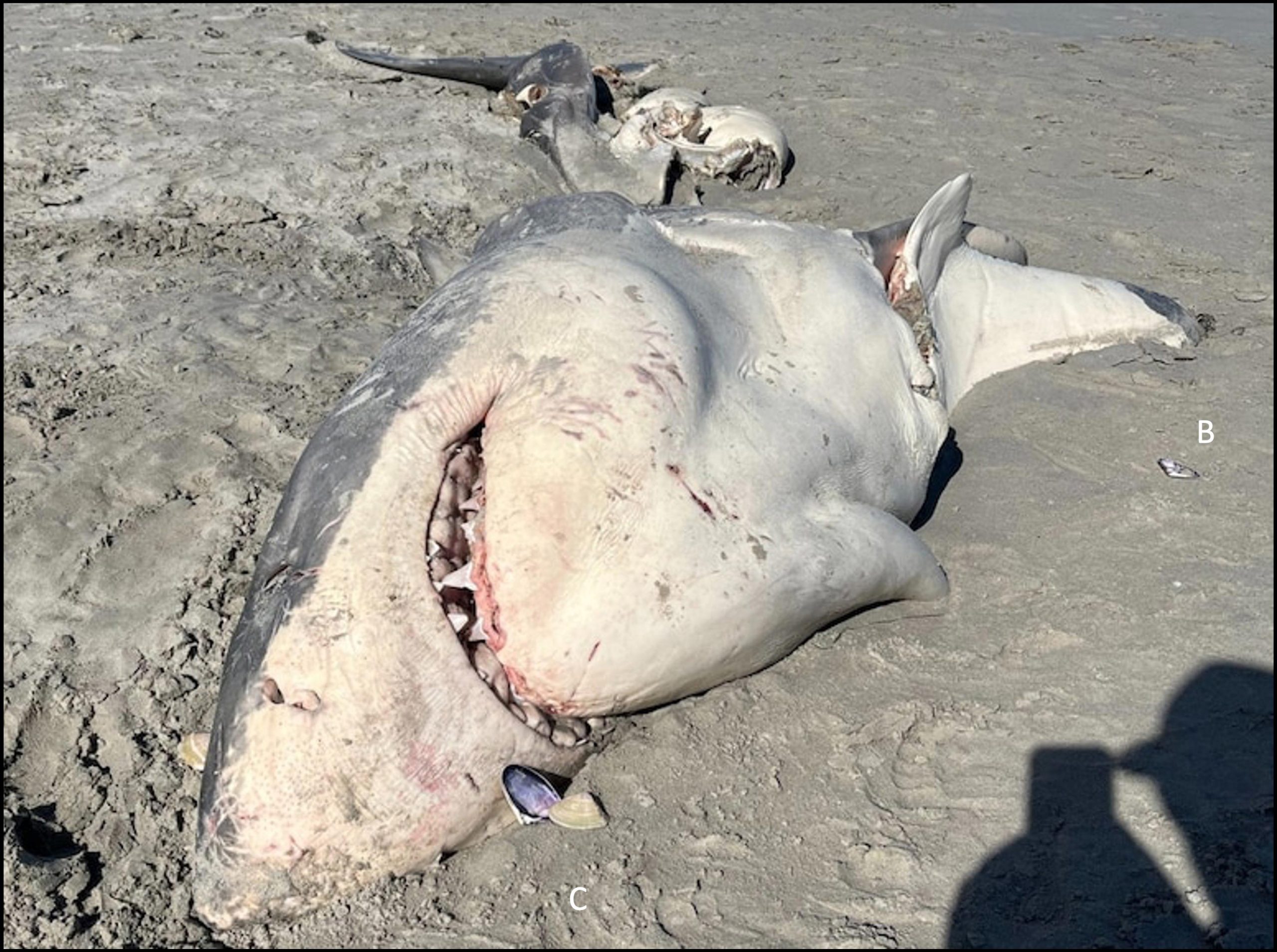
DNA evidence has confirmed that killer whales in Australia hunted a white shark for its liver—marking the first recorded case in the region. The carcass, discovered in Victoria, showed telltale bite wounds, with genetic analysis linking the attack to killer whales.
For the first time, DNA evidence has confirmed that killer whales in Australia hunted a white shark for its liver.
A study led by Flinders University analyzed DNA from bite wounds on the carcass of a large white shark that washed ashore near Portland, Victoria, in 2023. The findings identified killer whales as the predators, specifically targeting the shark’s midsection, where the nutrient-rich liver is located.
Killer whales (Orcinus orca) are known to prey on various shark species, including white sharks (Carcharodon carcharias). Similar predation behavior has been previously documented in California and South Africa.
Distinctive Bite Wounds and DNA Analysis
The discovery of a 4.7-metre white shark missing its liver on a beach in southeastern Australia offered a rare opportunity to analyze distinctive bite wounds and unravel the predator’s identity.
“The liver, digestive and reproductive organs were missing, and there were four distinctive bite wounds, one of which was characteristic of liver extraction by killer whale, similar to what has been observed in South Africa,” says lead author Isabella Reeves, a PhD candidate with Flinders University’s Southern Shark Ecology Group and the West Australian Cetacean Research Centre (CETREC).
“Swabs were taken from bite wounds on the white shark and sequenced for remnant genetic material from the shark’s predator. We were able to confirm the presence of killer whale DNA in the primary bite area, while the other three wounds revealed DNA from scavenging broadnose sevengill sharks.

“These findings provide compelling evidence of killer whale predation on white sharks in Australian waters, with a strong indication of selective liver consumption. This suggests that such predation events may be more widespread and prevalent across the globe than previously believed.”
The study, published in Ecology and Evolution, used wildlife forensic techniques to confirm killer whales were responsible for excising and consuming the liver from the white shark. Civilian bystanders had witnessed several killer whales, including locally known individuals called ‘Bent Tip’ and ‘Ripple, catching a large prey in Bridgewater Bay two days before the white shark carcass washed ashore.
The beached large white shark carcass was collected by state government fisheries officers for investigation.
Killer whales in Australia have occasionally recorded preying on various shark species, including blue shark (Prionace glauca), porbeagle (Lamna nasus), shortfin mako (Isurus oxyrinchus), ground sharks (most likely school shark, Galeorhinus galeus), and tiger shark (Galeocerdo cuvier). But white shark liver consumption had yet to be observed in Australia – despite numerous reports of such behavior in California and by notorious duo ‘Port’ and ‘Starboard’ in South Africa.
Previous Killer Whale-White Shark Interactions in Australia
Several interactions between killer whales and white sharks have been reported in Australia, including at least one suspected kill at the Neptune Islands Group Marine Park in South Australia in February 2015. On that occasion, an oil slick indicative of a successful predation was observed following the interaction, although no carcass was recovered to confirm the kill.
Rhodes University (South Africa) marine biologist, Dr Alison Towner, an author in the study, says similar killer whale predation on white sharks has led to disruptions in local shark populations in both South Africa and California. “However direct observations of these interactions remain rare and their frequency is poorly understood,” she says.
Senior author, Flinders adjunct Associate Professor Adam Miller, says: “We don’t know how frequently these events occurred in Australian waters and therefore how significant these findings are,” says Associate Professor Miller, who is also a senior ecologist with Cesar Australia.

“Evidence suggests that the white sharks being displaced or directly killed as a result of the killer whale predation in South Africa has led to cascading shifts in the wider marine ecosystem.
“We know that white sharks are key regulators of ecosystem structure and functions, so it’s very important we preserve these top predators. Therefore, it is important that we keep a tab on these types of interactions in Australian waters where possible.”
Another author, Flinders University Research Fellow Dr Lauren Meyer, adds, “This study also provides DNA evidence that scavenging is facilitated by killer whales’ tissue selection, whereby the liver and internal organs are consumed, but much of the carcass remains as a nutrient source benefiting local ecosystems.”
Reference: “Genetic Evidence of Killer Whale Predation on White Sharks in Australia” by Isabella M. M. Reeves, Andrew R. Weeks, Alison V. Towner, Rachael Impey, Jessica J. Fish, Zach S. R. Clark, Paul A. Butcher, Lauren Meyer, David M. Donnelly, Charlie Huveneers, Nicky Hudson and Adam D. Miller, 27 January 2025, Ecology and Evolution.
DOI: 10.1002/ece3.70786
The study was supported by experts from Victoria’s EnviroDNA, The University of Melbourne, Rhodes University in South Africa, the South African International Maritime Institute, Deakin University’s EcoGenetics Lab, the NSW Department of Primary Industries National Marine Science Centre, Killer Whales Australia and Dolphin Research Institute in Victoria and the Gunditj Mirring Traditional Owners Aboriginal Corporation, Victoria.
Acknowledgements: Researchers acknowledge the Traditional Owners of the land on which this research was conducted, the Gunditjmara and Wurundjeri peoples. Thanks to Cameron McCallum and John Melis from the Victorian Fisheries Authority and the Gunditj Mirring Traditional Owner Aboriginal Corporation. The carcass is now held by Museums Victoria.
Never miss a breakthrough: Join the SciTechDaily newsletter.
Follow us on Google and Google News.
2 Comments
This isnt a mystery or anything new…. science has know this for a long time. Idk why yall pretendin like its brand new
“…, so it’s very important we preserve these top predators. Therefore, it is important that we keep a tab on these types of interactions in Australian waters where possible.”
Why? Is there a plan to cull Orca that learn to harvest White Shark livers?