
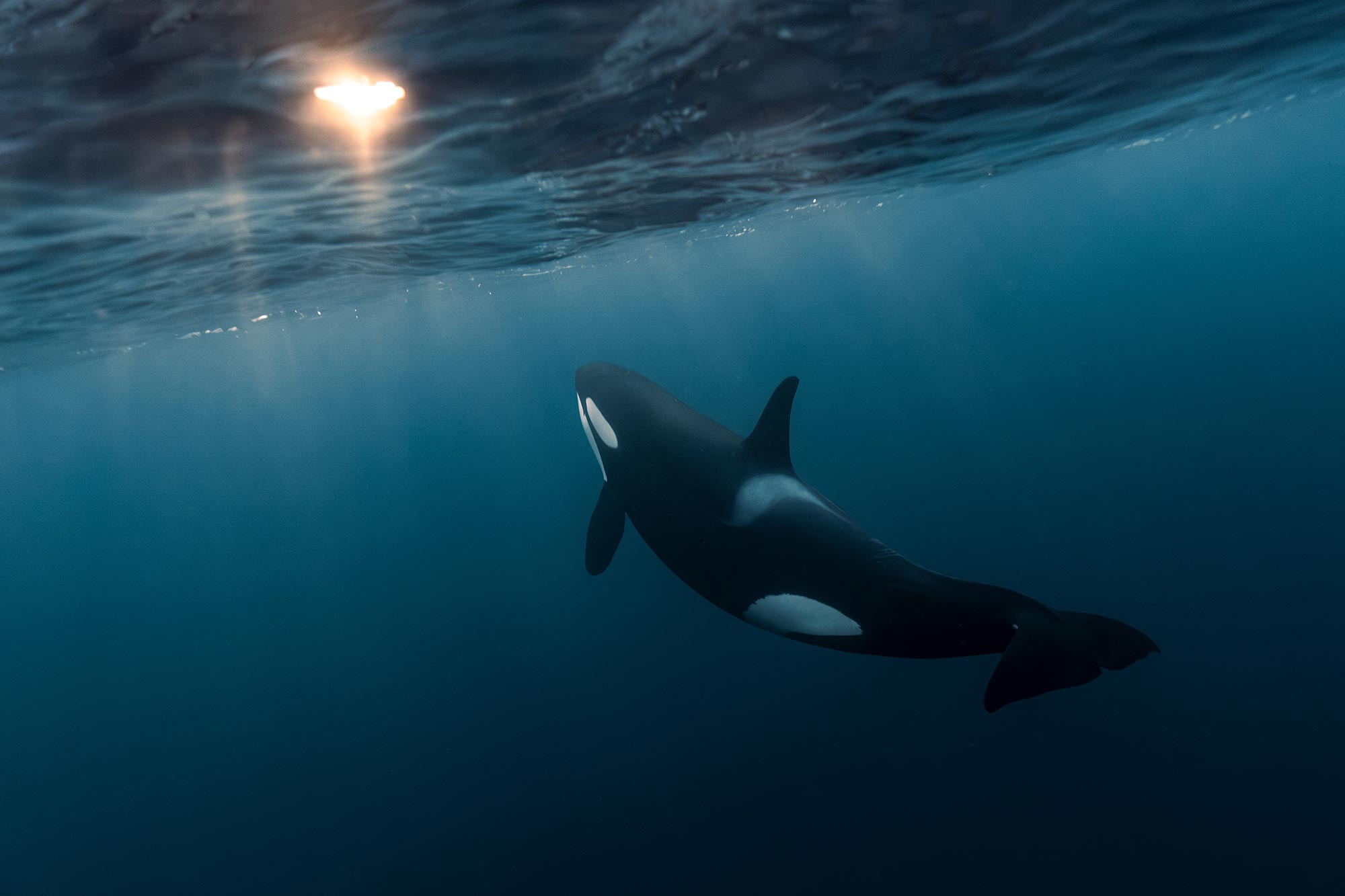
A widely publicized killer whale attack once seemed to explain why white sharks disappeared from a key aggregation site. Long-term tracking now suggests the reality is more nuanced.
Killer whales (Orcinus orca) are known to drive white sharks (Carcharodon carcharias) away from key gathering areas, but new research suggests that longer disappearances are not always caused by these encounters. Scientists report that extended absences may also reflect the sharks’ normal movement patterns.
A study led by Flinders University examined 12 years of acoustic tracking data along with wildlife tourism sighting records. The researchers concluded that the extended disappearance of white sharks from South Australia’s Neptune Islands after a 2015 predation event was unlikely to have been caused solely by killer whales.
Killer whales have been documented hunting a variety of shark species worldwide, including white sharks. Confirmed cases have been reported in Australia, Mexico, California, and South Africa.
Testing the Long-Term Impact
On February 2, 2015, about six killer whales were seen attacking and killing a white shark roughly 20 meters from a cage diving vessel at the Neptune Islands Group Marine Park in South Australia. (See video embedded below.)
Observers reported that three whales appeared to herd the shark, limiting its movement, while others struck it with their heads. The shark was forced underwater, and an oil slick later formed on the surface, a sign that the attack had been successful.
The incident drew widespread attention and was broadly shared. In the weeks that followed, white sharks were absent from the area for approximately two months. Many attributed the disappearance to the killer whale attack, drawing comparisons to similar incidents documented in South Africa.
Predation by killer whales is often believed to cause abrupt shifts in shark behavior, prompting them to leave coastal aggregation sites. These departures can also influence the surrounding marine ecosystem.
Testing the Long-Term Impact
Research from South Africa, Mexico, and California indicates that shark absences after killer whale encounters can last weeks or months and may even lead to long term abandonment of certain locations. However, much of that earlier work relied mainly on surface observations rather than extended tracking data.
In the new study, led by Dr. Isabella Reeves and published in Wildlife Research, scientists combined more than a decade of acoustic telemetry with tourism sighting records. Their goal was to determine whether the 2015 disappearance was unusual or part of the natural ebb and flow of white shark presence at the Neptune Islands.
“Our results show that killer whales can absolutely trigger an immediate response from white sharks, but they are not always the whole story when it comes to long-term shark disappearances,” says Dr. Reeves, postdoctoral candidate from Flinders University’s Southern Shark Ecology Group and the Western Australian Cetacean Research Centre (CETREC).
“Across the 12-year study, we recorded six prolonged absences of more than 42 days, and only one of them coincided with the presence of killer whales.
“The longest absence we recorded was even longer than the 2015 event and occurred when no killer whales were detected at all. This shows that while killer whales can trigger immediate short-term departures, they are not always the sole driver of extended disappearances of sharks from their local sites.”
Natural Variability in Shark Residency
The findings also show that not every encounter with killer whales or even the death of a shark leads to a lengthy absence.
For instance, a killer whale sighting in October 2024 was followed by a departure that lasted just five days. In another case, the death of a tagged white shark, which may have released chemical cues known as necromones, was associated with only a four-day gap in sightings.
Senior author Professor Charlie Huveneers, leader of the Southern Shark Ecology Group, explains that white shark residency at aggregation sites can vary widely. According to the study, extended gaps in shark presence can occur even when there is no evidence of killer whale activity or shark deaths.
“While these events seem to lead to immediate departure, long absences of white sharks at the Neptune Islands are more likely to reflect natural variability in white shark residency than a behavioural response to killer whales,” says Professor Huveneers.
“This study highlights the importance of long-term monitoring to understand white shark movements and site fidelity, while challenging the idea that killer whales are always or solely responsible for prolonged shark absences,” says Dr. Lauren Meyer, co-author of the study.
Reference: “Absence or avoidance? White shark response to killer whale predation risk ” by Isabella M. Reeves, Adam Barnett, David Donnelly, Lauren Meyer and Charlie Huveneers, 9 February 2026, Wildlife Research.
DOI: 10.1071/WR25088
Never miss a breakthrough: Join the SciTechDaily newsletter.
Follow us on Google and Google News.
1 Comment
“A widely publicized killer whale attack once seemed to explain why white sharks disappeared from a key aggregation site.”
It wasn’t just a single attack, as suggested by the quote, that led to the adoption of the current paradigm.
“…, extended gaps in shark presence can occur even when there is no evidence of killer whale activity or shark deaths.”
Absence of evidence is not evidence against killer whale hunting activity. It is simply absence of evidence. It is a big ocean, rarely monitored at night.