

A long-term study using DNA from whale scat has revealed surprising complexity in the diets of southern Alaska’s fish-eating killer whales.
Fish-eating killer whales in southern Alaska consume a wide range of prey that changes with the seasons, according to a new study published in Ecosphere. Their food choices include several salmon species as well as groundfish, and the mix varies noticeably among different feeding areas across the region.
Researchers have tracked killer whales in Prince William Sound and Kenai Fjords since 1984 through a long-term monitoring effort led by the North Gulf Oceanic Society. Each year from May through September, scientists collect fish remains and fecal samples left behind after feeding. Over time, they have gathered about 400 samples to better understand what these whales are eating.
The analysis shows that the whales shift their primary prey among Chinook, chum, and coho salmon depending on the season and location. They also consume Pacific halibut, arrowtooth flounder, and sablefish, though in smaller amounts. For certain pods, or family groups, these groundfish species make up a meaningful portion of their diet.
New Tools Reveal a Broader Menu
In the past, studies of killer whale diets relied mainly on collecting fish fragments from the water’s surface, most often scales. That approach made it easier to identify salmon but provided a limited view of the whales’ overall feeding habits.
Newer methods examine DNA found in fecal samples, allowing scientists to detect a much wider range of prey species.
Hannah Myers, an assistant professor at the University of Alaska Fairbanks College of Fisheries and Ocean Sciences, said it was striking to see how the whales’ main prey changed among feeding hotspots, even in areas located close to one another.
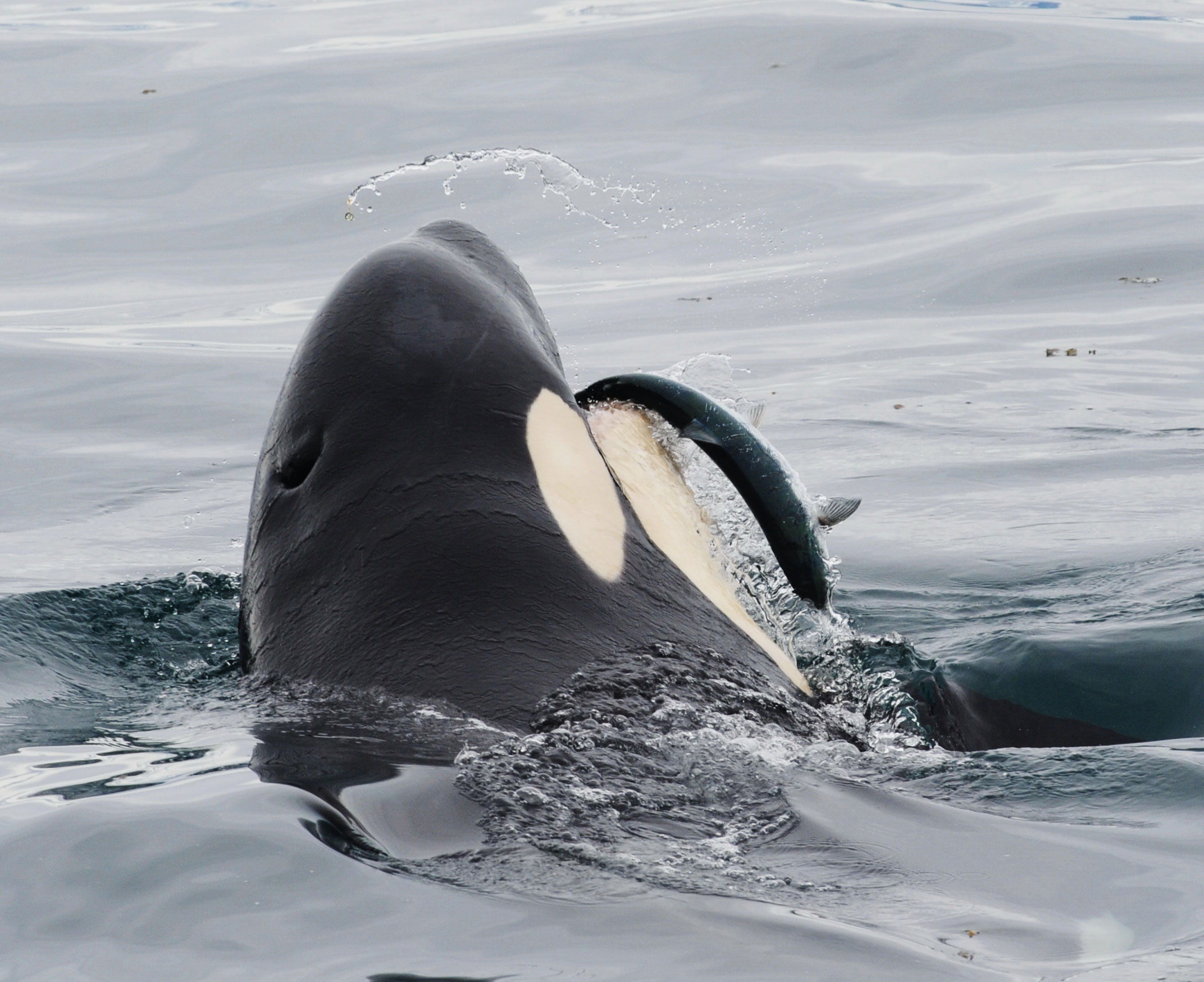
“Switching between these salmon species — with important contributions from groundfish — is a different narrative from the one we usually hear about the diet of fish-eating killer whales in the North Pacific, which emphasizes Chinook salmon as their primary prey,” said Myers, the lead author of the paper.
The findings also underscore the need to consider sampling bias. Myers explained that Chinook salmon appeared most frequently in collected samples, but they were also the easiest remains to spot and retrieve. When the team examined diet patterns by season and specific location, the role of other fish species became more apparent.
How Researchers Track a Hunt
To gather prey remains, scientists follow whales during feeding bouts and watch for sharp turns and splashing at the surface that signal a fish chase. After the whales move away, researchers carefully approach the area and use pool nets to collect floating scales or bits of tissue.
Collecting fecal samples requires patience and distance. Researchers trail behind the whales and look for scat rising to the surface in the swirling water created by the animals’ flukes as they dive.
In the North Pacific, killer whales that feed exclusively on fish, often referred to as “residents,” are considered a separate subspecies from two other groups: one that preys on marine mammals and another that focuses largely on sharks. Fish-eating killer whales are the most widespread type in the region. Roughly 1,000 of them range from Southeast Alaska to Kodiak Island. They live in stable family groups led by females, with offspring remaining alongside their mothers for life.
Implications for Ecosystems and Fisheries
A flexible diet could help southern Alaska’s resident killer whales cope with shifts in fish abundance. If one prey species declines, they may be able to rely more heavily on others.
The research may also matter for fisheries management. Managers estimate how many fish are lost to natural predators when setting catch limits. A clearer understanding of which species are targeted by killer whales, and when, could eventually inform those decisions.
“DNA studies from fecal samples are exciting because they have so much more information than previous techniques,” said Dan Olsen, a biologist with the North Gulf Oceanic Society and a co-author of the paper. “This prey diversity is important to understanding the ecosystem, and perhaps future winter samples will show even more variability when times are lean.”
Reference: “The diverse diet of southern Alaska resident killer whales shifts across spatiotemporally distinct foraging hotspots” by Hannah J. Myers, Daniel W. Olsen, Amy M. Van Cise, Abigail H. Wells, Kim M. Parsons and Craig O. Matkin, 14 December 2025, Ecosphere.
DOI: 10.1002/ecs2.70509
Never miss a breakthrough: Join the SciTechDaily newsletter.
Follow us on Google and Google News.
1 Comment
Are these things wiping out other life-forms? Hunter-gathers got together in coordinated trapping and butchering the massive numbers of animals – but finally destroyed them and then humans moved into the lower areas to farm.
The Orcas aren’t going to farm after they destroy the food chain.