
Record wildfires scorched Spain and France, creating vast burn scars and a rare fire-powered cloud over France.
Wildfires are a recurring summer threat across Europe, but the fires that swept through Spain and France in July 2026 ranked among the most destructive and disruptive either country had experienced in decades. Some of the most serious outbreaks developed in southwestern France’s Gironde Department and in the Spanish provinces of Ávila and Madrid during the middle of the month. Together, the fires forced hundreds of thousands of residents to leave their homes and destroyed hundreds of houses.
Spain Records Its Largest Wildfire
Spanish government officials said the fire in Ávila became the largest ever recorded in the country after burning about 50,000 hectares (124,000 acres). It surpassed the 2025 fire that affected Larouco, Quiroga, and Oencia.
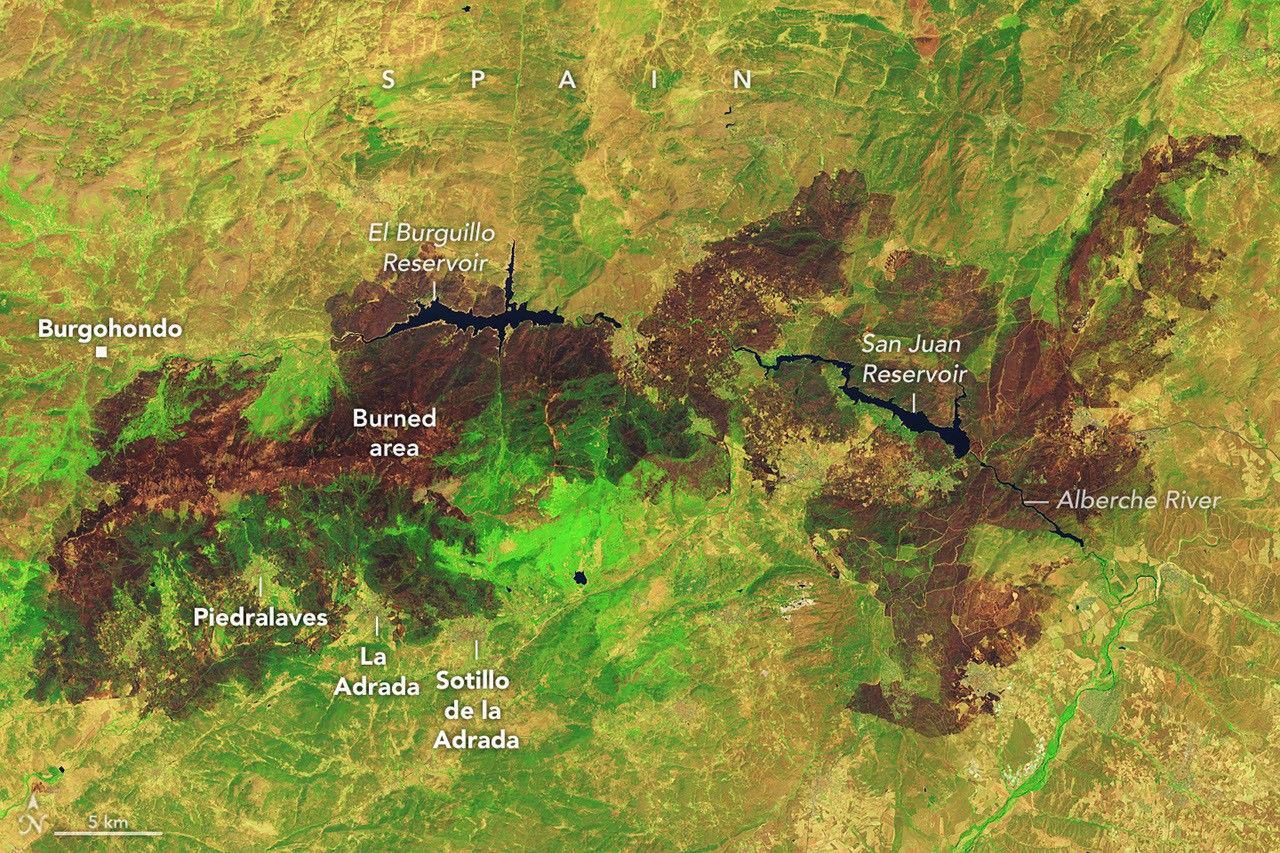
NASA satellites first detected signs of the Ávila fire near Burgohondo on July 22 and July 23. By July 24, the blaze had joined with fires burning in nearby provinces. The combined burned area reached 77,000 hectares, roughly equal to the size of New York City.
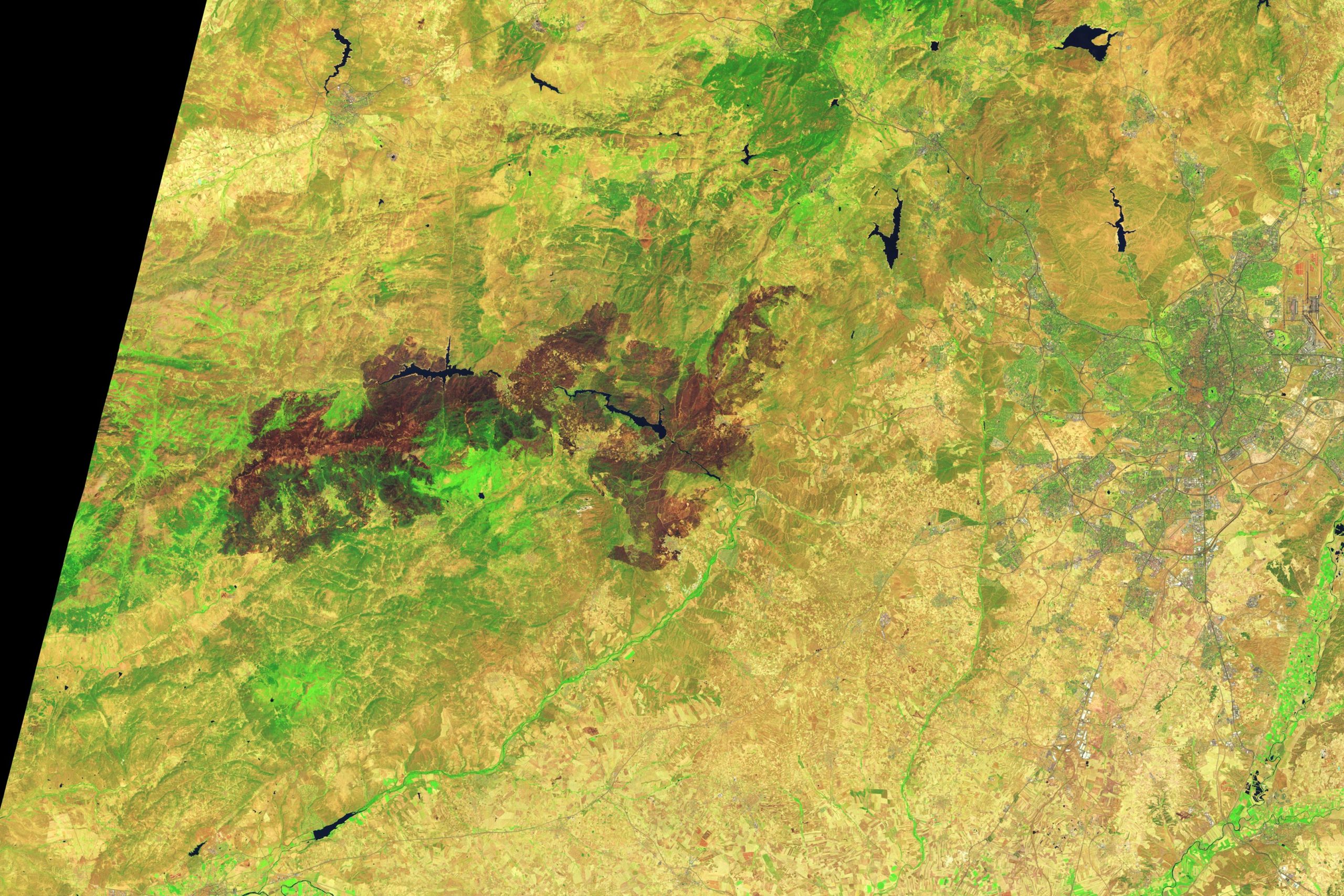
A Landsat 9 image captured on July 29, 2026, reveals the extensive burned landscape surrounding Burgohondo. In the false-color view, healthy vegetation appears light green, while fire-damaged areas appear brown.
The two reservoirs near the center of the image were especially hard hit. According to news reports, the flames damaged or destroyed homes, restaurants, campgrounds, marinas, and other facilities around the reservoirs.
Major Fires Devastate Southwestern France
A similarly severe emergency unfolded west of Bordeaux in southwestern France. One of the country’s largest fires of the decade burned more than 42,000 hectares, triggered mass evacuations, and devastated the village of Le Porge.
By late July, wildfires across France had burned more than 90,000 hectares. Data from the European Forest Fire Information System indicated that the total was higher than in any other French fire season in decades.
Weather Created Dangerous Fire Conditions
Researchers with The State of Wildfires Project found that conditions developing months before the fires began had left parts of Spain and France unusually vulnerable.
An exceptionally wet winter encouraged thick vegetation growth across grasslands, shrublands, and forest understories. Later, repeated periods of extreme heat and drought dried out that vegetation, creating abundant fuel for the fires.
Several days of powerful winds then helped the flames spread rapidly. At times, wind speeds reached 65 kilometers (40 miles) per hour, according to the researchers.
France Reports a Rare Fire Cloud
On July 25, fire conditions in southwestern France became so extreme that firefighters reported the formation of a pyrocumulonimbus, a towering type of “fire cloud” fueled by convective energy rising from the intense heat below.
An international team of atmospheric scientists and wildfire experts that monitors these unusual clouds has recorded occasional examples over Spain and Portugal in recent decades. However, members of the group said this was the first reported case of a fire in France producing one.
Firefighters Battle the Blazes
Thousands of firefighters and military personnel were deployed across both countries. Aircraft dropped water and flame retardant from above, while ground crews built firebreaks with equipment ranging from bulldozers to hand tools.
By late July, firefighters had begun to gain control, allowing officials to lift some evacuation orders. Even so, forecasters warned that the wildfire threat would remain elevated in the days ahead because hot and dry weather was expected to continue.
Satellites Track Wildfires From Space
Government satellite observations are part of a worldwide monitoring network used to follow wildfire behavior and identify developing trends.
NASA provides several tools for tracking active fires in real time, including FIRMS (Fire Information for Resource Management System) and the Worldview browser.
Never miss a breakthrough: Join the SciTechDaily newsletter.
Follow us on Google and Google News.