
Long after a nuclear reactor goes dark, its radioactive fuel continues to whisper through matter, leaving behind a hidden signal that scientists have detected for the first time.
Turning off a nuclear reactor stops the chain reaction, but it does not make the reactor completely quiet. Long after the core goes dark, radioactive fragments left behind by fission continue to decay, releasing a faint stream of nearly undetectable particles known as antineutrinos.
Now, scientists have measured that lingering signal directly for the first time. Using the Double Chooz experiment in France, researchers detected antineutrinos emitted after two nuclear reactors had been shut down, revealing the subtle particle “afterglow” produced by partially used fuel in the cores and spent fuel stored nearby.
The result could eventually give nuclear inspectors a new way to verify reactor activity and monitor spent-fuel inventories even when a facility is offline. Because antineutrinos pass through reactor walls, shielding, and surrounding rock with little difficulty, they can carry information from places that are otherwise hard to observe directly.
The study, published in Physical Review Letters, was led by Anthony Onillon and Thierry Lasserre of the Max Planck Institute for Nuclear Physics (MPIK) in Heidelberg, Germany. It provides the first quantitative measurement of the residual antineutrino flux that remains after reactors are switched off.
Antineutrinos are produced in enormous numbers during nuclear fission, but they are exceptionally difficult to detect because they rarely interact with matter. Most travel straight through reactor walls, shielding, and the surrounding landscape without leaving a trace. That same property makes them valuable messengers. Unlike heat, radiation, or other conventional signals, they cannot easily be blocked or concealed.
After shutdown, the intense antineutrino output from active fission quickly falls. A much weaker signal remains as long-lived fission products continue to decay in partially used fuel inside the reactor and in spent-fuel assemblies stored in cooling pools. This residual emission can persist for months or years.
How Double Chooz Detects Antineutrinos
The Double Chooz detector is installed underground at the Chooz nuclear power plant in northern France, about 400 meters (1,300 feet) from the plant’s two reactor cores. It contains more than 30 cubic meters (1,060 cubic feet) of liquid scintillator, which produces brief flashes of light when certain particles interact inside it.
“Antineutrinos interact only extremely rarely with matter. However, when one interacts within the Double-Chooz detector, a characteristic double-light signal is produced that can be distinguished from background events,” explains Thierry Lasserre from the independent research group OMINA, also located at MPIK.
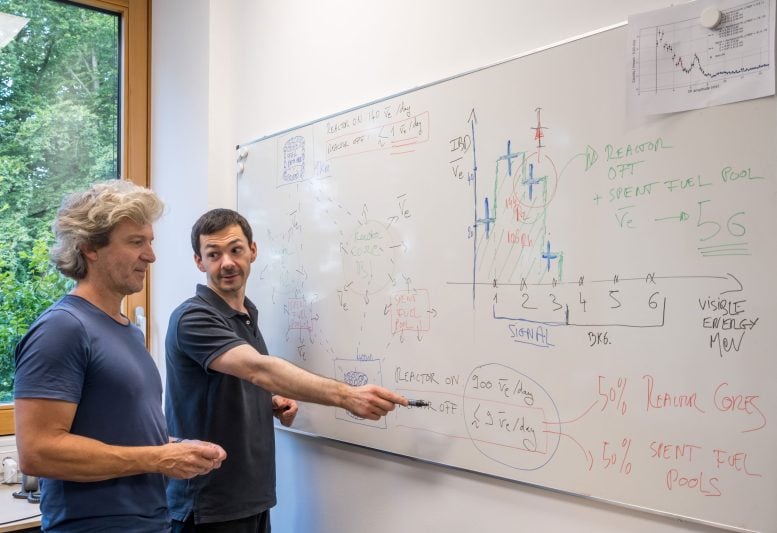
The two flashes do not occur simultaneously. An antineutrino interaction first produces a positron, generating an immediate burst of light. A neutron created in the same interaction is captured a short time later, producing a second flash. Detecting this closely timed pair helps researchers separate genuine antineutrino events from natural radioactivity, cosmic rays, and other background signals.
First Direct Measurement of the Residual Signal
The collaboration studied 17.2 days of data collected while both Chooz reactors were completely shut down. In the energy range where the remaining signal was strongest, the detector recorded 106 candidate events, with an uncertainty of 18 events. The detection reached a statistical significance of 5.9 sigma, well above the standard normally used to claim a discovery in particle physics.
Detailed reactor simulations had predicted 88 events, with an uncertainty of seven. The close agreement between the observed and expected numbers offers the first direct experimental test of models describing antineutrinos from shut-down reactors and stored nuclear fuel.
“Until now, reactor antineutrino experiments have mainly focused on operating reactors, where the antineutrino flux is much larger. Detecting the tiny residual signal after shutdown required exceptionally low backgrounds and careful analysis techniques developed by the Double Chooz collaboration over many years,” adds Dr. Onillon.
Nuclear Monitoring and Future Experiments
Because antineutrinos travel freely through shielding and carry information about radioactive decay, future detectors might offer an independent way to verify reactor status or monitor changes in spent-fuel inventories. Researchers are already beginning to test how well this approach could work in other settings.
Initial JUNO-TAO results presented at Neutrino 2026 indicate that the team is analyzing reactor-off data to isolate antineutrinos emitted by spent fuel. The Double Chooz measurement now provides the first published benchmark for evaluating and comparing future observations.
Double Chooz was originally built for a different purpose: studying neutrino oscillations, the process through which neutrinos change from one type to another while traveling. The experiment helped measure the mixing angle θ13, a fundamental value that has shaped later efforts to investigate possible differences between matter and antimatter in the neutrino sector. With this latest work, Double Chooz has reached another milestone by becoming the first experiment to detect the faint antineutrino glow that persists after a reactor goes dark.
Reference: “First Measurement of Neutrino Emissions from Spent Nuclear Fuel by the Double Chooz Experiment” by T. Abrahão, H. Almazan, J. C. dos Anjos, S. Appel, J. C. Barriere, I. Bekman, T. J. C. Bezerra, L. Bezrukov, E. Blucher, E. Blucher, C. Bourgeois, C. Buck, J. Busenitz, A. Cabrera, M. Cerrada, E. Chauveau, P. Chimenti, O. Corpace, J. V. Dawson, J. F. Du, Z. Djurcic, A. Etenko, H. Furuta, I. Gil-Botella, A. Givaudan, H. Gomez, M. C. Goodman, T. Hara, J. Haser, D. Hellwig, A. Hourlier, M. Ishitsuka, J. Jochum, C. Jollet, K. Kale, M. Kaneda, M. Karakac, T. Kawasaki, E. Kemp, D. Kryn, M. Kuze, T. Lachenmaier, C. E. Lane, T. Lasserre, D. Lhuillier, H. P. Lima, Jr., M. Lindner, J. M. LoSecco, B. Lubsandorzhiev, J. Maeda, C. Mariani, J. Maricic, J. Martino, T. Matsubara, G. Mention, A. Meregaglia, T. Miletic, R. Milincic, A. Minotti, X. Mougeot, D. Navas-Nicolás, Y. Nikitenko, P. Novella, L. Oberauer, M. Obolensky, A. Onillon, A. Oralbaev, C. Palomares, I. M. Pepe, L. Perisse, G. Pronost, J. Reichenbacher, S. Schönert, S. Schoppmann, L. Scola, R. Sharankova, V. Sibille, V. Sinev, M. Skorokhvatov, P. Soldin, A. Stahl, I. Stancu, M. R. Stock, L. F. F. Stokes, F. Suekane, S. Sukhotin, T. Sumiyoshi, C. Veyssiere, B. Viaud, M. Vivier, S. Wagner, C. Wiebusch, G. Yang and F. Yermia, 4 August 2026, Physical Review Letters.
DOI: 10.1103/dr26-j19g
Never miss a breakthrough: Join the SciTechDaily newsletter.
Follow us on Google and Google News.
3 Comments
“What’s striking here is the clear convergence between macro planetary geophysics and engineered nuclear systems. Whether it’s asymmetric geoneutrino flux bleeding from deep mantle nodes or the residual afterglow leaking from a shut-down reactor core, the core mechanism is identical: unstable, excited lattice states continuously releasing phase-decay stress into the spatial medium until baseline equilibrium is reached.” “Great demonstration of continuous field relaxation across scales. The lingering reactor signal proves that decay isn’t an isolated event, but an ongoing structural adjustment—the exact same process driving deep-Earth geoneutrino emission. Macro or micro, excited states always bleed off residual stress to restore equilibrium.”
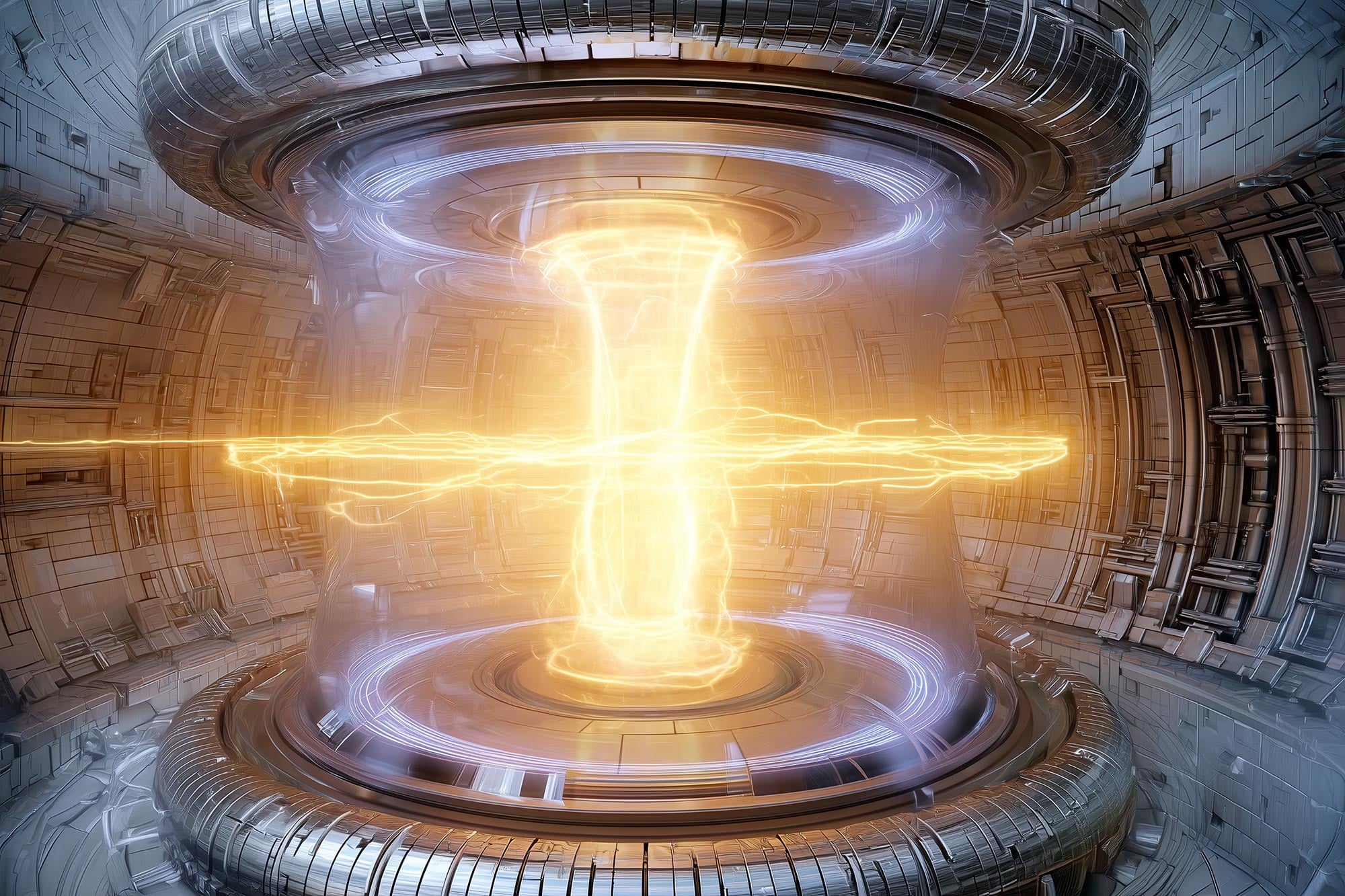
“First off, that stock photo is a Tokamak fusion reactor torus, not a fission core or cooling pool—two completely different animals! That aside, the physics here is spot-on: this residual antineutrino signal demonstrates continuous lattice stress relaxation. Shutting down the control rods stops forced fission, but those long-lived fragments must continuously bleed off their residual phase energy into the surrounding spatial medium until baseline equilibrium is restored.”
Citing the uncertainty of the predicted number of events is a step in the right direction. However, is it +/-1 sigma (68%) or +/-2 sigma (95%)?