

High-precision measurements from the KATRIN experiment strongly limit the existence of light sterile neutrinos and narrow the search for new physics.
Neutrinos are extremely difficult to detect, yet they are some of the most abundant matter particles in the Universe. The Standard Model includes three known types, but discoveries showing that neutrinos oscillate revealed that they have mass and can change from one type to another as they move.
For many years, unexplained results from several experiments have raised the possibility of a fourth kind, known as a sterile neutrino, which would interact even more weakly than the others. Confirming its existence would fundamentally reshape modern particle physics.
In a new study published in Nature, the KATRIN collaboration reports the most sensitive direct search so far for sterile neutrinos, using detailed measurements of tritium β-decay.
How KATRIN searches for hidden neutrinos
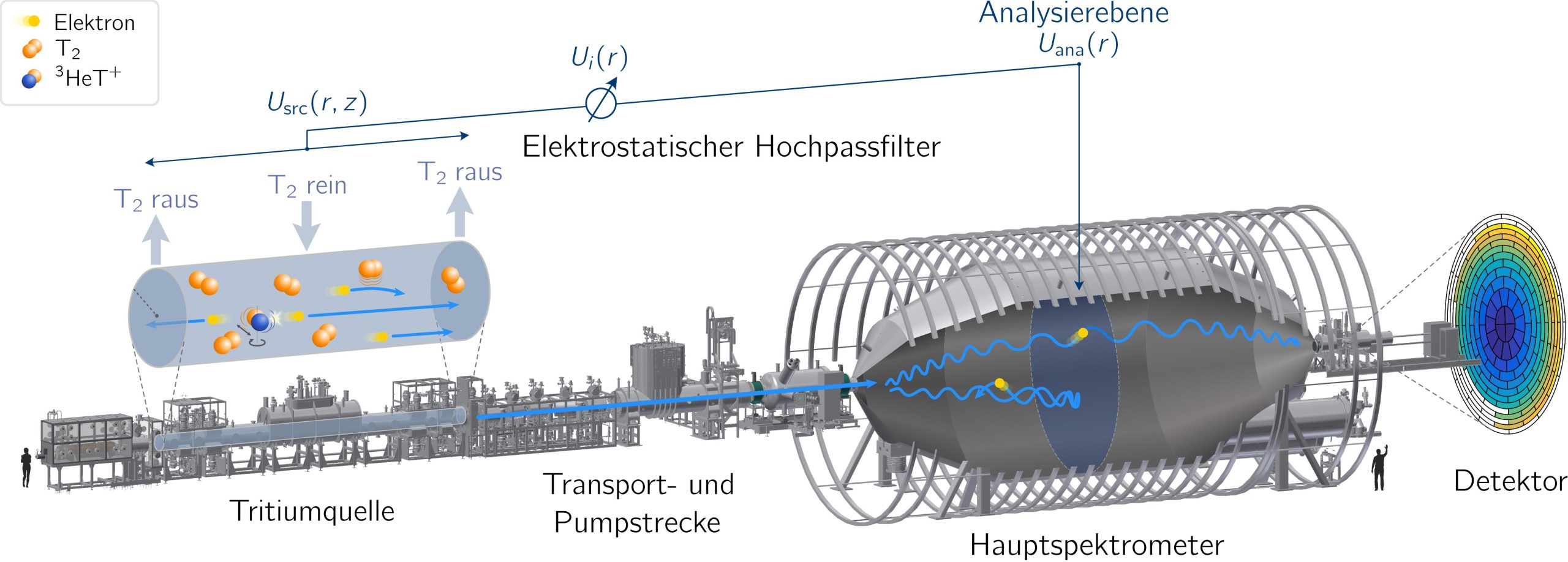
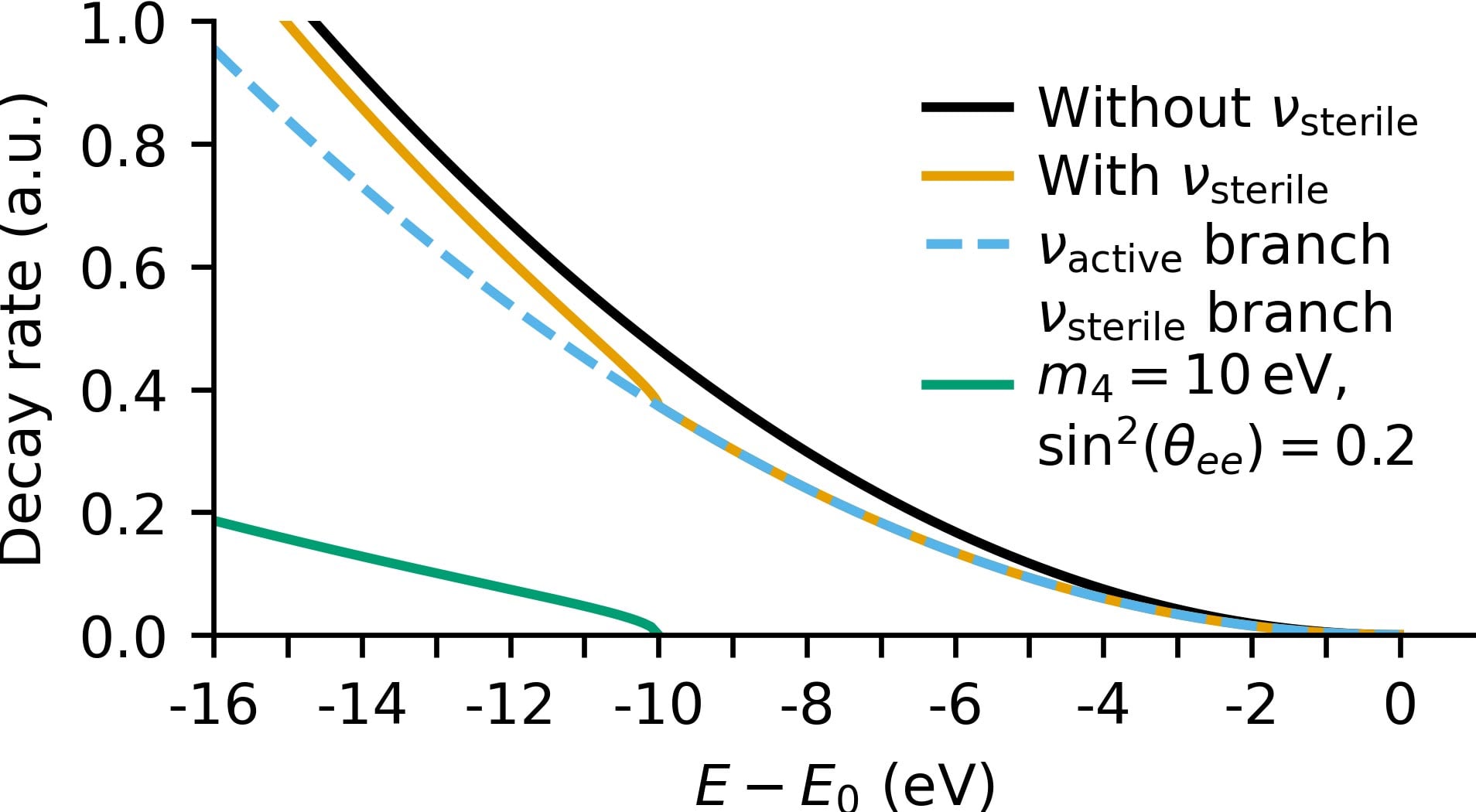
The KATRIN (Karlsruhe Tritium Neutrino) experiment was designed to measure the mass of neutrinos by examining the energy spectrum of electrons released during the β-decay of tritium. In this decay process, part of the energy is carried away by the neutrino, subtly influencing the energy of the emitted electron.
If a sterile neutrino were produced in some of these decays, it would leave a recognizable feature, described as a “kink”, in the electron energy spectrum. The experiment is based at the Karlsruhe Institute of Technology in Germany and stretches over more than 70 meters.
It consists of three main elements: a high-intensity windowless gaseous tritium source, a high-resolution spectrometer to analyze electron energies, and a detector that records them. Since 2019, KATRIN has been collecting exceptionally precise measurements of the tritium β-decay spectrum, searching for even the smallest deviations that could signal the presence of a sterile neutrino.
The new Nature study represents the most sensitive tritium β-decay search for sterile neutrinos to date. Between 2019 and 2021, KATRIN recorded 36 million electrons over 259 days and compared the data with a detailed β-decay model, achieving measurement precision below one percent.

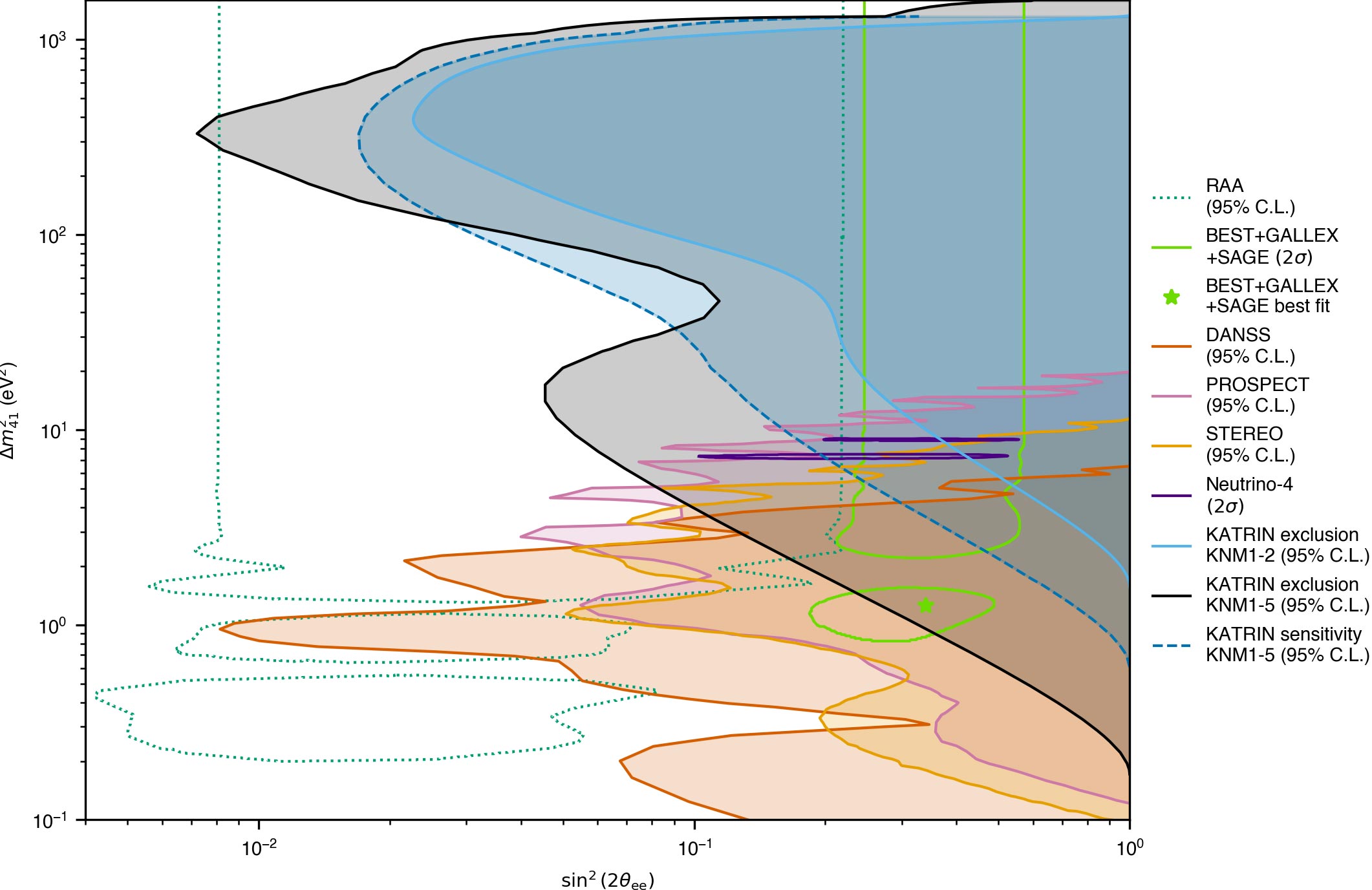
The analysis found no evidence for a sterile neutrino. These results rule out a large portion of the parameter space suggested by earlier experimental anomalies, including deficits reported in reactor-neutrino and gallium-source studies that had pointed to a possible fourth neutrino. The findings also completely exclude the claim from the Neutrino-4 experiment, which had reported signs of such a particle.
Thanks to its very low background, almost all detected electrons can be confidently attributed to tritium β-decay, allowing KATRIN to measure the spectrum with exceptional clarity.
Unlike oscillation experiments, which track how neutrinos change type after traveling some distance, KATRIN examines the energy distribution at the moment the neutrinos are produced. Together, these different approaches provide complementary evidence that strongly disfavors the existence of light sterile neutrinos.
“Our new result is fully complementary to reactor experiments such as STEREO,” explains Thierry Lasserre (Max-Planck-Institut für Kernphysik) in Heidelberg, who led the analysis. “While reactor experiments are most sensitive to sterile–active mass splittings below a few eV², KATRIN explores the range from a few to several hundred eV². Together, the two approaches now consistently rule out light sterile neutrinos that would noticeably mix with the known neutrino types.”
Pushing sensitivity toward darker candidates
With data collection continuing through 2025, KATRIN’s sensitivity will further increase, enabling even more stringent searches for light sterile neutrinos.
“By the completion of data taking in 2025, KATRIN will have recorded more than 220 million electrons in the region of interest, increasing the statistics by over a factor of six,” says KATRIN co-spokesperson Kathrin Valerius (KIT). “This will allow us to push the boundaries of precision and probe mixing angles below the present limits.” In 2026, the KATRIN experiment will be upgraded with the TRISTAN detector, capable of recording the full tritium β-decay spectrum with unprecedented statistics.
By bypassing the main spectrometer and measuring electron energies directly TRISTAN will be able to explore much higher sterile-neutrino masses. “This next-generation setup will open a new window into the keV-mass range, where sterile neutrinos might even form the Universe’s dark matter,” says co-spokesperson Susanne Mertens (Max-Planck-Institut für Kernphysik).
Reference: “Sterile-neutrino search based on 259 days of KATRIN data” by The KATRIN Collaboration, 3 December 2025, Nature.
DOI: 10.1038/s41586-025-09739-9
Never miss a breakthrough: Join the SciTechDaily newsletter.
Follow us on Google and Google News.
7 Comments
Physicists Tighten the Net Around the Elusive Sterile Neutrino.
VERY GOOD!!!
Please ask the physicists to think deeply:
1. Are neutrinos high-dimensional spacetime matter or low dimensional spacetime matter?
2. Is topological vortex high-dimensional spacetime matter or low dimensional spacetime matter?
3. Can low dimensional spacetime matter be the basis of high-dimensional spacetime matter?
4. Do topological vortices have momentum?
5. Do topological vortices have energy?
When we pursue the ultimate truth of all things, the space in which our bodies and all things exist may itself be the final and deepest puzzle we need to explore. This is not only the pursuit of physics, but also the most magnificent exploration of the origin of the universe by human reason.
Based on the Topological Vortex Theory (TVT), space is an uniformly incompressible physical entity. Space-time vortices are the products of topological phase transitions of the tipping points in space, are the point defects in spacetime. Point defects do not only impact the thermodynamic properties, but are also central to kinetic processes. They create all things and shape the world through spin and self-organization.
In today’s physics, some so-called peer-reviewed journals—including Physical Review Letters, Nature, Science, and others—stubbornly insist on and promote the following:
1. Even though θ and τ particles exhibit differences in experiments, physics can claim they are the same particle. This is science.
2. Even though topological vortices and antivortices have identical structures and opposite rotational directions, physics can define their structures and directions as entirely different. This is science.
3. Even though two sets of cobalt-60 rotate in opposite directions and experiments reveal asymmetry, physics can still define them as mirror images of each other. This is science.
4. Even though vortex structures are ubiquitous—from cosmic accretion disks to particle spins—physics must insist that vortex structures do not exist and require verification. Only the particles that like God, Demonic, or Angelic are the most fundamental structures of the universe. This is science.
5. Even though everything occupies space and maintains its existence in time, physics must still debate and insist on whether space exists and whether time is a figment of the human mind. This is science.
6. Even though space, with its non-stick, incompressible, and isotropic characteristics, provides a solid foundation for the development of physics, physics must still insist that the ideal fluid properties of space do not exist. This is science.
and go on.
Is this the counterintuitive science they widely promote? Compromising with pseudo academic publications and peer review by pseudo scholars is an insult to science and public intelligence. Some so-called scholars no longer understand what shame is. The study of Topological Vortex Theory (TVT) reminds us that the most profound problems in physics often lie at the intersection of different theories. By exploring these border regions, we can not only resolve contradictions in existing theories but also discover new physical phenomena and application possibilities.
Under the topological vortex architecture, it is highly challenging for even two hydrogen atoms or two quarks to be perfectly symmetrical, let alone counter-rotating two sets of cobalt-60. Contemporary physics and so-called peer-reviewed publications (including Physical Review Letters, Science, Nature, etc.) stubbornly believe that two sets of counter rotating cobalt-60 are two mirror images of each other, constructing a more shocking pseudoscientific theoretical framework in the history of science than the “geocentric model”. This pseudo scientific framework and system have seriously hindered scientific progress and social development.
For nearly a century, physics has been manipulated by this pseudo scientific theoretical system and the interest groups behind it, wasting a lot of manpower, funds, and time. A large amount of pseudo scientific research has been conducted, and countless pseudo scientific papers have been published, causing serious negative impacts on scientific and social progress, as well as humanistic development.
Complexity does not necessarily mean that there is no logical and architectural framework to follow. Mathematics is the language and tool that reveals the motion of spacetime, rather than the motion itself. Although the physical form of spacetime vortices is extremely simple, their interaction patterns are highly complex, and we must develop more and richer mathematical languages to describe and understand them.
The development of the Topological Vortex Theory (TVT) reflects a progression from concrete physical phenomena to abstract mathematical modeling and, ultimately, to interdisciplinary unification. Its core innovation lies in forging the continuous spacetime geometry of general relativity with the discrete interactions of quantum field theory within the same topological dynamical system. The core idea of TVT — space is physical, and matter is its topological excitation—already provides a solid and elegant scientific path for understanding the origin of all things.
——Excerpted from https://scitechdaily.com/microscope-spacecrafts-most-precise-test-of-key-component-of-the-theory-of-general-relativity/#comment-909171 and https://t.pineal.cn/blogs/6255/A-Mathematical-and-Physical-Analysis-On-the-Origin-of-Objects.
Neutrinos are extremely difficult to detect, yet they are some of the most abundant matter particles in the Universe.
WHY? WHY? WHY?
What does the most abundant matter, extremely difficult to detect, mean? Endless funding, endless abyss, what is shameful?
The search for the so-called neutrino trick of point to a deer then call it a horse — deliberately misrepresent is so shocking.
Please inform the public: 1. Topological vortices do not exist because they are mathematical, geometric, and topological movements. 2. Neutrinos exist because neutrinos are physicist’s imagination, physicist’s angels, and physicist’s gods. What is the difference between physics and theology today?
“Tightening the net”? Isn’t that a bit rich, seeing as its existence has already been – according to at least one previous article – contradicted by recent experiment results?
VERY GOOD! Thank you for your attention and comments.
Complexity does not necessarily mean that there is no logical and architectural framework to follow. Mathematics is the language and tool that reveals the motion of spacetime, rather than the motion itself. Although the physical form of spacetime vortices is extremely simple, their interaction patterns are highly complex, and we must develop more and richer mathematical languages to describe and understand them.