
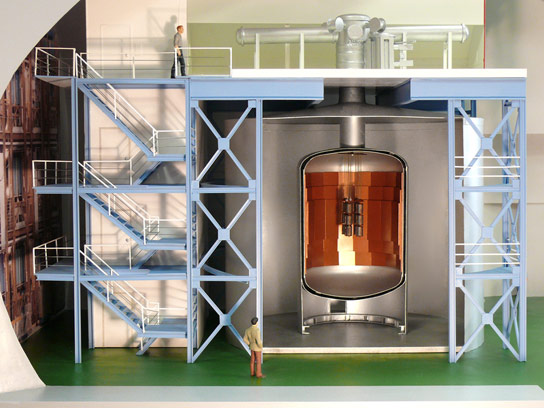
The phase I results from the GERDA experiment have revealed no signal of neutrino-less double beta decay in Ge-76, ruling out an earlier claim for a signal by others.
Neutrinos are the most elusive particles having extremely weak interactions with all other particles. They have rather unusual properties and are even expected to be identical to their own antiparticles. So far this property is, however, not experimentally verified. Now scientists of the GERDA collaboration obtained new strong limits for the so-called neutrino-less double beta decay, which tests if neutrinos are their own antiparticles. The result rules out an earlier claim.
Besides photons, neutrinos are the most abundant particles in the Universe. They are often called `ghost particles’, because they interact extremely weakly with matter. They are therefore an invisible, but very important component of the Universe, which could carry altogether as much mass as all other known forms of matter, albeit traveling almost at the speed of light over fantastic distances.
Their tiny masses have also important consequences for the structures in the Universe and they are the driving element in the explosion of Supernovae. But their most remarkable and important property has been proposed by Ettore Majorana in the 1930ies: Unlike all other particles that form the known matter around us, neutrinos may be their own antiparticles.
Particle and antiparticle are distinguished by their charges. The positron, for example, the antiparticle of the negatively charged electron, is positively charged. The neutrino, on the other hand, is electrically neutral – the prerequisite for the ability of being its own antiparticle. If this is really the case is being investigated by the GERDA experiment (GERmanium Detector Array) which is being carried out in the underground laboratories of the Laboratori Nazionali del Gran Sasso of the Istituto Nazionale di Fisica Nucleare in Italy. In addition, the researchers want to determine the mass of neutrinos. To this end, GERDA examines so-called double beta decay processes in the germanium isotope Ge-76 with and without emissions of neutrinos – the latter being a consequence of the Majorana properties.
In normal beta decay, a neutron inside a nucleus decays to a proton, an electron and an antineutrino. For nuclei like Ge-76, normal beta decay is energetically forbidden, but the simultaneous conversion of two neutrons with the emission of two antineutrinos is possible and has been measured by GERDA recently with unprecedented precision. This is one of the rarest decays ever observed with a half-life of about 2*1021 years, which is about 100 billion times longer than the age of the Universe.
If neutrinos are Majorana particles, neutrino-less double beta decay should also occur at an even lower rate. In this case, the antineutrino from one beta decay is absorbed as neutrino by the second beta-decaying neutron, which becomes possible if neutrinos are their own antiparticle.
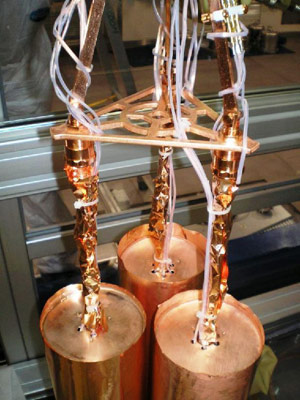
In GERDA germanium crystals are both source and detector. Ge-76 has an abundance of about 8% in natural germanium and its fraction was therefore enriched more than 10-fold before the special detector crystals were grown. Searching for a needle in a haystack is trivial compared to the detection of double beta decay, since environmental radioactivity is a background occurring at a rate at least a billion times higher than double beta decay. The GERDA detector crystals and the surrounding detector parts were therefore very carefully chosen and processed.
The observation of the extremely rare process requires in addition very delicate techniques to further suppress backgrounds from cosmic particles, natural radioactivity of the surroundings, and even the experiment itself. The scientists met this challenge by mounting the detectors in the center of a huge vessel that is filled with extremely clean liquid argon, lined by ultrapure copper, which in turn is surrounded by a 10-meter-diameter (33-foot-diameter) tank filled with highly pure water; the whole located underground below 1,400 meters (4,600 feet) of rock. Combining all these innovative and pioneering techniques it was possible to reduce the background to unprecedented levels.
Data taking started in fall 2011 using 8 detectors the size of a tin can and weighing two kilograms (4.4 pounds)each. Subsequently, 5 additional newly designed detectors were commissioned. Until recently, the signal region was blinded and the scientists focused on the optimization of the data analysis procedures. The experiment has now completed its first phase.
The analysis in which all calibrations and cuts had been defined before the data in the signal region were processed, revealed no signal of neutrino-less double beta decay in Ge-76 which leads to the world’s best lower limit for the half-life of 2,1*1025 years. Combined with information from other experiments, this result rules out an earlier claim for a signal by others. The new results from GERDA have interesting consequences for the knowledge on neutrino masses, extensions of the standard model of elementary particle physics, astrophysical processes, and cosmology.
The next steps for GERDA will be to add additional newly produced detectors effectively doubling the amount of Ge-76. Data taking will then continue in a second phase after some further improvements are implemented to achieve even stronger background suppression.
GERDA is a European collaboration with scientists from 16 research institutes or universities in Germany, Italy, Russia, Switzerland, Poland and Belgium. The participating institutes are the Max-Planck-Institute for Nuclear Physics in Heidelberg, the Max-Planck-Institute for Physics and the Technical University in Munich, the universities of Tübingen and Dresden, INFN LNGS at Gran Sasso, INFN and University Milano, INFN and University Milano Bicocca, University of Padova, INR RAS, ITEP and Kurchatov Institute in Moscow, JINR Dubna, the universities of Zürich and Cracow and IRMM Geel. The Max Planck Society (MPG) is a significant funding contributor: the universities are supported by the German Federal Ministry for Education and Research (BMBF) and the German Research Foundation (DFG).
Reference: “Results on neutrinoless double beta decay of 76Ge from GERDA Phase I” by M. Agostini et al. (GERDA Collaboration), 19 September 2013, Physical Review Letters.
DOI: 10.1103/PhysRevLett.111.122503
Never miss a breakthrough: Join the SciTechDaily newsletter.
Follow us on Google and Google News.