
Silver-110’s decay reveals a promising path to measure antineutrino mass. New data could reshape future neutrino studies.
Neutrinos and antineutrinos are fundamental particles that possess mass, although their exact value remains unknown. Recent high-precision atomic mass measurements carried out at the Accelerator Laboratory of the University of Jyväskylä in Finland suggest that the beta decay of the silver-110 isomer could serve as a promising method for determining the mass of the electron antineutrino. This finding marks a significant advancement toward future experiments focused on measuring antineutrino mass.
The question of how much mass neutrinos and antineutrinos have is one of the major unresolved issues in modern physics. As particles included in the Standard Model, neutrinos are found throughout the universe. They are generated in vast numbers by processes such as nuclear reactions in the Sun, with trillions of them passing through our bodies every second.
“Their mass determination would be of utmost importance,” says Professor Anu Kankainen from the University of Jyväskylä. “Understanding them can give us a better picture of the evolution of the universe.”
A path to understanding electron antineutrinos
Electron antineutrinos can be produced through a process known as nuclear beta decay, which also offers a potential way to measure their mass. This type of decay occurs through the weak nuclear force and results in the formation of a daughter nucleus, an electron, and an electron antineutrino. The amount of energy released during the decay is called the Q value, which depends on the mass difference between the original nucleus and the resulting decay products.
“Since the electron antineutrino mass is estimated to be at least five orders of magnitude smaller than the electron mass, it is very challenging to observe its contribution to the beta decay,” says doctoral researcher Jouni Ruotsalainen from University of Jyväskylä, who is studying this issue as part of his doctoral thesis. “To make it more accountable, beta decays which release very little energy, the so-called low-Q-value beta decays, are of particular interest.”
Beta decay of silver-110 isomer: a new and promising candidate for antineutrino mass measurements
A research team at the University of Jyväskylä has identified a promising nuclear beta decay process that may be suitable for measuring the mass of the electron antineutrino.
“Previous searches have mainly focused on ground-state beta decays but also many long-lived excited states known as isomers decay via beta decay,” says Ruotsalainen. “One such case is the isomer in the silver-110 isotope. It has a long half-life of around 250 days and decays primarily via beta decay to excited states in its daughter nucleus cadmium-110.”
Researcher surprised by the ease of mass measurement and results
Based on the literature values, the beta-decay Q-value from the silver-110 isomer to an excited state at 3008.41 keV could be negative, meaning that the decay is not possible, or slightly positive. The main uncertainty comes from the parent and daughter nuclide ground states.
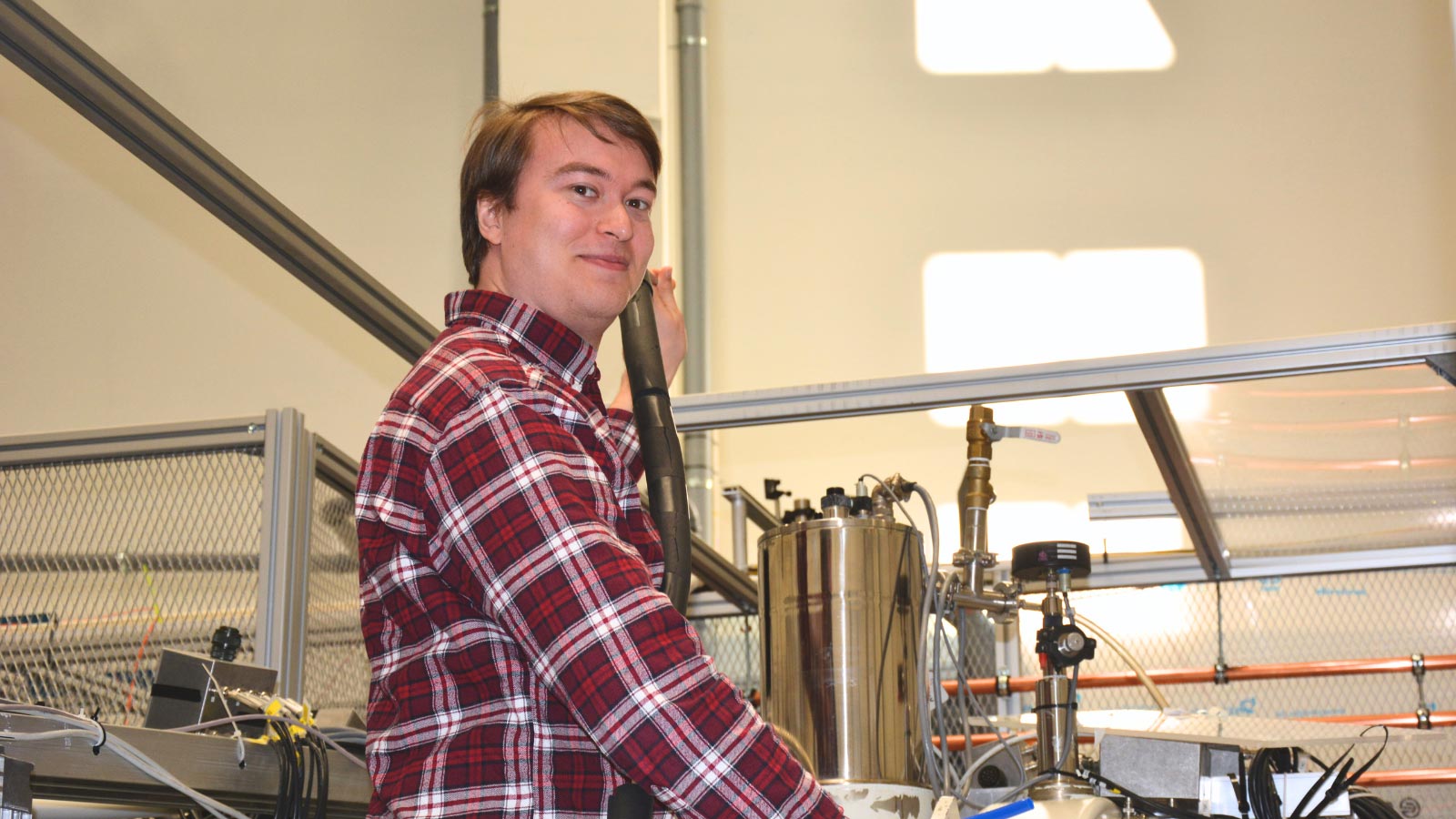
“We could considerably reduce the uncertainty of this Q value by measuring the mass difference between the stable silver-109 and cadmium-110 isotopes with the JYFLTRAP Penning trap mass spectrometer of the Accelerator Laboratory,” explains Ruotsalainen. “It was quite easy to produce the stable silver and cadmium ions with our existing electric discharge ion sources and measure their mass difference using the phase-imaging ion cyclotron resonance technique. I was thrilled to see that the resulting Q value, 405(135) eV, is positive and actually the lowest for any allowed beta decay transition discovered so far.”
Theoretical physicists confirmed experimental results
Not all the decays of the silver-110 isomer lead to the state at 3008.41 keV in cadmium-110. To estimate their fraction, shell-model calculations were performed.
“Our calculations show that about three out of every million decays from this isomer follow the fascinating, low-energy route. While that may sound tiny, it’s actually quite significant for such a low-energy transition. Moreover, with a half-life of around 250 days, the isomer sticks around long enough for researchers to produce a meaningful sample and hopefully catch a good number of these rare decays in action,” comments researcher Marlom Ramalho, who performed the theoretical work. Ramalho recently defended his PhD thesis at the University of Jyväskylä and is currently a postdoctoral fellow of the Oskar Huttunen Foundation at the University of York.
Measurements continue
The allowed character of the beta decay of the silver-110 isomer, the obtained very low Q value, and the fact that the isomer is easily produced in nuclear reactors via thermal neutrons, make silver-110 a very attractive candidate for future antineutrino experiments.
“This is certainly a case to be studied in more detail,” says Kankainen. “Our fruitful collaboration with the local theorists also indicated a couple of new isomeric beta decays that could be studied next for neutrino physics. It is nice to see that measurements of stable or near-stable isotopes can still be very impactful.”
Reference: “Ultralow Qβ Value for the Allowed Decay of Ag110m Confirmed via Mass Measurements” by J. Ruotsalainen, M. Stryjczyk, M. Ramalho, T. Eronen, Z. Ge, A. Kankainen, M. Mougeot and J. Suhonen, 28 April 2025, Physical Review Letters.
DOI: 10.1103/PhysRevLett.134.172501
Never miss a breakthrough: Join the SciTechDaily newsletter.
Follow us on Google and Google News.
7 Comments
Physicists Unlock New Path to Weighing the Universe’s “Ghost Particle”.
VREY GOOD!
Please ask physicists to think deeply:
1. Where do the “Ghost Particle” you are obsessed with and imagining come from?
2. Are these “Ghost Particle” from God, devils, Angels, or from the dynamic evolution of space itself?
3. What is the difference between physics and theology?
Physicists rarely think deeply. In an astronomy course back in 1980, I commented, ” Wouldn’t it be cool to find a gas giant orbiting it’s host star about the radius of Mercury? ” The instructor said that couldn’t happen. I’d give up my Mustang if I could go back in time to be there when he heard about 51 Pegasus.
Sometimes, we get so involved with the math that we overlook imagination. I doubt the Einstein was smarter than many of his peers, but he could imagine space and time ‘ outside of the box ‘ on a level they couldn’t match… and then, they would explain the maths of his ideas to such a degree that even he had difficulty understanding.
Been awhile since we talked. You have a good day.
Thank you for browsing and commenting.
“Sometimes, we get so involved with the math that we overlook imagination. ” I don’t quite agree with this statement. Mathematics is very important. Although mathematics is not physics, physics must never abandon mathematics and imagine freely.
Happy every day for you.
Silver-110 is an isotope, not an isomer. Isomers are different forms of the same molecule.
Thank you for clarification. I suspected that something is wrong.
Your three questions were very, very funny. Thank you for the laugh.
Thank you for browsing and thinking.
Today’s physics, misled by so-called peer-reviewed publications, is almost indistinguishable from theology. If you are interested in this, please browse https://zhuanlan.zhihu.com/p/1918614826130838141 (If the link is not blocked).