

For decades, scientists struggled to catch neutrinos—tiny, nearly invisible particles that pass through everything, including Earth itself.
Now, a breakthrough has arrived: using a detector the size of a lunchbox, researchers have finally captured these ghostlike particles as they interacted inside a nuclear reactor.
Tiny Detector, Big Discovery: Catching Elusive Neutrinos
Neutrinos are some of the most elusive particles in the universe. Every second, around 60 billion of them pass through each square centimeter of Earth, coming from the Sun. Because these particles rarely interact with matter, they move through the planet without any resistance.
Although scientists first proposed their existence many years ago, it took decades before they were successfully observed. Detecting neutrinos usually requires massive, sensitive equipment due to how weakly they interact with surrounding materials.
Now, researchers at the Max Planck Institute for Nuclear Physics (MPIK) in Heidelberg have made a breakthrough: using a detector weighing only 3 kilograms, the CONUS+ experiment has managed to detect antineutrinos produced by a nuclear reactor.
From Power Plants to Precision: CEvNS in Action
The CONUS experiment was originally set up at Germany’s Brokdorf nuclear power plant, but in the summer of 2023, it was moved to the Leibstadt nuclear power plant (KKL) in Switzerland. The relocation, along with upgrades to its 1-kilogram germanium semiconductor detectors and ideal measurement conditions at KKL, enabled researchers to detect a rare process called Coherent Elastic Neutrino-Nucleus Scattering (CEvNS) for the first time in this environment.
In CEvNS, a neutrino interacts not with the individual parts of an atomic nucleus, but with the nucleus as a whole. This kind of interaction increases the likelihood of producing a very subtle, yet measurable, recoil of the entire nucleus. To picture this effect, imagine a ping-pong ball bouncing off a parked car. The car barely moves, but the motion is detectable. In the case of CONUS+, the nuclei of germanium atoms act as the “cars,” registering the recoil. To observe this phenomenon, researchers rely on low-energy neutrinos, which are produced in vast quantities inside nuclear reactors.
Historic First: Detecting Reactor Neutrinos With Full Coherence
The effect was predicted as early as 1974, but was first confirmed in 2017 by the COHERENT experiment at a particle accelerator. The CONUS+ experiment has now successfully observed the effect at full coherence and lower energies in a reactor for the first time, as described in a recent Nature research article.
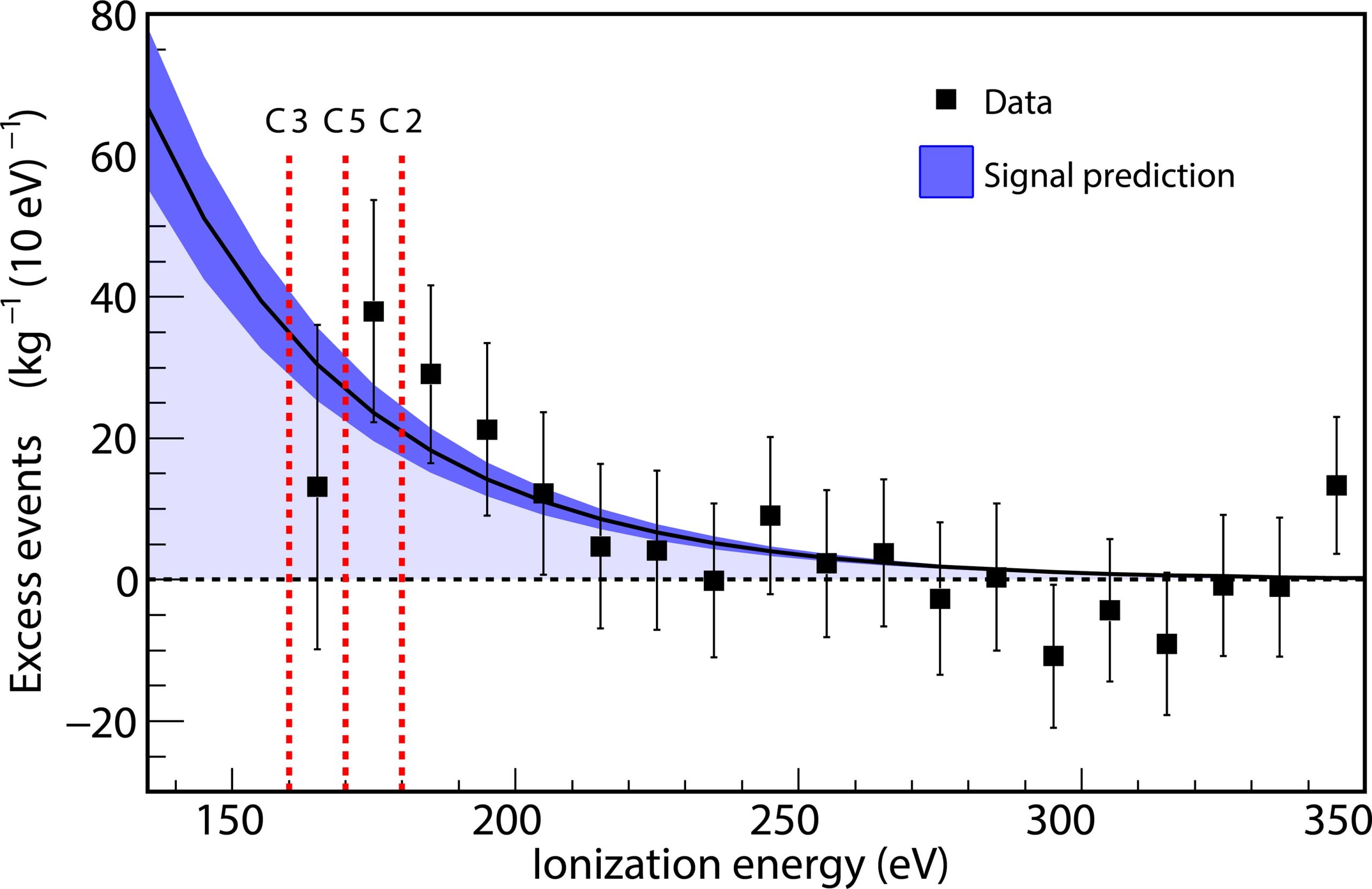
The compact CONUS+ setup is located 20.7 m from the reactor core (see Figure 1). At this position, more than 10 trillion neutrinos flow through every square centimeter of surface every second. After approximately 119 days of measurement between autumn 2023 and summer 2024, the researchers were able to extract an excess of 395±106 neutrino signals from the CONUS+ data, after subtracting all background and interfering signals (see Figure 2). This value is in very good agreement with theoretical calculations, within the measurement uncertainty.
“We have thus successfully confirmed the sensitivity of the CONUS+ experiment and its ability to detect antineutrino scattering from atomic nuclei,” explains Dr. Christian Buck, one of the authors of the study. He also emphasizes the potential development of small, mobile neutrino detectors to monitor reactor heat output or isotope concentration as possible future applications of the CEvNS technique presented here.
Opening Doors to New Physics: The Future of CONUS+
The CEvNS measurement provides unique insights into fundamental physical processes within the Standard Model of particle physics, the current theory describing the structure of our universe. Compared to other experiments, the measurements with CONUS+ allow for a reduced dependence on nuclear physics aspects, thereby improving the sensitivity to new physics beyond the Standard Model. For this reason, CONUS+ was already equipped with improved and larger detectors in autumn 2024. With the resulting measurement accuracy, even better results are expected.
“The techniques and methods used in CONUS+ have excellent potential for fundamental new discoveries,” emphasizes Prof. Lindner, initiator of the project and also an author of the study. “The groundbreaking CONUS+ results could therefore mark the starting point for a new field in neutrino research.”
Reference: “Direct observation of coherent elastic antineutrino–nucleus scattering” by N. Ackermann, H. Bonet, A. Bonhomme, C. Buck, K. Fülber, J. Hakenmüller, J. Hempfling, G. Heusser, M. Lindner, W. Maneschg, K. Ni, M. Rank, T. Rink, E. Sánchez García, I. Stalder, H. Strecker, R. Wink and J. Woenckhaus, 30 July 2025, Nature.
DOI: 10.1038/s41586-025-09322-2
Never miss a breakthrough: Join the SciTechDaily newsletter.
Follow us on Google and Google News.
11 Comments
After 50 Years, a Neutrino Detector Finally Catches Elusive Ghost Particles.
VERY GOOD.
Please ask researchers to think deeply:
Do the so-called neutrinos you observe come from God or from the topological evolution of space itself?
If researchers are interested in this, please visit https://zhuanlan.zhihu.com/p/1900140514277320438 (If the link is available).
Please ask researchers to think deeply:
Are the so-called Neutrinos and Ghost Particles from God or from the topological evolution of space itself?
What is God?
Perhaps it is the “God particle”, “Devil particle”, or “Angel particle” widely promoted in so-called academic publications.
Better this than the superstition and blather that underpins all religions
VERY GOOD!
What is the difference between particle worship and God worship? Is one humanoid and the other spherical?
If researchers are interested, please browse https://zhuanlan.zhihu.com/p/1938229158724498993 (if the link is available).
Which controls everything on the earth and environment
Human being can’t interfere in his approach
A cube 1.2 meters on a side is either a ridiculously large lunchbox, or it is the size of a hotel refrigerator.
The description of the detector is incorrect!
This was confirmed 8 years ago, hardly “news”.
I heard it was a false positive…going to rerun the test.